impact
about
our story
explore our impact
careers and opportunities
join us
open science
sharing science to speed discovery
open science week
celebrating open science
team science
people & teams
discovery is a team effort
allenites
the people who make our work possible
advisors
their input shapes our science
board of directors
they help us fulfill our mission
shanahan foundation fellowship
at the interface of data and neuroscience
next generation leaders
fostering emerging leaders in bioscience
research
overview
our approach
science at the scale of greatest impact
publications
explore our publications
open science
sharing science to speed discovery
science accelerators
brain science
building a blueprint of the brain
cell science
understanding how cells become organs
neural dynamics
revealing the brain’s hidden algorithms
immunology
creating the ultimate immune system reference
synthetic biology
seattle hub for synthetic biology
education
overview
science education
science is for everyone
open science
sharing science speeds discovery
engagement
education resources
real science. real skills.
field trips
experience science where it happens
educator development
empowering educators
news
overview
all news
explore the latest news
podcast
the human stories behind discovery
sign up for our newsletter
stay connected to our science
events
overview
all events
public engagement, workshops, seminars and more
conferences
connect with us
science resources
science resources
allencell.org
allenimmunology.org
allenneuraldynamics.org
brain-bican.org
brain-map.org
microns-explorer.org
impact
back to menu
team science
our story
explore our impact
careers and opportunities
join us
open science
sharing science to speed discovery
open science week
celebrating open science
team science
people & teams
discovery is a team effort
allenites
the people who make our work possible
advisors
their input shapes our science
board of directors
they help us fulfill our mission
shanahan foundation fellowship
at the interface of data and neuroscience
next generation leaders
fostering emerging leaders in bioscience
research
back to menu
overview
our approach
science at the scale of greatest impact
publications
explore our publications
open science
sharing science to speed discovery
science accelerators
brain science
building a blueprint of the brain
cell science
understanding how cells become organs
neural dynamics
revealing the brain’s hidden algorithms
immunology
creating the ultimate immune system reference
synthetic biology
seattle hub for synthetic biology
education
back to menu
overview
science education
science is for everyone
open science
sharing science speeds discovery
engagement
education resources
real science. real skills.
field trips
experience science where it happens
educator development
empowering educators
news
back to menu
overview
all news
explore the latest news
podcast
the human stories behind discovery
newsletter
stay connected to our science
events
back to menu
overview
all events
public engagement, workshops, seminars and more
conferences
connect with us
science resources
back to menu
science resources
allencell.org
allenimmunology.org
allenneuraldynamics.org
brain-bican.org
brain-map.org
microns-explorer.org
search
news

A new discovery about ALS

Stem cell researcher Evangelos Kiskinis and his colleagues discovered a strange — literal — wrinkle in neurons from ALS patients. Allen Institute for Cell Science resources are helping them study these features in more detail.

February 13, 2020
 min read
share/
Stem cell researcher Evangelos Kiskinis and his colleagues discovered a strange — literal — wrinkle in neurons from ALS patients. Allen Institute...
Thank you! Your submission has been received!
Oops! Something went wrong while submitting the form.

in this article

table of contents will display on published page only
set h2 to populate the table of contents here

ALS neurons have a problem with garbage.

The devastating neurodegenerative disease — which causes the irreversible loss of motor neurons in patients and, eventually, paralysis of many muscle groups — is marked by an accumulation of toxic molecules in certain parts of the neurons. It’s unclear how this cellular garbage is tied to the death of motor neurons, but research has suggested that in ALS patients, the neurons have difficulty moving these molecules between different parts of the cell. So perhaps it’s more accurate to say that ALS neurons have a problem with their garbage trucks.

Understanding the details of this molecular refuse is crucial. Also known as Lou Gehrig’s disease, ALS is rare, striking around 5,000 people in the U.S. each year, but it is progressive and always fatal. The average person with ALS lives just three years past their diagnosis. Currently, there is no cure. People with ALS often die from the eventual paralysis in the muscles that control breathing.

Northwestern University biologist Evangelos Kiskinis, Ph.D., wanted to better understand ALS’s cellular garbage build-up by taking a closer look at the tiny barrier the molecules normally cross — the nuclear envelope. If you think of your cells as small water balloons, the nucleus is an even smaller water balloon inside the cell, only instead of water, it’s filled with the DNA that makes up your genome and the genome’s many other associated molecules. The thin skin of that balloon, separating the nucleus from the rest of the cell, is the nuclear envelope.

Unlike a water balloon, though, the nucleus is dynamic, shuttling proteins and other molecules across its border on a regular basis. In ALS neurons, toxic molecules pile up outside the nucleus; in healthy neurons, more of these molecules are found inside.

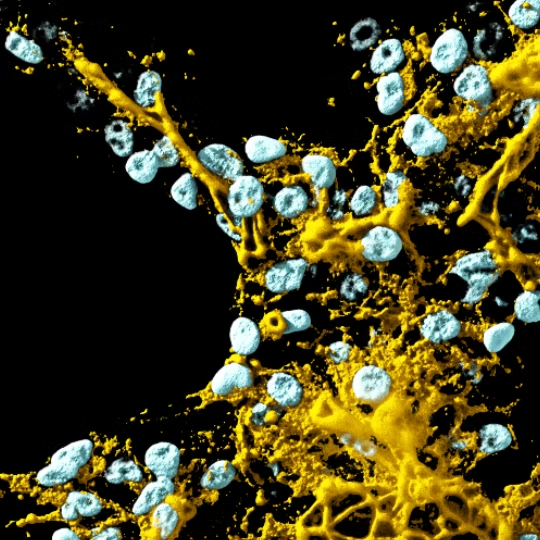
Kiskinis thought something might be going wrong at the very fine levels of this shuttling process in ALS. But when he and his research team looked more closely at healthy and diseased neurons, the entire nuclear envelope of ALS neurons looked very different from the expected smooth-water-balloon shape. The nuclei were puckered and wrinkled, full of narrow furrows. It almost looked like the folds of a tiny brain, Kiskinis said.

“They’re really fascinating,” he said, describing the first time the team noticed this strange nuclear envelope feature under the microscope. “They’re like tunnels that extend the rest of the cell deep within the nucleus.”

From stem cells to ALS neurons

With a disease as mysterious as ALS, any finding that could shed new light on the disease is valuable. But the researchers have reason to believe these tunnels could play a role in the death of motor neurons. They found that the furrows are studded with proteins involved in a cellular error-checking process — namely, the process that could prevent the pileup of toxic molecules before they are even produced. If the tunnels turn out to play a role in neuron damage, Kiskinis thinks these proteins themselves could be an untapped avenue for new ALS treatments.

But first, the researchers need to better understand this newly discovered feature, previously unappreciated in neurons.

For their experiments, the researchers use stem cells, cells that have the potential to grow and transform into a myriad of other types of cells. Thanks to blood donations from ALS patients, the scientists are able to grow motor neurons in the lab that bear a genetic mutation linked to certain forms of the disease. The research team first saw the strange tunnels in these cells.

The team turned to cells from the Allen Cell Collection, human stem cells that were gene-edited by Allen Institute for Cell Science researchers to label different subcellular structures. Kiskinis’ group is using a cell line from the collection that lights up the nuclear envelope, allowing them to track the formation of the tunnels in living cells as they develop from stem cells into neurons. Because the stem cells donated by ALS patients aren’t genetically engineered, the researchers couldn’t track structures in these cells in real time.

They could have made the edited neurons themselves in the lab, Kiskinis said, but it would have been a huge effort. The existence of the cell collection allowed them to jump straight to a new line of experiments.

“The existence of this invaluable resource allowed us to begin to address the questions we were interested in, immediately,” he said. “It really has saved us time, effort and important resources.”

That time is critical in the face of this particular disease, Kiskinis said. New therapies are already being tested in clinical trials, but there’s still so much they don’t understand about ALS and how to stop it.

“I’m optimistic that over the next decade, we’ll see treatments that are meaningful,” he said. “We’re very mindful of the urgency of what we’re doing, and we continue to work hard on a daily basis to come up with fruitful discoveries that will impact patients’ lives.”

Citations
No items found.

about the allen institute

The Allen Institute is an independent, 501(c)(3) nonprofit research organization founded by philanthropist and visionary, the late Paul G. Allen. The Allen Institute is dedicated to answering some of the biggest questions in bioscience and accelerating research worldwide. The Institute is a recognized leader in large-scale research with a commitment to an open science model. For more information, visit alleninstitute.org.
related news

all news
No articles for the category
we acceleratedevelopcatalyzeimpact

science done differently. shared with the world.

explore our accelerators

brain science

Mapping every cell, connection, and circuit in the brain—openly shared with the world.

cell science

Decoding how cells become tissues, then programming that knowledge into powerful new research tools.

neural dynamics

Revealing the brain's hidden algorithms that transform neural activity into real-world behavior.

immunology

Creating the deepest open reference for the healthy human immune system ever built.

synthetic biology

Engineering cells to record their own histories, transforming how we understand disease over time.

research

Big questions, open answers, and science built to be shared.

education

Inspiring the next generation of scientists through open science resources.

impact

Our science is empowering researchers and advancing health worldwide.
advancing science through open, collaborative research
Get the allen institute newsletter
Stay informed on the latest breakthroughs in neuroscience, bioscience, and AI-driven research.
allen institute
impactpeople & teamscareers & opportunitiesalumnihistory & founder
science resources
allencell.orgallenimmunology.orgallenneuraldynamics.orgbrain-bican.orgbrain-map.orgmicrons-explorer.org
research
brain sciencecell scienceneural dynamicsimmunologysynthetic biologypublications
education
science educationfield tripsprofessional developmenteducation resources
quick links
newseventsopen sciencepodcastscience resourceshuman brain donationvisit uscontact
follow us/

allen institute, 615 Westlake Ave North, Seattle, WA 98109 +12065487055

© 0000 allen institute. all rights reserved.
privacy policyterms of usecitation policyemployee portalpolicy & compliance