impact
about
our story
explore our impact
careers and opportunities
join us
open science
sharing science to speed discovery
open science week
celebrating open science
team science
people & teams
discovery is a team effort
allenites
the people who make our work possible
advisors
their input shapes our science
board of directors
they help us fulfill our mission
shanahan foundation fellowship
at the interface of data and neuroscience
next generation leaders
fostering emerging leaders in bioscience
research
overview
our approach
science at the scale of greatest impact
publications
explore our publications
open science
sharing science to speed discovery
science accelerators
brain science
building a blueprint of the brain
cell science
understanding how cells become organs
neural dynamics
revealing the brain’s hidden algorithms
immunology
creating the ultimate immune system reference
synthetic biology
seattle hub for synthetic biology
education
overview
science education
science is for everyone
open science
sharing science speeds discovery
engagement
education resources
real science. real skills.
field trips
experience science where it happens
educator development
empowering educators
news
overview
all news
explore the latest news
podcast
the human stories behind discovery
sign up for our newsletter
stay connected to our science
events
overview
all events
public engagement, workshops, seminars and more
conferences
connect with us
science resources
science resources
allencell.org
allenimmunology.org
allenneuraldynamics.org
brain-bican.org
brain-map.org
microns-explorer.org
impact
back to menu
team science
our story
explore our impact
careers and opportunities
join us
open science
sharing science to speed discovery
open science week
celebrating open science
team science
people & teams
discovery is a team effort
allenites
the people who make our work possible
advisors
their input shapes our science
board of directors
they help us fulfill our mission
shanahan foundation fellowship
at the interface of data and neuroscience
next generation leaders
fostering emerging leaders in bioscience
research
back to menu
overview
our approach
science at the scale of greatest impact
publications
explore our publications
open science
sharing science to speed discovery
science accelerators
brain science
building a blueprint of the brain
cell science
understanding how cells become organs
neural dynamics
revealing the brain’s hidden algorithms
immunology
creating the ultimate immune system reference
synthetic biology
seattle hub for synthetic biology
education
back to menu
overview
science education
science is for everyone
open science
sharing science speeds discovery
engagement
education resources
real science. real skills.
field trips
experience science where it happens
educator development
empowering educators
news
back to menu
overview
all news
explore the latest news
podcast
the human stories behind discovery
newsletter
stay connected to our science
events
back to menu
overview
all events
public engagement, workshops, seminars and more
conferences
connect with us
science resources
back to menu
science resources
allencell.org
allenimmunology.org
allenneuraldynamics.org
brain-bican.org
brain-map.org
microns-explorer.org
search
news

Allen Institute publishes highest resolution map of the entire human brain to date

The Allen Institute for Brain Science has published the highest resolution atlas of the human brain to date in a stand-alone issue of the Journal of...

September 15, 2016
 min read
share/
The Allen Institute for Brain Science has published the highest resolution atlas of the human brain to date in a stand-alone issue of the Journal of Comparative Neurology.
Thank you! Your submission has been received!
Oops! Something went wrong while submitting the form.

in this article

table of contents will display on published page only
set h2 to populate the table of contents here

The Allen Institute for Brain Science has published the highest resolution atlas of the human brain to date in a stand-alone issue of the Journal of Comparative Neurology. This digital human brain atlas allows researchers to investigate the structural basis of human brain function.

“To understand the human brain, we need to have a detailed description of its underlying structure,” says Ed Lein, Ph.D., Investigator at the Allen Institute for Brain Science. “Human brain atlases have long lagged behind atlases of the brain of worms, flies or mice, both in terms of spatial resolution and in terms of completeness due to technical limitations related to the enormous size and complexity of the human brain. This large-scale focused effort aimed to create a large resource combining different data types at high resolution, and use these data to generate a comprehensive mapping of brain regions.”

Combining neuroimaging with cellular resolution histological analysis and expert structural mapping, “This is the most structurally complete atlas to date and we hope it will serve as a new reference standard for the human brain across different disciplines,” says Lein.

To create this modern atlas, the team at the Allen Institute partnered with Bruce Fischl, Ph.D. at Massachusetts General Hospital to perform magnetic resonance and diffusion tensor imaging on an intact brain before it was cut into slabs and serially sectioned to allow histological staining of individual sections. This imaging on the same brain created opportunities for linking fine molecular and cellular studies of the brain in health and disease with non-invasive neuroimaging studies.

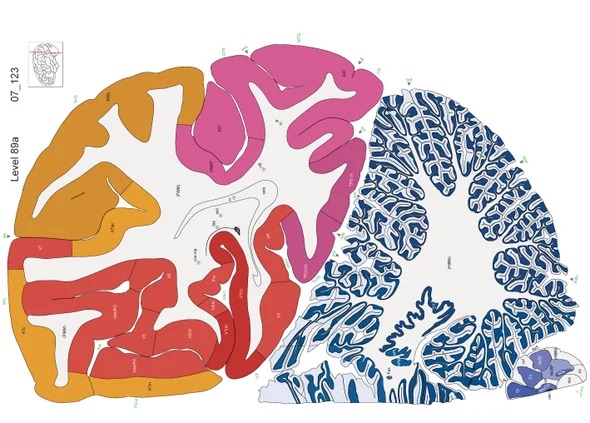
The Allen Human Brain Reference Atlas aimed to advance human brain mapping by digitizing the histological data at true cellular microscopic resolution, creating a complete ontology of brain regions, and delineating all brain regions on a series of cross-sections through the brain. To image these sections, the Allen Institute team had to develop a new tile-based scanner that could image tissue sections the size of a complete human brain hemisphere at the resolution of roughly a hundredth of the width of a human hair. The atlas was drawn from a single postmortem brain obtained from a 34-year old female donor.

The Allen Human Brain Reference Atlas is an integrated, freely accessible online resource that allows users to navigate the brain and travel from the macroscopic scale of full brain sections to the level of individual neurons. “These features are common in reference atlases of model organisms such as mouse, but have been lacking in human, for which mappings nearly a hundred years old are still in common usage,” says Song-Lin Ding, M.D., Senior Scientist at the Allen Institute for Brain Science and lead author on the project.

“In this regard, the Allen Human Brain Reference Atlas represents a further departure from the classical atlases in its innovative publication format,” says Patrick Hof, M.D., Editor-in-Chief of the Journal of Comparative Neurology and a participant in the project. “It is the only brain atlas to date to combine the rigor of a peer-reviewed scientific research paper with a presentation as a book format that includes the full set of annotated plates, open-access online availability of the resource with the ability to navigate and explore the details of any given area, and have programmatic access to the underlying data.”

Creating this kind of atlas of the human brain is enormously resource-intensive and comes with a unique set of technical challenges, from acquiring specimens to sectioning the tissue and dedicating the time of expert anatomists to painstakingly annotate the data. The outcome is a community resource that is freely available as part of the suite of Allen Brain Atlas tools at brain-map.org.

“The opportunity now is to align our high-resolution atlas with other maps of the human brain, such as those that come from functional studies or studies of the cellular makeup of brain regions,” says Lein. “Reference atlases provide a framework for integrating data types, and the combining of different studies is essential to get to the roots of brain function.”

Publication reference: Ding, S.-L., et al (2016), Comprehensive cellular-resolution atlas of the adult human brain. J. Comp. Neurol. 524(16):3127–3481. doi:10.1002/cne.24080

Citations
No items found.

about the allen institute

The Allen Institute is an independent, 501(c)(3) nonprofit research organization founded by philanthropist and visionary, the late Paul G. Allen. The Allen Institute is dedicated to answering some of the biggest questions in bioscience and accelerating research worldwide. The Institute is a recognized leader in large-scale research with a commitment to an open science model. For more information, visit alleninstitute.org.
related news

all news
No articles for the category
we acceleratedevelopcatalyzeimpact

science done differently. shared with the world.

explore our accelerators

brain science

Mapping every cell, connection, and circuit in the brain—openly shared with the world.

cell science

Decoding how cells become tissues, then programming that knowledge into powerful new research tools.

neural dynamics

Revealing the brain's hidden algorithms that transform neural activity into real-world behavior.

immunology

Creating the deepest open reference for the healthy human immune system ever built.

synthetic biology

Engineering cells to record their own histories, transforming how we understand disease over time.

research

Big questions, open answers, and science built to be shared.

education

Inspiring the next generation of scientists through open science resources.

impact

Our science is empowering researchers and advancing health worldwide.
advancing science through open, collaborative research
Get the allen institute newsletter
Stay informed on the latest breakthroughs in neuroscience, bioscience, and AI-driven research.
allen institute
impactpeople & teamscareers & opportunitiesalumnihistory & founder
science resources
allencell.orgallenimmunology.orgallenneuraldynamics.orgbrain-bican.orgbrain-map.orgmicrons-explorer.org
research
brain sciencecell scienceneural dynamicsimmunologysynthetic biologypublications
education
science educationfield tripsprofessional developmenteducation resources
quick links
newseventsopen sciencepodcastscience resourceshuman brain donationvisit uscontact
follow us/

allen institute, 615 Westlake Ave North, Seattle, WA 98109 +12065487055

© 0000 allen institute. all rights reserved.
privacy policyterms of usecitation policyemployee portalpolicy & compliance