impact
about
our story
explore our impact
careers and opportunities
join us
open science
sharing science to speed discovery
open science week
celebrating open science
team science
people & teams
discovery is a team effort
allenites
the people who make our work possible
advisors
their input shapes our science
board of directors
they help us fulfill our mission
shanahan foundation fellowship
at the interface of data and neuroscience
next generation leaders
fostering emerging leaders in bioscience
research
overview
our approach
science at the scale of greatest impact
publications
explore our publications
open science
sharing science to speed discovery
science accelerators
brain science
building a blueprint of the brain
cell science
understanding how cells become organs
neural dynamics
revealing the brain’s hidden algorithms
immunology
creating the ultimate immune system reference
synthetic biology
seattle hub for synthetic biology
education
overview
science education
science is for everyone
open science
sharing science speeds discovery
engagement
education resources
real science. real skills.
field trips
experience science where it happens
educator development
empowering educators
news
overview
all news
explore the latest news
podcast
the human stories behind discovery
sign up for our newsletter
stay connected to our science
events
overview
all events
public engagement, workshops, seminars and more
conferences
connect with us
science resources
science resources
allencell.org
allenimmunology.org
allenneuraldynamics.org
brain-bican.org
brain-map.org
microns-explorer.org
impact
back to menu
team science
our story
explore our impact
careers and opportunities
join us
open science
sharing science to speed discovery
open science week
celebrating open science
team science
people & teams
discovery is a team effort
allenites
the people who make our work possible
advisors
their input shapes our science
board of directors
they help us fulfill our mission
shanahan foundation fellowship
at the interface of data and neuroscience
next generation leaders
fostering emerging leaders in bioscience
research
back to menu
overview
our approach
science at the scale of greatest impact
publications
explore our publications
open science
sharing science to speed discovery
science accelerators
brain science
building a blueprint of the brain
cell science
understanding how cells become organs
neural dynamics
revealing the brain’s hidden algorithms
immunology
creating the ultimate immune system reference
synthetic biology
seattle hub for synthetic biology
education
back to menu
overview
science education
science is for everyone
open science
sharing science speeds discovery
engagement
education resources
real science. real skills.
field trips
experience science where it happens
educator development
empowering educators
news
back to menu
overview
all news
explore the latest news
podcast
the human stories behind discovery
newsletter
stay connected to our science
events
back to menu
overview
all events
public engagement, workshops, seminars and more
conferences
connect with us
science resources
back to menu
science resources
allencell.org
allenimmunology.org
allenneuraldynamics.org
brain-bican.org
brain-map.org
microns-explorer.org
search
news

Allen Institute Releases Data from 30,000 Brain Cells in Action

The Allen Institute for Brain Science today announced new data aimed at helping researchers understand the various types of cells in the brain and how cells compute visual information.

October 11, 2018
 min read
share/
The Allen Institute for Brain Science, a division of the Allen Institute, today announced new data aimed at helping researchers understand the various...
Thank you! Your submission has been received!
Oops! Something went wrong while submitting the form.

in this article

table of contents will display on published page only
set h2 to populate the table of contents here

Allen Institute Releases Data from 30,000 Brain Cells in Action

The Allen Institute for Brain Science, a division of the Allen Institute, today announced new data aimed at helping researchers understand the various types of cells in the brain and how cells compute visual information. Joining these new data is a software toolkit for building models of the neuronal networks making up the brain more easily and more reproducibly. Scientists around the world can find these resources at the newly redesigned Allen Brain Atlas portal and use them to study basic questions about brain structure and function, as well as brain diseases and disorders.
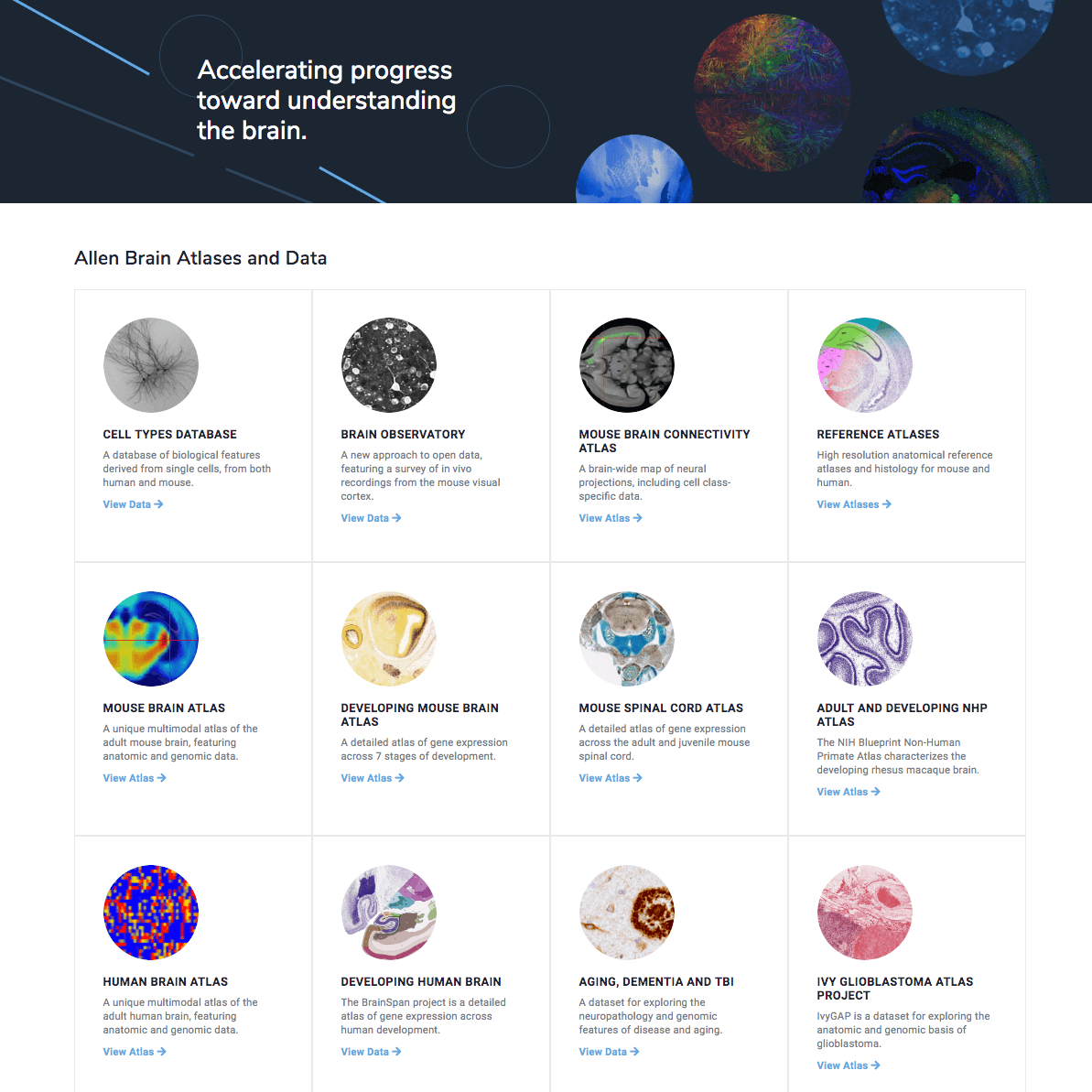
Allen Brain Atlases and Data showcase cell types, brain connectivity, and neural mapping resources.

Observing the mind in real-time

New data in the Allen Brain Observatory captures the activity of nearly 30,000 mouse brain cells in the visual cortex, the part of the brain that processes visual information. The release nearly doubles the number of cells observed to date, bringing the total to more than 63,000 brain cells from 13 different types of excitatory and inhibitory nerve cells. Allen Institute researchers have looked across six different regions of the mouse visual cortex, and the dataset now also includes cells in the deepest layers of the mouse visual cortex.

Taken together, the Allen Brain Observatory data gives researchers the opportunity to explore how the brain functions at a comprehensive level, said Saskia de Vries, Ph.D., Assistant Investigator at the Allen Institute for Brain Science.

“What’s great about the dataset is that it isn’t just one experiment or five populations of cells, it’s hundreds of different populations of cells. You can test a theory about how the cortex works across different populations, and you can test it exhaustively,” she said. “That’s the real value of the dataset and why we hope it will be valuable to the scientific community, because we’re not the only ones who have theories about the visual cortex.”

New brain cell types data

The Allen Cell Types Database team also added data from more than 30,000 different brain cells. This resource now contains data capturing which genes in an individual cell are turned on or off from a total of more than 33,000 human brain cells and more than 44,000 mouse brain cells. These data are a central part of an ongoing effort to create a “periodic table” of brain cell types, allowing researchers to understand the brain by better understanding its fundamental building blocks — the cells.

A toolkit for computation

The Brain Modeling Toolkit is a software suite that will allow computational neuroscientists to build models of the brain at different levels of granularity more easily and more reproducibly, said Anton Arkhipov, Ph.D., Associate Investigator at the Allen Institute for Brain Science. The toolkit is built in Python, an open-source programming language, and freely available on GitHub. The team’s hope with the toolkit was that it would bring the power of computational modeling to more researchers who want to use it but don’t have extensive experience in all the available modeling tools. The toolkit can do some of that work for them, said Arkhipov.

“It’s all about being able to take advantage of the existing wonderful tools without becoming an expert,” he said. “The toolkit is like the steering wheel that lets you go where you need to go.”

Portal redesign

The redesign of brain-map.org came about organically, said Amy Bernard, Ph.D., Product Architect at the Allen Institute for Brain Science. Bernard and her colleagues responded to feedback from users of the site that certain datasets could be made more accessible and easier to use.

“Our redesign was based on feedback from the community and we’ve aimed to make the site more navigable, more usable and more accessible,” Bernard said. “We hope the new portal better showcases the diversity of the data we have available.”

For now, the portal homepage features a new user-friendly design; all brain atlases and other datasets are accessible from the homepage. In coming months, users can expect additional features to roll out on the website.

Citations
No items found.

about the allen institute

The Allen Institute is an independent, 501(c)(3) nonprofit research organization founded by philanthropist and visionary, the late Paul G. Allen. The Allen Institute is dedicated to answering some of the biggest questions in bioscience and accelerating research worldwide. The Institute is a recognized leader in large-scale research with a commitment to an open science model. For more information, visit alleninstitute.org.


related news

all news
No articles for the category
we acceleratedevelopcatalyzeimpact

science done differently. shared with the world.

explore our accelerators

brain science

Mapping every cell, connection, and circuit in the brain—openly shared with the world.

cell science

Decoding how cells become tissues, then programming that knowledge into powerful new research tools.

neural dynamics

Revealing the brain's hidden algorithms that transform neural activity into real-world behavior.

immunology

Creating the deepest open reference for the healthy human immune system ever built.

synthetic biology

Engineering cells to record their own histories, transforming how we understand disease over time.

research

Big questions, open answers, and science built to be shared.

education

Inspiring the next generation of scientists through open science resources.

impact

Our science is empowering researchers and advancing health worldwide.
advancing science through open, collaborative research
Get the allen institute newsletter
Stay informed on the latest breakthroughs in neuroscience, bioscience, and AI-driven research.
allen institute
impactpeople & teamscareers & opportunitiesalumnihistory & founder
science resources
allencell.orgallenimmunology.orgallenneuraldynamics.orgbrain-bican.orgbrain-map.orgmicrons-explorer.org
research
brain sciencecell scienceneural dynamicsimmunologysynthetic biologypublications
education
science educationfield tripsprofessional developmenteducation resources
quick links
newseventsopen sciencepodcastscience resourceshuman brain donationvisit uscontact
follow us/

allen institute, 615 Westlake Ave North, Seattle, WA 98109 +12065487055

© 0000 allen institute. all rights reserved.
privacy policyterms of usecitation policyemployee portalpolicy & compliance


