impact
about
our story
explore our impact
careers and opportunities
join us
open science
sharing science to speed discovery
open science week
celebrating open science
team science
people & teams
discovery is a team effort
allenites
the people who make our work possible
advisors
their input shapes our science
board of directors
they help us fulfill our mission
shanahan foundation fellowship
at the interface of data and neuroscience
next generation leaders
fostering emerging leaders in bioscience
research
overview
our approach
science at the scale of greatest impact
publications
explore our publications
open science
sharing science to speed discovery
science accelerators
brain science
building a blueprint of the brain
cell science
understanding how cells become organs
neural dynamics
revealing the brain’s hidden algorithms
immunology
creating the ultimate immune system reference
synthetic biology
seattle hub for synthetic biology
education
overview
science education
science is for everyone
open science
sharing science speeds discovery
engagement
education resources
real science. real skills.
field trips
experience science where it happens
educator development
empowering educators
news
overview
all news
explore the latest news
podcast
the human stories behind discovery
sign up for our newsletter
stay connected to our science
events
overview
all events
public engagement, workshops, seminars and more
conferences
connect with us
science resources
science resources
allencell.org
allenimmunology.org
allenneuraldynamics.org
brain-bican.org
brain-map.org
microns-explorer.org
impact
back to menu
team science
our story
explore our impact
careers and opportunities
join us
open science
sharing science to speed discovery
open science week
celebrating open science
team science
people & teams
discovery is a team effort
allenites
the people who make our work possible
advisors
their input shapes our science
board of directors
they help us fulfill our mission
shanahan foundation fellowship
at the interface of data and neuroscience
next generation leaders
fostering emerging leaders in bioscience
research
back to menu
overview
our approach
science at the scale of greatest impact
publications
explore our publications
open science
sharing science to speed discovery
science accelerators
brain science
building a blueprint of the brain
cell science
understanding how cells become organs
neural dynamics
revealing the brain’s hidden algorithms
immunology
creating the ultimate immune system reference
synthetic biology
seattle hub for synthetic biology
education
back to menu
overview
science education
science is for everyone
open science
sharing science speeds discovery
engagement
education resources
real science. real skills.
field trips
experience science where it happens
educator development
empowering educators
news
back to menu
overview
all news
explore the latest news
podcast
the human stories behind discovery
newsletter
stay connected to our science
events
back to menu
overview
all events
public engagement, workshops, seminars and more
conferences
connect with us
science resources
back to menu
science resources
allencell.org
allenimmunology.org
allenneuraldynamics.org
brain-bican.org
brain-map.org
microns-explorer.org
search
news

Allen Integrated Cell Released Online

Powerful public resource gives researchers a new way to see inside live human cells

May 9, 2018
 min read
share/
Powerful public resource gives researchers a new way to see inside live human cells
Thank you! Your submission has been received!
Oops! Something went wrong while submitting the form.

in this article

table of contents will display on published page only
set h2 to populate the table of contents here

Download PDF

Colorful 3D sculptural pillow-shaped art piece with layered purple, blue, and yellow sections

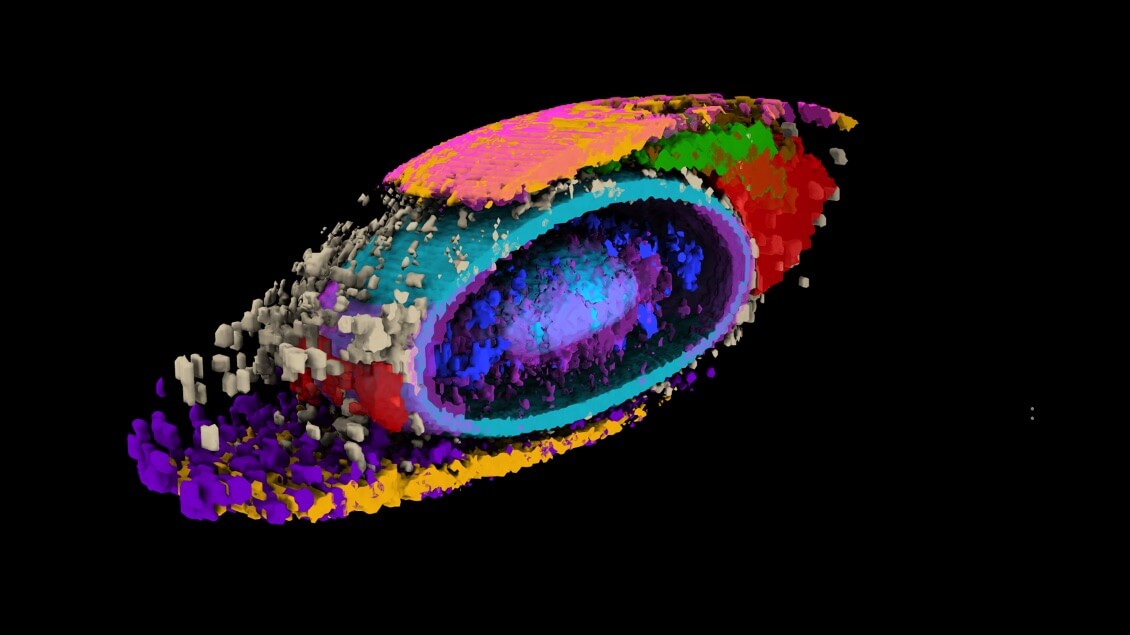
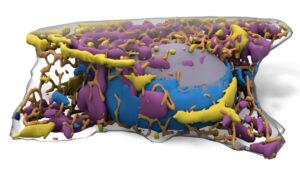
SEATTLE, WASH. – May 9, 2018 – The Allen Institute for Cell Science today launched the first predictive and comprehensive, 3D model of a live human cell, the Allen Integrated Cell. By allowing researchers around the world to see many structures inside a living cell together at the same time, the Allen Integrated Cell provides a baseline for understanding cells and studying human disease models.

“This is a new way to see inside living human cells,” said Rick Horwitz, Ph.D., Executive Director of the Allen Institute for Cell Science. “It’s like seeing the whole cell for the first time. In the future, this will impact drug discovery, disease research and how we frame basic studies involving human cells.”

“Nearly every biologist has mental models of whole cells that are pieced together over their careers with information from dozens of different types of data,” said Graham Johnson, Ph.D., Director of the Animated Cell. “The Allen Integrated Cell provides a new option, where 3-D visualizations of whole living cells link to analysis tools to allow for more direct data-driven exploration and hypothesis generation.”

The Allen Integrated Cell summarizes a large collection of live human cells, gene edited by Allen Institute scientists to incorporate fluorescent protein tags. These tags illuminate specific structures inside of cells, such as the nucleus and mitochondria. Scientists took pictures of tens of thousands of these glowing cells and used artificial intelligence to study them.

First, researchers developed a computer algorithm that studied the shape of the plasma membrane, the nucleus and other fluorescently labeled cell structures to learn their spatial relationships. A powerful probabilistic model emerged from this training, that accurately predicts the most probable shape and location of structures in any cell, based solely on the shape of the plasma membrane and the nucleus.

Second, researchers took images of those same fluorescently labeled cells and applied a different machine learning algorithm. This algorithm used what it learned from cells with fluorescent labels to find cellular structures in cells without fluorescent labels. This label-free model can be used on relatively easy to collect brightfield microscope images to visualize the integration of many structures inside of cells, simultaneously and with high precision. Viewed side-by-side, the images generated by the label-free method look nearly identical to the fluorescently labeled photographs of cells.

“Fluorescence microscopy is expensive and toxic to cells; increasingly so when you tag multiple structures,” said Molly Maleckar, Ph.D., Director of Modeling. “Our approach allows scientists to view cells and conduct experiments at the reduced cost of brightfield microscopy, with the structure-identifying power of fluorescence microscopy – and without its toxic effects. It’s really the best of both worlds.”

Until now, our ability to see what is going on inside of human cells has been very limited,” said Michael Elowitz, Ph.D., Professor of Biology, Bioengineering, and Applied Physics at California Institute of Technology. “Previously, we could only see the proteins that we deliberately labeled. But the Allen Integrated Cell is like the ultimate free lunch. We get to sample a ‘buffet’ of many different proteins and organelles, without having to label anything at all. This opens up a totally new and much more powerful way of doing cell biology. It’s a total game changer.”

Rolling out alongside the Allen Integrated Cell is the Visual Guide to Human Cells: an online interactive overview of human cell structure and function. Users can explore how cells change throughout phases of the cell cycle. Both of these resources, as well as cell lines, tools and models, are publicly available on the Allen Cell Explorer at allencell.org – the online data portal for the Allen Institute for Cell Science.

About the Allen Institute for Cell Science

The Allen Institute for Cell Science, a division of the Allen Institute, an independent, 501(c)(3) nonprofit medical research organization, is dedicated to understanding and modeling cells: the fundamental units of life. By integrating technologies, approaches, models and data into a common standardized framework, the Allen Institute for Cell Science is creating dynamic, visual models of how genetic information is transformed into cellular behavior, and how the molecules and organelles within each cell interact and function as systems. These predictive models will enable the cell science community to better understand the role of cells in both health and disease. The Allen Institute for Cell Science was launched in 2014 with a contribution from founder and philanthropist Paul G. Allen. The data, tools and models from the Allen Institute for Cell Science are publicly available online.

Citations
No items found.

about the allen institute

The Allen Institute is an independent, 501(c)(3) nonprofit research organization founded by philanthropist and visionary, the late Paul G. Allen. The Allen Institute is dedicated to answering some of the biggest questions in bioscience and accelerating research worldwide. The Institute is a recognized leader in large-scale research with a commitment to an open science model. For more information, visit alleninstitute.org.


related news

all news
No articles for the category
we acceleratedevelopcatalyzeimpact

science done differently. shared with the world.

explore our accelerators

brain science

Mapping every cell, connection, and circuit in the brain—openly shared with the world.

cell science

Decoding how cells become tissues, then programming that knowledge into powerful new research tools.

neural dynamics

Revealing the brain's hidden algorithms that transform neural activity into real-world behavior.

immunology

Creating the deepest open reference for the healthy human immune system ever built.

synthetic biology

Engineering cells to record their own histories, transforming how we understand disease over time.

research

Big questions, open answers, and science built to be shared.

education

Inspiring the next generation of scientists through open science resources.

impact

Our science is empowering researchers and advancing health worldwide.
advancing science through open, collaborative research
Get the allen institute newsletter
Stay informed on the latest breakthroughs in neuroscience, bioscience, and AI-driven research.
allen institute
impactpeople & teamscareers & opportunitiesalumnihistory & founder
science resources
allencell.orgallenimmunology.orgallenneuraldynamics.orgbrain-bican.orgbrain-map.orgmicrons-explorer.org
research
brain sciencecell scienceneural dynamicsimmunologysynthetic biologypublications
education
science educationfield tripsprofessional developmenteducation resources
quick links
newseventsopen sciencepodcastscience resourceshuman brain donationvisit uscontact
follow us/

allen institute, 615 Westlake Ave North, Seattle, WA 98109 +12065487055

© 0000 allen institute. all rights reserved.
privacy policyterms of usecitation policyemployee portalpolicy & compliance


