
impact
about
our story
explore our impact
careers and opportunities
join us
open science
sharing science to speed discovery
open science week
celebrating open science
team science
people & teams
discovery is a team effort
allenites
the people who make our work possible
advisors
their input shapes our science
board of directors
they help us fulfill our mission
shanahan foundation fellowship
at the interface of data and neuroscience
next generation leaders
fostering emerging leaders in bioscience
research
overview
our approach
science at the scale of greatest impact
publications
explore our publications
open science
sharing science to speed discovery
science accelerators
brain science
building a blueprint of the brain
cell science
understanding how cells become organs
neural dynamics
revealing the brain’s hidden algorithms
immunology
creating the ultimate immune system reference
synthetic biology
seattle hub for synthetic biology
education
overview
science education
science is for everyone
open science
sharing science speeds discovery
engagement
education resources
real science. real skills.
field trips
experience science where it happens
educator development
empowering educators
news
overview
all news
explore the latest news
podcast
the human stories behind discovery
sign up for our newsletter
stay connected to our science
events
overview
all events
public engagement, workshops, seminars and more
conferences
connect with us
science resources
science resources
allencell.org
allenimmunology.org
allenneuraldynamics.org
brain-bican.org
brain-map.org
microns-explorer.org
impact
back to menu
team science
our story
explore our impact
careers and opportunities
join us
open science
sharing science to speed discovery
open science week
celebrating open science
team science
people & teams
discovery is a team effort
allenites
the people who make our work possible
advisors
their input shapes our science
board of directors
they help us fulfill our mission
shanahan foundation fellowship
at the interface of data and neuroscience
next generation leaders
fostering emerging leaders in bioscience
research
back to menu
overview
our approach
science at the scale of greatest impact
publications
explore our publications
open science
sharing science to speed discovery
science accelerators
brain science
building a blueprint of the brain
cell science
understanding how cells become organs
neural dynamics
revealing the brain’s hidden algorithms
immunology
creating the ultimate immune system reference
synthetic biology
seattle hub for synthetic biology
education
back to menu
overview
science education
science is for everyone
open science
sharing science speeds discovery
engagement
education resources
real science. real skills.
field trips
experience science where it happens
educator development
empowering educators
news
back to menu
overview
all news
explore the latest news
podcast
the human stories behind discovery
newsletter
stay connected to our science
events
back to menu
overview
all events
public engagement, workshops, seminars and more
conferences
connect with us
science resources
back to menu
science resources
allencell.org
allenimmunology.org
allenneuraldynamics.org
brain-bican.org
brain-map.org
microns-explorer.org
search
news

Delving into the science of a mystifying optical illusion: visual masking

A new study sheds light on how our brains perceive - or fail to perceive - what we see

November 13, 2023
 min read
share/
A new study sheds light on how our brains perceive — or fail to perceive — what we see.
Thank you! Your submission has been received!
Oops! Something went wrong while submitting the form.

in this article

table of contents will display on published page only
set h2 to populate the table of contents here

authors

Rachel Tompa
Senior Editor

Did you ever wish you could unsee something? It turns out your brain is capable of that — no bleach required.

Unfortunately, it’s a limited superpower: In a phenomenon known as “visual masking,” we don’t consciously perceive an image if another image is shown in quick succession. But the timing of those images matters. The first image needs to flash on and off fairly quickly, and the second image needs to follow rapidly (on the order of 50 milliseconds), for the masking to work.

Plain gray rectangular background with uniform neutral color
Visual masking video used during this research.

To be clear, while the first image doesn’t last in your field of vision for very long, it’s definitely long enough that you would be aware of it without the second image, or mask.

Abstract line art portrait showing profile of human head with fragmented, striped pattern effect

What are the steps between the rain of photons on your retina and actual conscious perception of what you are seeing?

Christof Koch, Ph.D.

meritorious investigator at the Allen Institute

Scientists discovered this strange phenomenon in the 19th century, but why — and how — the human brain does this remains a mystery.

“This is an interesting observation, where what is present in the world is not accurately reflected in your perception,” said Shawn Olsen, Ph.D., an investigator at the Allen Institute. “Like other visual illusions, we think that it tells us something about the way the visual system works and ultimately about the neural circuits that underlie visual awareness.”

In a new study published today in the journal Nature Neuroscience, Olsen and his colleagues delved into the science behind this odd optical illusion — and showed for the first time that it happens in mice too. After training mice to report on what they saw, the team was also able to pinpoint a certain region of the brain that’s necessary for the visual masking illusion to work.

The study narrows down the parts of the brain responsible for awareness of the world around us, said Christof Koch, Ph.D., a meritorious investigator at the Allen Institute, who led the study along with Olsen and Sam Gale, Ph.D., a scientist at the Allen Institute. “What are the steps between the rain of photons on your retina and actual conscious perception of what you are seeing?” he asked.

How do we perceive?
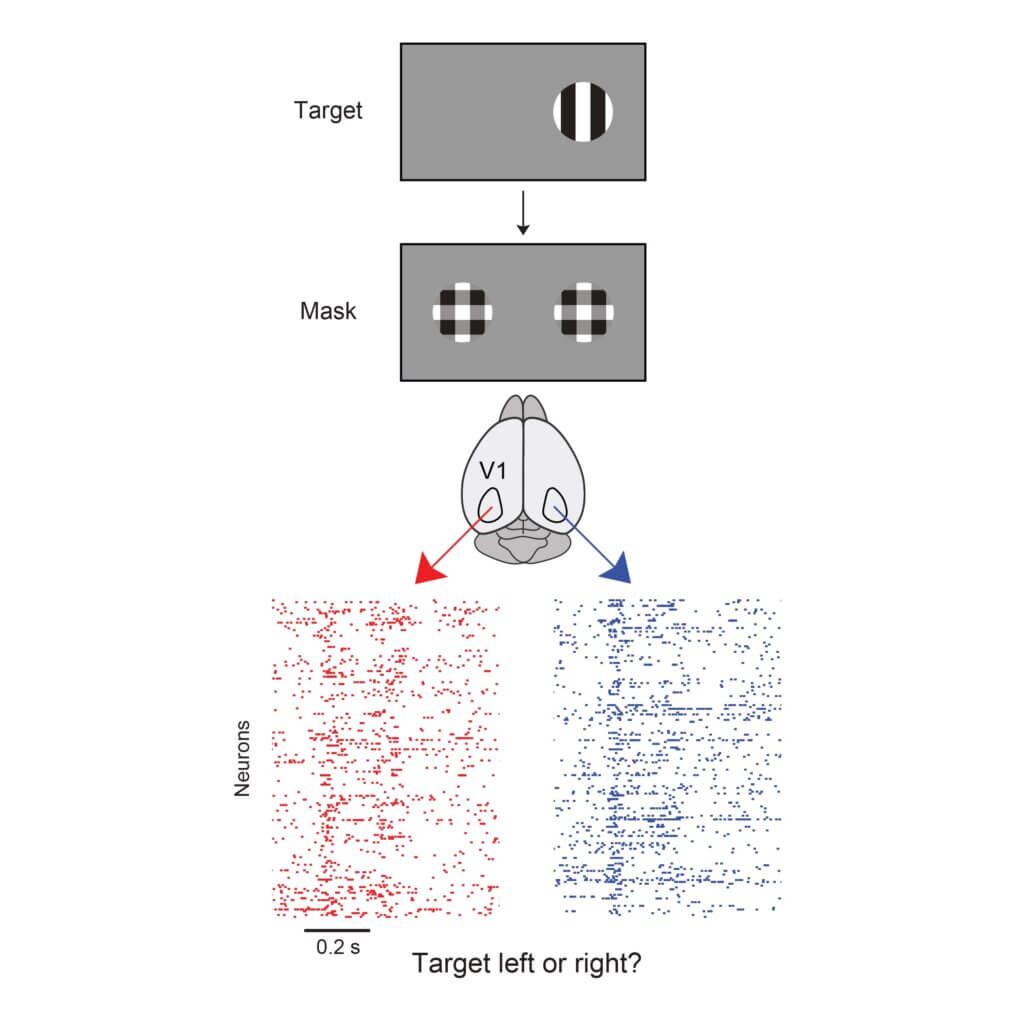
Visual neuroscience experiment showing target stimulus, mask, and two neuron response patterns indicating left or right target location.
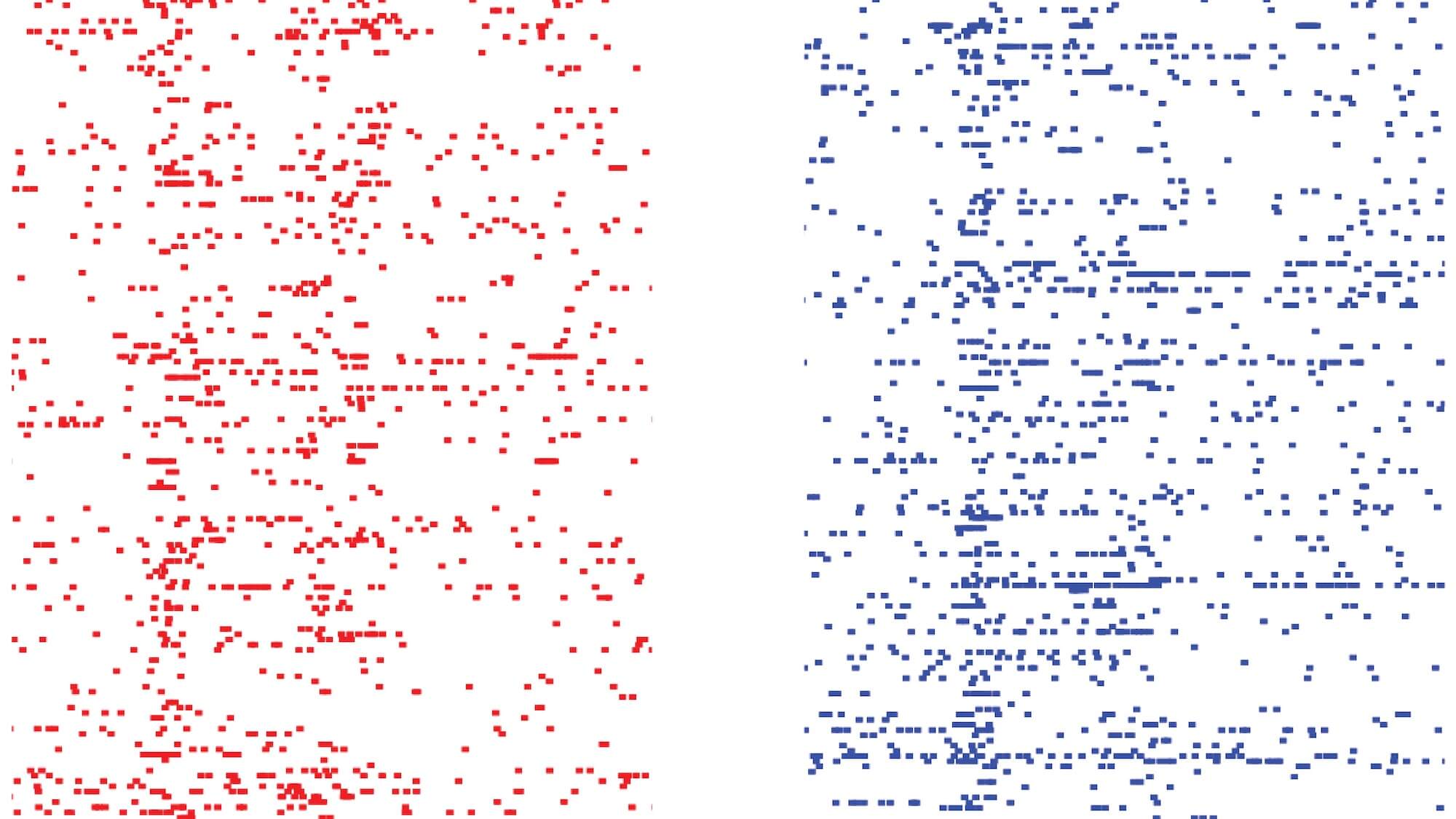
The colored plots illustrate neural activity recorded in mouse visual cortex (V1). Each row of tick marks represents the spikes of a different neuron. Researchers can predict the target side from the neural activity with near perfect accuracy, animal subjects get many masked trials wrong due to how brain regions downstream of V1 process this information.

When the rain of photons impinges on our retinas, the information takes a prescribed path from our eyeballs through several different regions of the brain, ending in higher processing areas of the cortex, the wrinkled outermost shell of the brain. From previous studies of visual masking, scientists know that neurons in the retina and parts of the brain early in that pathway are activated even when a person is not aware that they’re seeing an image. In other words, your brain is seeing things without your knowledge.

To explore where unconscious sensation turns into conscious perception and action, the scientists first trained 16 mice to turn a tiny LEGO wheel toward the direction of a quickly flashed image in exchange for a treat if they chose the correct direction. The scientists then added a different masking image on both sides of the screen, directly following the target image. With the addition of the mask, the animals could no longer do the task correctly — implying they were no longer aware of the original, target image.

Because visual masking had never been tested in mice before, the research team had to create the task for them, meaning the images and how they were shown differed from those used in previous human studies. To confirm that the optical illusion they showed the rodents is relevant to us, the team also tested it in 16 people (the wheel replaced by keystroke; no treats required). Human perception (or lack thereof) and mouse perception of this specific visual masking illusion turned out to be very similar.

The scientists then used a special technique known as optogenetics that can quickly suppress the activity of cells or entire regions of the brain with a flash of light. They aimed this suppression at the mouse primary visual cortex, known to be the first part of the cortex where visual information from the eyes enters the higher cortical areas of the brain. By turning off the primary visual cortex at the instant the masking image was shown, but after the target image, the research team was able to block visual masking entirely — the mice went back to correctly pinpointing the location of the first image even though a masking image was present.

That result means that conscious perception is happening either in the visual cortex or in higher areas of the cortex downstream of it. That fits with the general sentiment in the field that the cortex is the seat of conscious perception in mammals, including us, Koch said.

Although their study narrowed down the region responsible for conscious perception to the cortex, there are still many areas of the cortex that could be involved. Further studies would need to silence these other regions to test their effect on the visual masking task.

“We’re starting to put some bounds on where masking is occurring,” Olsen said. “We think this is a good paradigm to follow up on to track down the other regions that are listening to the primary visual cortex and essentially fusing the streams of target and mask information in the brain.”

Citations
No items found.

about the allen institute

The Allen Institute is an independent, 501(c)(3) nonprofit research organization founded by philanthropist and visionary, the late Paul G. Allen. The Allen Institute is dedicated to answering some of the biggest questions in bioscience and accelerating research worldwide. The Institute is a recognized leader in large-scale research with a commitment to an open science model. For more information, visit alleninstitute.org.


related news

all news
No articles for the category
we acceleratedevelopcatalyzeimpact

science done differently. shared with the world.

explore our accelerators

brain science

Mapping every cell, connection, and circuit in the brain—openly shared with the world.

cell science

Decoding how cells become tissues, then programming that knowledge into powerful new research tools.

neural dynamics

Revealing the brain's hidden algorithms that transform neural activity into real-world behavior.

immunology

Creating the deepest open reference for the healthy human immune system ever built.

synthetic biology

Engineering cells to record their own histories, transforming how we understand disease over time.

research

Big questions, open answers, and science built to be shared.

education

Inspiring the next generation of scientists through open science resources.

impact

Our science is empowering researchers and advancing health worldwide.
advancing science through open, collaborative research
Get the allen institute newsletter
Stay informed on the latest breakthroughs in neuroscience, bioscience, and AI-driven research.
allen institute
impactpeople & teamscareers & opportunitiesalumnihistory & founder
science resources
allencell.orgallenimmunology.orgallenneuraldynamics.orgbrain-bican.orgbrain-map.orgmicrons-explorer.org
research
brain sciencecell scienceneural dynamicsimmunologysynthetic biologypublications
education
science educationfield tripsprofessional developmenteducation resources
quick links
newseventsopen sciencepodcastscience resourceshuman brain donationvisit uscontact
follow us/

allen institute, 615 Westlake Ave North, Seattle, WA 98109 +12065487055

© 0000 allen institute. all rights reserved.
privacy policyterms of usecitation policyemployee portalpolicy & compliance


