impact
about
our story
explore our impact
careers and opportunities
join us
open science
sharing science to speed discovery
open science week
celebrating open science
team science
people & teams
discovery is a team effort
allenites
the people who make our work possible
advisors
their input shapes our science
board of directors
they help us fulfill our mission
shanahan foundation fellowship
at the interface of data and neuroscience
next generation leaders
fostering emerging leaders in bioscience
research
overview
our approach
science at the scale of greatest impact
publications
explore our publications
open science
sharing science to speed discovery
science accelerators
brain science
building a blueprint of the brain
cell science
understanding how cells become organs
neural dynamics
revealing the brain’s hidden algorithms
immunology
creating the ultimate immune system reference
synthetic biology
seattle hub for synthetic biology
education
overview
science education
science is for everyone
open science
sharing science speeds discovery
engagement
education resources
real science. real skills.
field trips
experience science where it happens
educator development
empowering educators
news
overview
all news
explore the latest news
podcast
the human stories behind discovery
sign up for our newsletter
stay connected to our science
events
overview
all events
public engagement, workshops, seminars and more
conferences
connect with us
science resources
science resources
allencell.org
allenimmunology.org
allenneuraldynamics.org
brain-bican.org
brain-map.org
microns-explorer.org
impact
back to menu
team science
our story
explore our impact
careers and opportunities
join us
open science
sharing science to speed discovery
open science week
celebrating open science
team science
people & teams
discovery is a team effort
allenites
the people who make our work possible
advisors
their input shapes our science
board of directors
they help us fulfill our mission
shanahan foundation fellowship
at the interface of data and neuroscience
next generation leaders
fostering emerging leaders in bioscience
research
back to menu
overview
our approach
science at the scale of greatest impact
publications
explore our publications
open science
sharing science to speed discovery
science accelerators
brain science
building a blueprint of the brain
cell science
understanding how cells become organs
neural dynamics
revealing the brain’s hidden algorithms
immunology
creating the ultimate immune system reference
synthetic biology
seattle hub for synthetic biology
education
back to menu
overview
science education
science is for everyone
open science
sharing science speeds discovery
engagement
education resources
real science. real skills.
field trips
experience science where it happens
educator development
empowering educators
news
back to menu
overview
all news
explore the latest news
podcast
the human stories behind discovery
newsletter
stay connected to our science
events
back to menu
overview
all events
public engagement, workshops, seminars and more
conferences
connect with us
science resources
back to menu
science resources
allencell.org
allenimmunology.org
allenneuraldynamics.org
brain-bican.org
brain-map.org
microns-explorer.org
search
news

How immune cells detect different threat levels from salmonella

Your immune system has a tough job.

March 20, 2019
 min read
share/
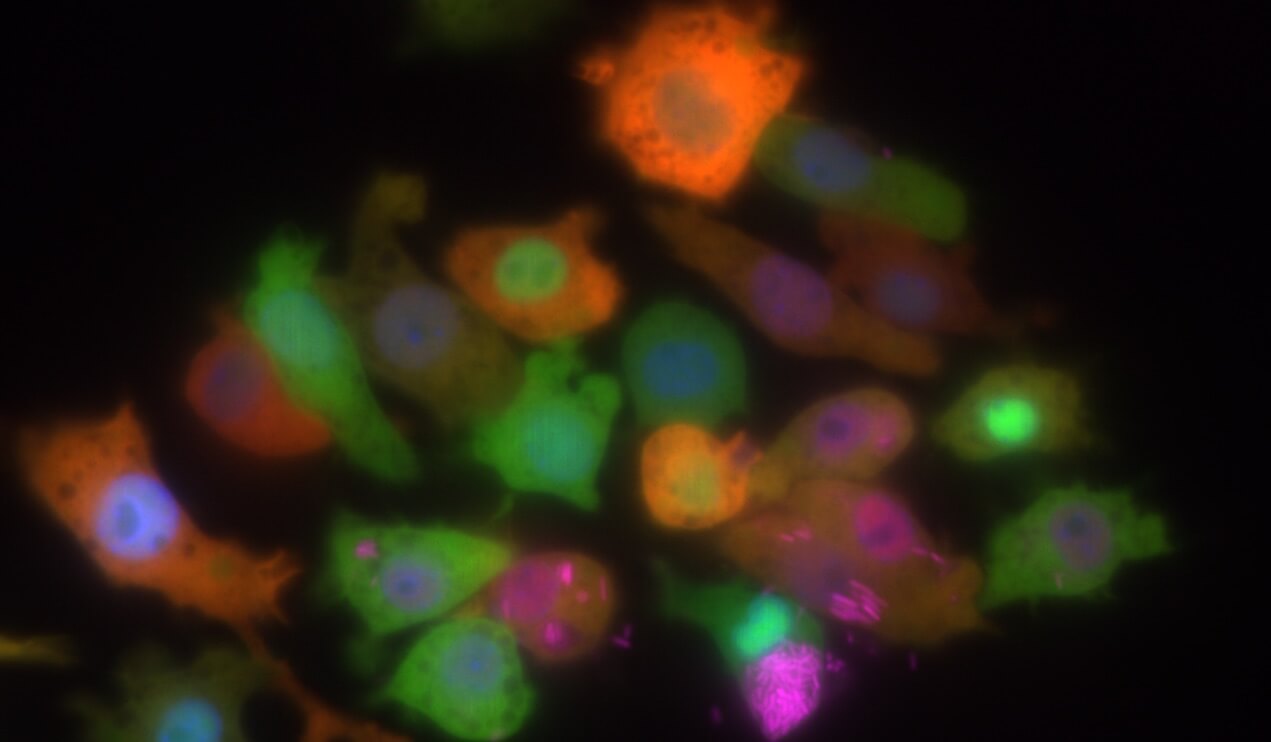
Mouse immune cells infected with salmonella (purple). The immune cells are engineered to flash red or green as a readout of their response to different threat levels of bacterial infection. Image courtesy of Keara Lane.
Your immune system has a tough job.
Thank you! Your submission has been received!
Oops! Something went wrong while submitting the form.

in this article

table of contents will display on published page only
set h2 to populate the table of contents here

This suite of cells circulating in your blood has to detect and respond to hundreds of different possible infections that could attack your body, distinguishing them from your own cells and from safe bacteria like those in your gut microbiome.

A new study from researchers at the Allen Discovery Center at Stanford University has found that the innate immune system, our first line of defense against dangerous invaders, has an even more fine-tuned sensory system than previously realized. Macrophages, the type of immune cell that detect and destroy invading bacteria, can distinguish very subtle differences about the infectious bacteria salmonella. The researchers describe their findings in a study published Wednesday in the journal Cell Systems.

“The way that our immune system works to alert the body to the presence of an infection is of critical interest,” said Markus Covert, Ph.D., director of the Allen Discovery Center and a lead author on the study. “If we can figure out ways to stimulate those signals, we can get in to help the immune system do its job and fight off agents like salmonella.”

Salmonella is a common food-borne bacterium that afflicts more than 100 million people around the world every year, killing approximately half a million. The bacteria breach the walls of the intestines, which causes diarrhea or more serious infections like typhoid fever. Salmonella then infect macrophages in the gut and other parts of the body. Most salmonella strains are resistant to common antibiotics. A better understanding of how the bacteria and our immune systems interact could point to future targets for better therapies, Covert said.

The Stanford research team looked at mouse macrophage cells infected with salmonella in the lab and found that the immune cells can sense several important distinctions about the level of infection or danger of infection. The cells can tell the difference between bacterial debris and live bacteria in their vicinity, and between dangerous bacteria like salmonella and safe bacteria like E. coli. They can also sense if there’s a bacterium nearby versus inside themselves, and if they are infected with actively growing or dormant bacteria.

A cellular Morse code

The team was able to track these subtle differences by studying the macrophages over time and one cell at a time, thanks to a special fluorescent reporter system that reads out cellular responses to infection. That system, which the researchers developed as part of their work within the Allen Discovery Center, a program under The Paul G. Allen Frontiers Group, a division of the Allen Institute, enabled them to understand the individual differences in immune cell-bacterial cell interactions. Previous studies looked just at the average response among a large group of macrophages.

“By doing this dynamic live imaging over time, what you see is that there’s significant variation at the single-cell level,” said Denise Monack, Ph.D., an investigator at the Allen Discovery Center and co-lead author on the study.

The immune cells switch on two different internal response systems in response to salmonella; the research team created colored readouts of those systems. They saw that the macrophages flashed different patterns of fluorescence depending on the bacterial threat level — switching on one or both response systems for different lengths of time — like a cellular Morse code.

The next steps will be to figure out how other immune cells read and respond to these coded signals, and to ask how salmonella slips through these defenses when infection leads to disease. They’re trying to address the latter by infecting macrophages with salmonella missing certain genes to ask which pieces of the bacteria trigger specific responses from the immune cells.

“We’d like to watch the chess games between these two,” Covert said. “Right now, we’re just seeing the moves that are made by the immune cells, and we also want to watch the moves the bacterium makes in response.”

Citations
No items found.

about the allen institute

The Allen Institute is an independent, 501(c)(3) nonprofit research organization founded by philanthropist and visionary, the late Paul G. Allen. The Allen Institute is dedicated to answering some of the biggest questions in bioscience and accelerating research worldwide. The Institute is a recognized leader in large-scale research with a commitment to an open science model. For more information, visit alleninstitute.org.


related news

all news
No articles for the category
we acceleratedevelopcatalyzeimpact

science done differently. shared with the world.

explore our accelerators

brain science

Mapping every cell, connection, and circuit in the brain—openly shared with the world.

cell science

Decoding how cells become tissues, then programming that knowledge into powerful new research tools.

neural dynamics

Revealing the brain's hidden algorithms that transform neural activity into real-world behavior.

immunology

Creating the deepest open reference for the healthy human immune system ever built.

synthetic biology

Engineering cells to record their own histories, transforming how we understand disease over time.

research

Big questions, open answers, and science built to be shared.

education

Inspiring the next generation of scientists through open science resources.

impact

Our science is empowering researchers and advancing health worldwide.
advancing science through open, collaborative research
Get the allen institute newsletter
Stay informed on the latest breakthroughs in neuroscience, bioscience, and AI-driven research.
allen institute
impactpeople & teamscareers & opportunitiesalumnihistory & founder
science resources
allencell.orgallenimmunology.orgallenneuraldynamics.orgbrain-bican.orgbrain-map.orgmicrons-explorer.org
research
brain sciencecell scienceneural dynamicsimmunologysynthetic biologypublications
education
science educationfield tripsprofessional developmenteducation resources
quick links
newseventsopen sciencepodcastscience resourceshuman brain donationvisit uscontact
follow us/

allen institute, 615 Westlake Ave North, Seattle, WA 98109 +12065487055

© 0000 allen institute. all rights reserved.
privacy policyterms of usecitation policyemployee portalpolicy & compliance


