impact
about
our story
explore our impact
careers and opportunities
join us
open science
sharing science to speed discovery
open science week
celebrating open science
team science
people & teams
discovery is a team effort
allenites
the people who make our work possible
advisors
their input shapes our science
board of directors
they help us fulfill our mission
shanahan foundation fellowship
at the interface of data and neuroscience
next generation leaders
fostering emerging leaders in bioscience
research
overview
our approach
science at the scale of greatest impact
publications
explore our publications
open science
sharing science to speed discovery
science accelerators
brain science
building a blueprint of the brain
cell science
understanding how cells become organs
neural dynamics
revealing the brain’s hidden algorithms
immunology
creating the ultimate immune system reference
synthetic biology
seattle hub for synthetic biology
education
overview
science education
science is for everyone
open science
sharing science speeds discovery
engagement
education resources
real science. real skills.
field trips
experience science where it happens
educator development
empowering educators
news
overview
all news
explore the latest news
podcast
the human stories behind discovery
sign up for our newsletter
stay connected to our science
events
overview
all events
public engagement, workshops, seminars and more
conferences
connect with us
science resources
science resources
allencell.org
allenimmunology.org
allenneuraldynamics.org
brain-bican.org
brain-map.org
microns-explorer.org
impact
back to menu
team science
our story
explore our impact
careers and opportunities
join us
open science
sharing science to speed discovery
open science week
celebrating open science
team science
people & teams
discovery is a team effort
allenites
the people who make our work possible
advisors
their input shapes our science
board of directors
they help us fulfill our mission
shanahan foundation fellowship
at the interface of data and neuroscience
next generation leaders
fostering emerging leaders in bioscience
research
back to menu
overview
our approach
science at the scale of greatest impact
publications
explore our publications
open science
sharing science to speed discovery
science accelerators
brain science
building a blueprint of the brain
cell science
understanding how cells become organs
neural dynamics
revealing the brain’s hidden algorithms
immunology
creating the ultimate immune system reference
synthetic biology
seattle hub for synthetic biology
education
back to menu
overview
science education
science is for everyone
open science
sharing science speeds discovery
engagement
education resources
real science. real skills.
field trips
experience science where it happens
educator development
empowering educators
news
back to menu
overview
all news
explore the latest news
podcast
the human stories behind discovery
newsletter
stay connected to our science
events
back to menu
overview
all events
public engagement, workshops, seminars and more
conferences
connect with us
science resources
back to menu
science resources
allencell.org
allenimmunology.org
allenneuraldynamics.org
brain-bican.org
brain-map.org
microns-explorer.org
search
news

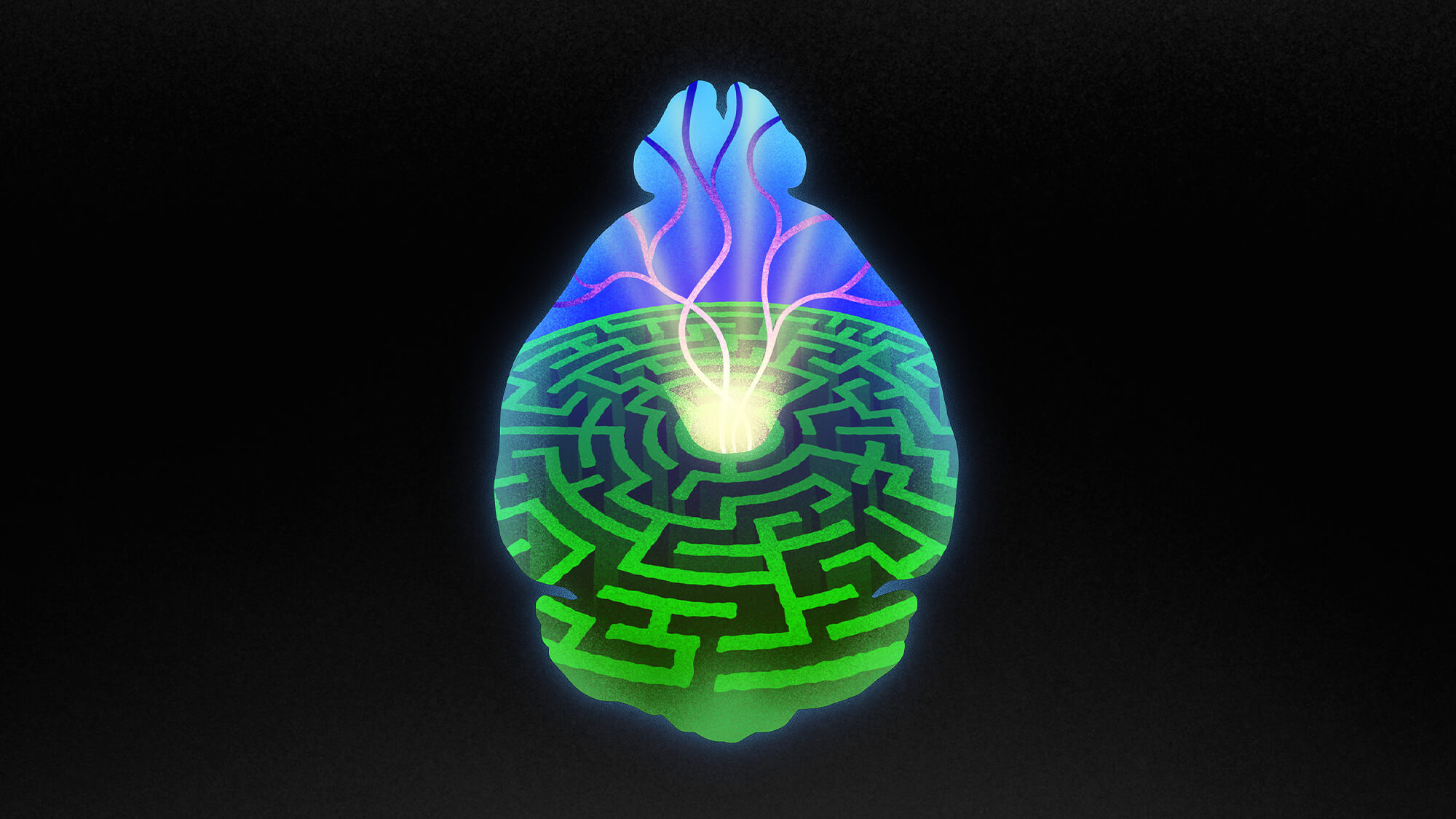
How the brain learns to find its next reward: Warm, warmer, hot!

Rewards don’t just reinforce a specific action-they quickly change the whole pattern of how we behave

December 13, 2023
 min read
share/
Rewards don’t just reinforce a specific action-they quickly change the whole pattern of how we behave
Rewards don’t just reinforce a specific action—they quickly change the whole pattern of how we behave.
Thank you! Your submission has been received!
Oops! Something went wrong while submitting the form.

in this article

table of contents will display on published page only
set h2 to populate the table of contents here

authors

Jake Siegel

Imagine you’re teaching a dog to play fetch. You throw a ball, and your dog sprints after it, picks it up, and runs back. You then reward your panting pup with a treat.

But now comes the real trick for your dog: figuring out which part of that sequence earned the treat.

Scientists call this the ‘credit assignment problem’ in the brain. It’s a fundamental question about understanding which actions are responsible for the positive outcomes we experience.

Dopamine, a key chemical messenger in the brain, is known to play a crucial role in this process. But exactly how the brain links specific actions to dopamine’s release has remained unclear.

A study published today in Nature by scientists at the Allen Institute, Columbia University’s Zuckerman Mind Brain Behavior Institute, the Champalimaud Centre for the Unknown and Seattle Children’s Research Institute sheds new light on this mystery. It reveals how dopamine not only signals a reward but also guides animals to home in on the specific behaviors that lead to these rewards through trial and error.

Intriguingly, the research also shows that the brain’s reward system can swiftly and dynamically alter the full range of an animal’s movements and behaviors. This highlights a sophisticated learning strategy where behaviors are not just reinforced, but actively shaped and fine-tuned through experience, said Rui Costa, D.V.M, Ph.D. , the study’s senior author.

“When you reinforce behavior, we often think it’s just that action,” said Costa, the president and CEO of the Allen Institute. “But no: you’re changing the entire behavioral structure. And what was really surprising was how rapid it was.”

Decoding how dopamine shapes learning

To uncover those insights, the team collaborated with engineers and neuroscientists at the Champalimaud Centre for the Unknown to develop a novel “closed loop” system that could link specific actions by mice to real-time dopamine release. The researchers outfitted mice with wireless sensors to track their movements within a simple controlled space. They then fed this data into a machine learning algorithm, which categorized these actions into distinct groups. The researchers then used optogenetics, a method for controlling neurons with light, to stimulate dopamine neurons once the mice performed predefined “target actions.”

They found that mice swiftly changed their behavior in response to dopamine release. Initially, they not only increased the frequency of the target action, but also of similar actions and those that occurred a few seconds before the dopamine release. Meanwhile, actions dissimilar to the target rapidly decreased. Over time, this refinement became more precise, with the mice increasingly focusing on the exact action that led to dopamine release.

The study also examined how mice learn a series of actions, unveiling a key process similar to rewinding time to understand what leads to a reward. When actions triggering dopamine occurred further apart, the mice learned more slowly. This shows that longer waits between actions make it harder for mice to connect the sequence with the reward. In essence, actions right before the reward are quickly grasped and improved upon, while earlier actions are refined more gradually. This ‘rewinding’ process strengthens the behavior and helps the mice progressively identify which precise actions and sequences yield the reward.

The findings could impact diverse fields like education and artificial intelligence (AI), said lead author Jonathan Tang, Ph.D., an assistant professor at University of Washington Medicine – Pediatrics, Seattle Children’s Research Institute. For example, allowing for exploration, mistakes, and gradual refinement in the classroom may be more in line with our brain’s innate learning processes.

In AI, the insights could lead to more sophisticated and efficient learning systems. By better replicating biological learning processes, we could create AI that is better at adapting to new data and situations.

This study offers deeper insight into how our brains learn and adapt through trial and error—whether you’re a scientist or a pup.

“We take a lot of stuff for granted about how things work, including credit assignment,” said Tang, who started the research with Costa while at Columbia University. “But it’s when you really start diving in that you realize the complexity. This is why people do science: to home in on the truth of the matter.”

Citations
No items found.

about the allen institute

The Allen Institute is an independent, 501(c)(3) nonprofit research organization founded by philanthropist and visionary, the late Paul G. Allen. The Allen Institute is dedicated to answering some of the biggest questions in bioscience and accelerating research worldwide. The Institute is a recognized leader in large-scale research with a commitment to an open science model. For more information, visit alleninstitute.org.
related news

all news
No articles for the category
we acceleratedevelopcatalyzeimpact

science done differently. shared with the world.

explore our accelerators

brain science

Mapping every cell, connection, and circuit in the brain—openly shared with the world.

cell science

Decoding how cells become tissues, then programming that knowledge into powerful new research tools.

neural dynamics

Revealing the brain's hidden algorithms that transform neural activity into real-world behavior.

immunology

Creating the deepest open reference for the healthy human immune system ever built.

synthetic biology

Engineering cells to record their own histories, transforming how we understand disease over time.

research

Big questions, open answers, and science built to be shared.

education

Inspiring the next generation of scientists through open science resources.

impact

Our science is empowering researchers and advancing health worldwide.
advancing science through open, collaborative research
Get the allen institute newsletter
Stay informed on the latest breakthroughs in neuroscience, bioscience, and AI-driven research.
allen institute
impactpeople & teamscareers & opportunitiesalumnihistory & founder
science resources
allencell.orgallenimmunology.orgallenneuraldynamics.orgbrain-bican.orgbrain-map.orgmicrons-explorer.org
research
brain sciencecell scienceneural dynamicsimmunologysynthetic biologypublications
education
science educationfield tripsprofessional developmenteducation resources
quick links
newseventsopen sciencepodcastscience resourceshuman brain donationvisit uscontact
follow us/

allen institute, 615 Westlake Ave North, Seattle, WA 98109 +12065487055

© 0000 allen institute. all rights reserved.
privacy policyterms of usecitation policyemployee portalpolicy & compliance