impact
about
our story
explore our impact
careers and opportunities
join us
open science
sharing science to speed discovery
open science week
celebrating open science
team science
people & teams
discovery is a team effort
allenites
the people who make our work possible
advisors
their input shapes our science
board of directors
they help us fulfill our mission
shanahan foundation fellowship
at the interface of data and neuroscience
next generation leaders
fostering emerging leaders in bioscience
research
overview
our approach
science at the scale of greatest impact
publications
explore our publications
open science
sharing science to speed discovery
science accelerators
brain science
building a blueprint of the brain
cell science
understanding how cells become organs
neural dynamics
revealing the brain’s hidden algorithms
immunology
creating the ultimate immune system reference
synthetic biology
seattle hub for synthetic biology
education
overview
science education
science is for everyone
open science
sharing science speeds discovery
engagement
education resources
real science. real skills.
field trips
experience science where it happens
educator development
empowering educators
news
overview
all news
explore the latest news
podcast
the human stories behind discovery
sign up for our newsletter
stay connected to our science
events
overview
all events
public engagement, workshops, seminars and more
conferences
connect with us
science resources
science resources
allencell.org
allenimmunology.org
allenneuraldynamics.org
brain-bican.org
brain-map.org
microns-explorer.org
impact
back to menu
team science
our story
explore our impact
careers and opportunities
join us
open science
sharing science to speed discovery
open science week
celebrating open science
team science
people & teams
discovery is a team effort
allenites
the people who make our work possible
advisors
their input shapes our science
board of directors
they help us fulfill our mission
shanahan foundation fellowship
at the interface of data and neuroscience
next generation leaders
fostering emerging leaders in bioscience
research
back to menu
overview
our approach
science at the scale of greatest impact
publications
explore our publications
open science
sharing science to speed discovery
science accelerators
brain science
building a blueprint of the brain
cell science
understanding how cells become organs
neural dynamics
revealing the brain’s hidden algorithms
immunology
creating the ultimate immune system reference
synthetic biology
seattle hub for synthetic biology
education
back to menu
overview
science education
science is for everyone
open science
sharing science speeds discovery
engagement
education resources
real science. real skills.
field trips
experience science where it happens
educator development
empowering educators
news
back to menu
overview
all news
explore the latest news
podcast
the human stories behind discovery
newsletter
stay connected to our science
events
back to menu
overview
all events
public engagement, workshops, seminars and more
conferences
connect with us
science resources
back to menu
science resources
allencell.org
allenimmunology.org
allenneuraldynamics.org
brain-bican.org
brain-map.org
microns-explorer.org
search
news

How the gut keeps time - and keeps us healthy

New study identifies brain-intestine circadian signals that could underlie health problems related to night shift work and poor sleep

September 18, 2019
 min read
share/
New study identifies brain-intestine circadian signals that could underlie health problems related to night shift work and poor sleep
Thank you! Your submission has been received!
Oops! Something went wrong while submitting the form.

in this article

table of contents will display on published page only
set h2 to populate the table of contents here
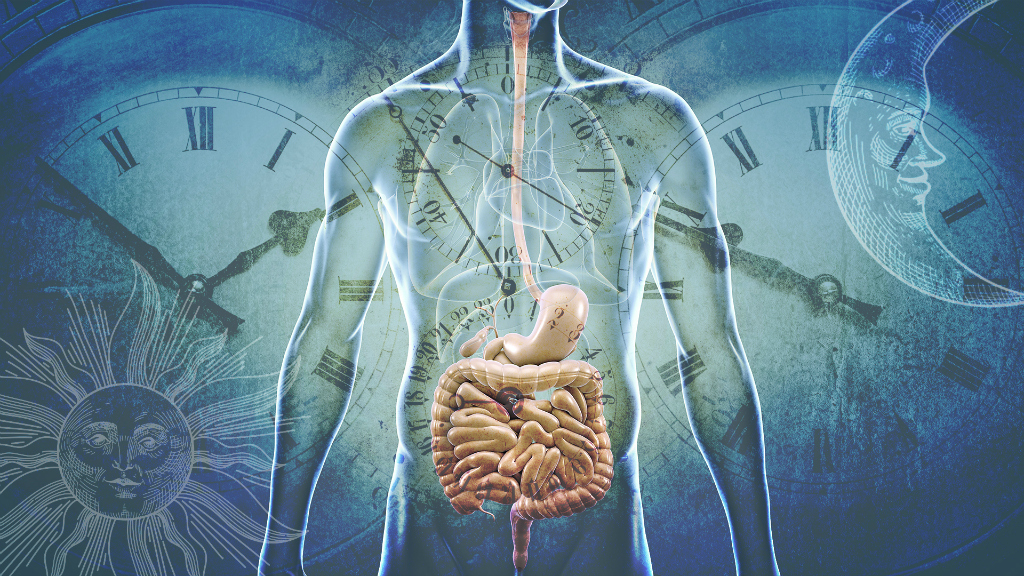
Medical illustration showing human anatomy with fetus, organs, clocks, and celestial symbols representing life cycles.

Researchers have uncovered immune cells in the mouse that signal light and dark in the gut, a finding that could explain why people with sleep disorders or who work the night shift have certain health problems. When these clock-keeping immune cells were disrupted, the animals took in more fat from their diets, causing them to gain excess weight, and their levels of inflammation jumped.

It might come as a surprise to learn that the dark depths of your gastrointestinal tract care about sunshine. It was a surprise to Henrique Veiga-Fernandes, D.V.M., Ph.D., who led a study published Wednesday in the journal Nature on the newly discovered brain-gut-immune connection.

Researchers had previously seen cyclical oscillations in the intestines — and in their associated bacteria, the gut microbiome — but other studies had linked these digestive rhythms to the timing of regular meals rather than to light cycles.

“What is novel here is the fact that we have a very distinct circuit in the brain that talks to immune cells in the intestine, that’s really surprising,” said Veiga-Fernandes, who leads a research team at Champalimaud Center for the Unknown in Lisbon, Portugal, and is also an Allen Distinguished Investigator. “If you disrupt the area of the brain that integrates light and dark signals, it’s a disaster for the animal. All the body’s time zones become completely mixed up, even within the same organ.”

Gut health and disease

n their study, the researchers found that a certain type of gut immune cells, known as ILC3s, have an innate rhythm that syncs up with the brain’s master clock, which Veiga-Fernandes terms “the body’s Big Ben.” When the researchers removed the region of the brain responsible for this time-keeping, a section within the hypothalamus known as the suprachiasmatic nuclei, the immune cells lost their regular rhythm and the animals’ gut health was also thrown out of balance.

The research team found that circadian rhythms are important for ILC3s to find their way in the body — when the brain’s light-dark signaling was disrupted, the immune cells never made it to the intestines. These cells play a role in wound repair and in slowing fat uptake in the gut. When the ILC3s couldn’t find their way, the animals gained weight to the point of obesity and had higher levels of inflammation and increased propensity to intestinal infection.

Veiga-Fernandes hypothesizes that the brain regulates ILC3 levels in the gut on purpose, allowing animals to absorb a certain amount of fat from their diet when ILC3 levels in the gut are low, and then to repair their intestines from potential damage related to eating when ILC3 function levels rise.

It’s not yet known whether ILC3s play a similar role in our gut health, although these cells and the associated proteins that help them keep time are evolutionarily conserved between mice and humans. If it exists in people too, this interaction between light and dark, the brain, and the intestines’ immune cells could explain why people with chronically altered sleep schedules – those who work the night shift, travel frequently, or have sleep disorders — suffer certain health problems, Veiga-Fernandes said.

Sleep problems are also associated with flare-ups in the chronic family of autoimmune disorders known as inflammatory bowel disease, or IBD. The underlying cause of IBD and its flare-ups is still mysterious, but in light of these recent results, the researchers wonder whether the circadian clock could play a similar role in these diseases.

In the future, Veiga-Fernandes aims to explore the precise architecture that links the brain and the intestinal immune system. There’s a growing appreciation of the importance of neuron-immune signaling, he said, and how it could play multiple roles in health and disease.

“What are the motorways, the routes that the system uses? We’ve seen that interactions between neurons and immune cells are important in many tissues,” he said. “We’re hopeful that by harnessing these neuro-immune interactions, we can shed light not only on understanding more about this biology but also improve therapies for several kinds of pathologies.”

Citations
No items found.

about the allen institute

The Allen Institute is an independent, 501(c)(3) nonprofit research organization founded by philanthropist and visionary, the late Paul G. Allen. The Allen Institute is dedicated to answering some of the biggest questions in bioscience and accelerating research worldwide. The Institute is a recognized leader in large-scale research with a commitment to an open science model. For more information, visit alleninstitute.org.
related news

all news
No articles for the category
we acceleratedevelopcatalyzeimpact

science done differently. shared with the world.

explore our accelerators

brain science

Mapping every cell, connection, and circuit in the brain—openly shared with the world.

cell science

Decoding how cells become tissues, then programming that knowledge into powerful new research tools.

neural dynamics

Revealing the brain's hidden algorithms that transform neural activity into real-world behavior.

immunology

Creating the deepest open reference for the healthy human immune system ever built.

synthetic biology

Engineering cells to record their own histories, transforming how we understand disease over time.

research

Big questions, open answers, and science built to be shared.

education

Inspiring the next generation of scientists through open science resources.

impact

Our science is empowering researchers and advancing health worldwide.
advancing science through open, collaborative research
Get the allen institute newsletter
Stay informed on the latest breakthroughs in neuroscience, bioscience, and AI-driven research.
allen institute
impactpeople & teamscareers & opportunitiesalumnihistory & founder
science resources
allencell.orgallenimmunology.orgallenneuraldynamics.orgbrain-bican.orgbrain-map.orgmicrons-explorer.org
research
brain sciencecell scienceneural dynamicsimmunologysynthetic biologypublications
education
science educationfield tripsprofessional developmenteducation resources
quick links
newseventsopen sciencepodcastscience resourceshuman brain donationvisit uscontact
follow us/

allen institute, 615 Westlake Ave North, Seattle, WA 98109 +12065487055

© 0000 allen institute. all rights reserved.
privacy policyterms of usecitation policyemployee portalpolicy & compliance