in this article
The Intelligence Advanced Research Projects Activity (IARPA) has awarded an $18.7 million contract to the Allen Institute for Brain Science, as part of a larger project with Baylor College of Medicine and Princeton University, to create the largest ever roadmap to understand how the function of networks in the brain’s cortex relates to the underlying connections of its individual neurons.
The project is part of the Machine Intelligence from Cortical Networks (MICrONS) program, which seeks to revolutionize machine learning by reverse-engineering the algorithms of the brain.
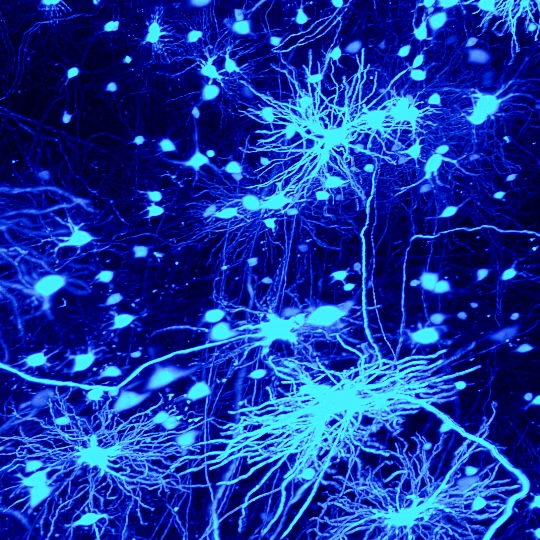
“This effort will be the first time that we can physically look at more than a thousand connections between neurons in a single cortical network and understand how those connections might allow the network to perform functions, like process visual information or store memories,” says R. Clay Reid, Ph.D., Senior Investigator at the Allen Institute for Brain Science, Principal Investigator on the project.
The ultimate goal is to implement the algorithms and learning rules that scientists decipher from the brain to advance the field of artificial intelligence. Artificial neural networks have recently developed capabilities to do speech recognition, recognize faces and help analyze big data for biomedical research. “However, in many ways, these artificial neural networks are still primitive compared to biological networks of neurons and do not learn the way real brains do,” says Andreas Tolias, Ph.D., Associate Professor in the Department of Neuroscience at Baylor College of Medicine. “Our goal is to fill this gap and apply the algorithms of the brain to engineer novel artificial network architectures.”
Experiments for the project will begin at Baylor College of Medicine, where researchers will perform studies to identify neurons that respond to particular patterns of visual stimulation, such as lines in different orientations on a screen.
The experiments will continue at the Allen Institute for Brain Science, where sections of the same brains will be stained, sliced and imaged in an array of electron microscopes, which capture the intricate details of neurons and their connections.
“The data we’re collecting is massive, with the work having virtually no margin for error,” says Christof Koch, Ph.D., President and Chief Scientific Officer of the Allen Institute for Brain Science. “If we lose two slices of brain in a row, each of which is vastly thinner than a human hair, we cannot hope to reconstruct the segment faithfully in three dimensions and have to start over. This is where the Allen Institute’s history of processing and scaling data effectively at an industrial scale is so crucial.”
Finally, the 3D image data will be sent to Princeton University, under Sebastian Seung, Ph.D., Professor of Computer Science and the Princeton Neuroscience Institute, where it will be painstakingly reconstructed in three dimensions by human annotators aided by powerful machine vision and machine learning algorithms, and each individual neuron with all its myriad processes will be traced and analyzed.
“We are delighted to be collaborating on this exciting project with our superb scientific colleagues at Baylor and the Allen Institute,” says Seung.
The end goal of the project is to create a reconstruction of a cubic millimeter of brain tissue, the size of a grain of sand, yet containing the largest section of brain ever to be studied in this way to date.
“This work is the next big step in understanding how networks in the brain work,” say Reid. “For the first time we will be able to come to grips with cortical networks in all their complexity, rather than a little bit at a time. No other technique can hope to grapple with their richness.”
Supported by the Intelligence Advanced Research Projects Activity (IARPA) via Department of Interior/Interior Business Center (DoI/IBC) contract number D16PC0004. The U.S. Government is authorized to reproduce and distribute reprints for Governmental purposes notwithstanding any copyright annotation thereon. Disclaimer: The views and conclusions contained herein are those of the authors and should not be interpreted as necessarily representing the official policies or endorsements, either expressed or implied, of IARPA, DoI/IBC, or the U.S. Government.
About the Allen Institute for Brain Science
The Allen Institute for Brain Science (www.alleninstitute.org) is an independent, 501(c)(3) nonprofit medical research organization dedicated to accelerating the understanding of how the human brain works in health and disease. Using a big science approach, the Allen Institute generates useful public resources used by researchers and organizations around the globe, drives technological and analytical advances, and discovers fundamental brain properties through integration of experiments, modeling and theory. Launched in 2003 with a seed contribution from founder and philanthropist Paul G. Allen, the Allen Institute is supported by a diversity of government, foundation and private funds to enable its projects. Given the Institute’s achievements, Mr. Allen committed an additional $300 million in 2012 for the first four years of a ten-year plan to further propel and expand the Institute’s scientific programs, bringing his total commitment to date to $500 million. The Allen Institute’s data and tools are publicly available online at www.brain-map.org.
About Baylor College of Medicine
Baylor College of Medicine (www.bcm.edu) in Houston is recognized as a premier academic health sciences center and is known for excellence in education, research and patient care. It is the only private medical school in the greater southwest and is ranked 21st among medical schools for research and 11th for primary care by U.S. News & World Report. Baylor is listed 20th among all U.S. medical schools for National Institutes of Health funding and number one in Texas. Located in the Texas Medical Center, Baylor has affiliations with seven teaching hospitals and jointly owns and operates CHI St. Luke’s Health, Baylor St. Luke’s Medical Center. Currently, Baylor trains more than 3,000 medical, graduate, nurse anesthesia, physician assistant and orthotics students, as well as residents and post-doctoral fellows. Follow Baylor College of Medicine on Facebook (http://www.facebook.com/BaylorCollegeOfMedicine) and Twitter (http://twitter.com/BCMHouston).
About Princeton University
Princeton University is a vibrant community of scholarship and learning that stands in the nation’s service and in the service of all nations. Chartered in 1746, Princeton is the fourth-oldest college in the United States. Princeton is an independent, coeducational, nondenominational institution that provides undergraduate and graduate instruction in the humanities, social sciences, natural sciences and engineering. As a world-renowned research university, Princeton seeks to achieve the highest levels of distinction in the discovery and transmission of knowledge and understanding. At the same time, Princeton is distinctive among research universities in its commitment to undergraduate teaching. Today, more than 1,100 faculty members instruct approximately 5,200 undergraduate students and 2,600 graduate students. The University’s generous financial aid program ensures that talented students from all economic backgrounds can afford a Princeton education. For more information, please visit http://www.princeton.edu or follow us on Facebook (https://www.facebook.com/PrincetonU/) and Twitter (https://twitter.com/princeton).
Citations
about the allen institute
The Allen Institute is an independent, 501(c)(3) nonprofit research organization founded by philanthropist and visionary, the late Paul G. Allen. The Allen Institute is dedicated to answering some of the biggest questions in bioscience and accelerating research worldwide. The Institute is a recognized leader in large-scale research with a commitment to an open science model. For more information, visit alleninstitute.org.