impact
about
our story
explore our impact
careers and opportunities
join us
open science
sharing science to speed discovery
open science week
celebrating open science
team science
people & teams
discovery is a team effort
allenites
the people who make our work possible
advisors
their input shapes our science
board of directors
they help us fulfill our mission
shanahan foundation fellowship
at the interface of data and neuroscience
next generation leaders
fostering emerging leaders in bioscience
research
overview
our approach
science at the scale of greatest impact
publications
explore our publications
open science
sharing science to speed discovery
science accelerators
brain science
building a blueprint of the brain
cell science
understanding how cells become organs
neural dynamics
revealing the brain’s hidden algorithms
immunology
creating the ultimate immune system reference
synthetic biology
seattle hub for synthetic biology
education
overview
science education
science is for everyone
open science
sharing science speeds discovery
engagement
education resources
real science. real skills.
field trips
experience science where it happens
educator development
empowering educators
news
overview
all news
explore the latest news
podcast
the human stories behind discovery
sign up for our newsletter
stay connected to our science
events
overview
all events
public engagement, workshops, seminars and more
conferences
connect with us
science resources
science resources
allencell.org
allenimmunology.org
allenneuraldynamics.org
brain-bican.org
brain-map.org
microns-explorer.org
impact
back to menu
team science
our story
explore our impact
careers and opportunities
join us
open science
sharing science to speed discovery
open science week
celebrating open science
team science
people & teams
discovery is a team effort
allenites
the people who make our work possible
advisors
their input shapes our science
board of directors
they help us fulfill our mission
shanahan foundation fellowship
at the interface of data and neuroscience
next generation leaders
fostering emerging leaders in bioscience
research
back to menu
overview
our approach
science at the scale of greatest impact
publications
explore our publications
open science
sharing science to speed discovery
science accelerators
brain science
building a blueprint of the brain
cell science
understanding how cells become organs
neural dynamics
revealing the brain’s hidden algorithms
immunology
creating the ultimate immune system reference
synthetic biology
seattle hub for synthetic biology
education
back to menu
overview
science education
science is for everyone
open science
sharing science speeds discovery
engagement
education resources
real science. real skills.
field trips
experience science where it happens
educator development
empowering educators
news
back to menu
overview
all news
explore the latest news
podcast
the human stories behind discovery
newsletter
stay connected to our science
events
back to menu
overview
all events
public engagement, workshops, seminars and more
conferences
connect with us
science resources
back to menu
science resources
allencell.org
allenimmunology.org
allenneuraldynamics.org
brain-bican.org
brain-map.org
microns-explorer.org
search
news

Machine learning toolkit lets biologists navigate their way through a 3D cell

In the world of computer vision, engineers need to build software that can recognize parts of an image or 3D visual field. Think, for example, a...

July 23, 2019
 min read
share/
In the world of computer vision, engineers need to build software that can recognize parts of an image or 3D visual field. Think, for example, a...
Thank you! Your submission has been received!
Oops! Something went wrong while submitting the form.

in this article

table of contents will display on published page only
set h2 to populate the table of contents here
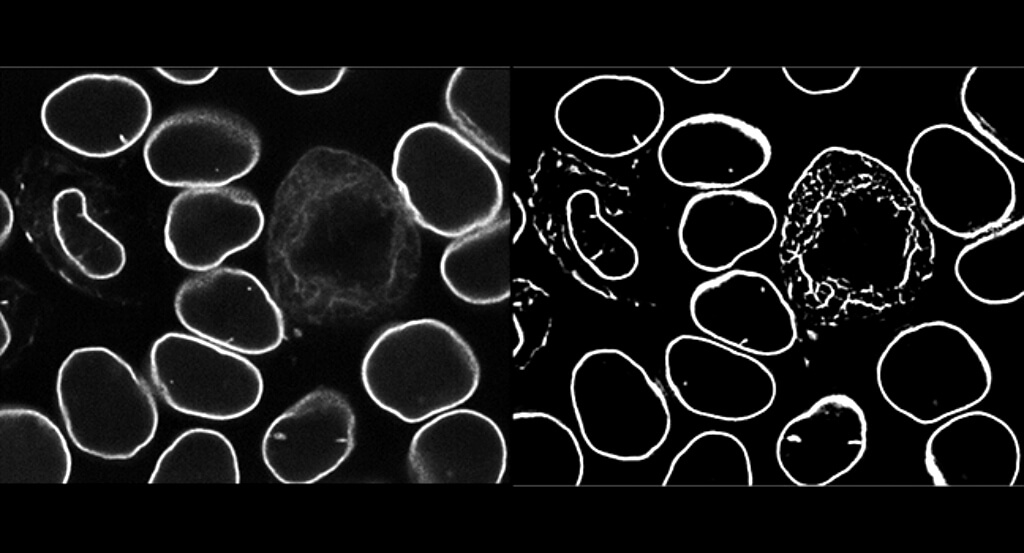
Microscopic view comparing normal and abnormal blood cells with white outlined membranes.

Biologists who want to find their way through the microscopic world inside a cell face a related challenge. To understand different components of the cell — and how they might change under important conditions, like growth or disease — you have to understand precisely where they are and what they look like. And that means knowing the exact location of those components’ edges, down to the pixel.

Enter the Allen Cell Structure Segmenter, a python-based, open-source toolkit incorporating machine learning techniques that does for cell biology what computer vision techniques have done for self-driving cars, broadly speaking. The tool helps scientists navigate complex images of cells by automatically capturing the boundaries of structures inside them.

The toolkit was developed by researchers at the Allen Institute for Cell Science, a division of the Allen Institute, as a way to probe 3D images in the Allen Cell Collection, a catalog of live human stem cell lines gene-edited so that different structures glow with fluorescent colors under the microscope. The collection includes 38 cell lines tagging 34 different cellular structures, with more coming down the pike. The researchers have collected an enormous number of images, and realized they needed an automated and accurate way to navigate the many different structures, whose shape in the fluorescent images varies from tiny dots to smooth boundaries to ruffled edges.

“We needed a way to access and define those structures for every single one of those cell lines,” said Susanne Rafelski, Ph.D., director of the Assay Development team at the Allen Institute for Cell Science, a division of the Allen Institute. “Given that every structure has its own set of challenges, and we’re going to have lots and lots of them, it gets really hard.”

And she knew that other cell biologists face similar challenges. Rafelski, along with Allen Institute for Cell Science researcher Jianxu Chen, Ph.D., and the rest of the Assay Development team, created the Allen Cell Structure Segmenter and decided to make the toolkit available publicly so other scientists could use it.

Not every cell biology question needs such a rigorous approach. In many cases, biologists can find structures in cells just by looking at the images. But in other situations — especially for scientists working with 3D images of cells — more precision or more automation is needed.

Two approaches for the cell biology community

The Segmenter toolkit was rolled out in two phases. Last year, the team debuted the first part, which gathers existing computer vision algorithms into a menu. This “classic workflow” part of the toolkit presents recommendations for segmenting a given image through a look-up table of representative pictures from the Allen Cell Collection. Researchers can scan the table and find images that look similar to their own. The recommendations depend on patterns of fluorescence — say, tiny speckles or large diffuse circles — rather than the specific structure identity.

The newest part of the toolkit, debuted this spring on allencell.org, uses machine learning to identify structure boundaries in images when the classic approach isn’t sufficient for the problem. For example, many structures in the cell change dramatically during the different stages of cell division. Some structures might look like a smooth circle most of the time, but quickly shift into a series of bright speckles as the cell divides. The machine learning part of the Segmenter toolkit can, with some straight-forward user input, tackle that problem.

“The classic workflow can work without the machine learning, and the machine learning can work without the classic,” Rafelski said. “We use them together and it’s really powerful.”

Github repositories for both parts of the Allen Cell Structure Segmenter are available on allencell.org, with a video tutorial available for the classic segmentation workflow. The team is working on additional tutorials and expansions to the tool as they receive community feedback.

“This is a nice resource to give back to the community,” said Derek Thirstrup, an image analyst at the Allen Institute for Cell Science who helped test the toolkit. “It’s really lowering the entry barrier to let cell biologists be more quantitative in their results.”

Citations
No items found.

about the allen institute

The Allen Institute is an independent, 501(c)(3) nonprofit research organization founded by philanthropist and visionary, the late Paul G. Allen. The Allen Institute is dedicated to answering some of the biggest questions in bioscience and accelerating research worldwide. The Institute is a recognized leader in large-scale research with a commitment to an open science model. For more information, visit alleninstitute.org.
related news

all news
No articles for the category
we acceleratedevelopcatalyzeimpact

science done differently. shared with the world.

explore our accelerators

brain science

Mapping every cell, connection, and circuit in the brain—openly shared with the world.

cell science

Decoding how cells become tissues, then programming that knowledge into powerful new research tools.

neural dynamics

Revealing the brain's hidden algorithms that transform neural activity into real-world behavior.

immunology

Creating the deepest open reference for the healthy human immune system ever built.

synthetic biology

Engineering cells to record their own histories, transforming how we understand disease over time.

research

Big questions, open answers, and science built to be shared.

education

Inspiring the next generation of scientists through open science resources.

impact

Our science is empowering researchers and advancing health worldwide.
advancing science through open, collaborative research
Get the allen institute newsletter
Stay informed on the latest breakthroughs in neuroscience, bioscience, and AI-driven research.
allen institute
impactpeople & teamscareers & opportunitiesalumnihistory & founder
science resources
allencell.orgallenimmunology.orgallenneuraldynamics.orgbrain-bican.orgbrain-map.orgmicrons-explorer.org
research
brain sciencecell scienceneural dynamicsimmunologysynthetic biologypublications
education
science educationfield tripsprofessional developmenteducation resources
quick links
newseventsopen sciencepodcastscience resourceshuman brain donationvisit uscontact
follow us/

allen institute, 615 Westlake Ave North, Seattle, WA 98109 +12065487055

© 0000 allen institute. all rights reserved.
privacy policyterms of usecitation policyemployee portalpolicy & compliance