
impact
about
our story
explore our impact
careers and opportunities
join us
open science
sharing science to speed discovery
open science week
celebrating open science
team science
people & teams
discovery is a team effort
allenites
the people who make our work possible
advisors
their input shapes our science
board of directors
they help us fulfill our mission
shanahan foundation fellowship
at the interface of data and neuroscience
next generation leaders
fostering emerging leaders in bioscience
research
overview
our approach
science at the scale of greatest impact
publications
explore our publications
open science
sharing science to speed discovery
science accelerators
brain science
building a blueprint of the brain
cell science
understanding how cells become organs
neural dynamics
revealing the brain’s hidden algorithms
immunology
creating the ultimate immune system reference
synthetic biology
seattle hub for synthetic biology
education
overview
science education
science is for everyone
open science
sharing science speeds discovery
engagement
education resources
real science. real skills.
field trips
experience science where it happens
educator development
empowering educators
news
overview
all news
explore the latest news
podcast
the human stories behind discovery
sign up for our newsletter
stay connected to our science
events
overview
all events
public engagement, workshops, seminars and more
conferences
connect with us
science resources
science resources
allencell.org
allenimmunology.org
allenneuraldynamics.org
brain-bican.org
brain-map.org
microns-explorer.org
impact
back to menu
team science
our story
explore our impact
careers and opportunities
join us
open science
sharing science to speed discovery
open science week
celebrating open science
team science
people & teams
discovery is a team effort
allenites
the people who make our work possible
advisors
their input shapes our science
board of directors
they help us fulfill our mission
shanahan foundation fellowship
at the interface of data and neuroscience
next generation leaders
fostering emerging leaders in bioscience
research
back to menu
overview
our approach
science at the scale of greatest impact
publications
explore our publications
open science
sharing science to speed discovery
science accelerators
brain science
building a blueprint of the brain
cell science
understanding how cells become organs
neural dynamics
revealing the brain’s hidden algorithms
immunology
creating the ultimate immune system reference
synthetic biology
seattle hub for synthetic biology
education
back to menu
overview
science education
science is for everyone
open science
sharing science speeds discovery
engagement
education resources
real science. real skills.
field trips
experience science where it happens
educator development
empowering educators
news
back to menu
overview
all news
explore the latest news
podcast
the human stories behind discovery
newsletter
stay connected to our science
events
back to menu
overview
all events
public engagement, workshops, seminars and more
conferences
connect with us
science resources
back to menu
science resources
allencell.org
allenimmunology.org
allenneuraldynamics.org
brain-bican.org
brain-map.org
microns-explorer.org
search
news

Naked mole rats don’t show signs of old age, but their DNA says otherwise

‘Queens’ of the rodent colonies age even more slowly than the extremely long-lived naked mole rat

December 23, 2021
 min read
share/
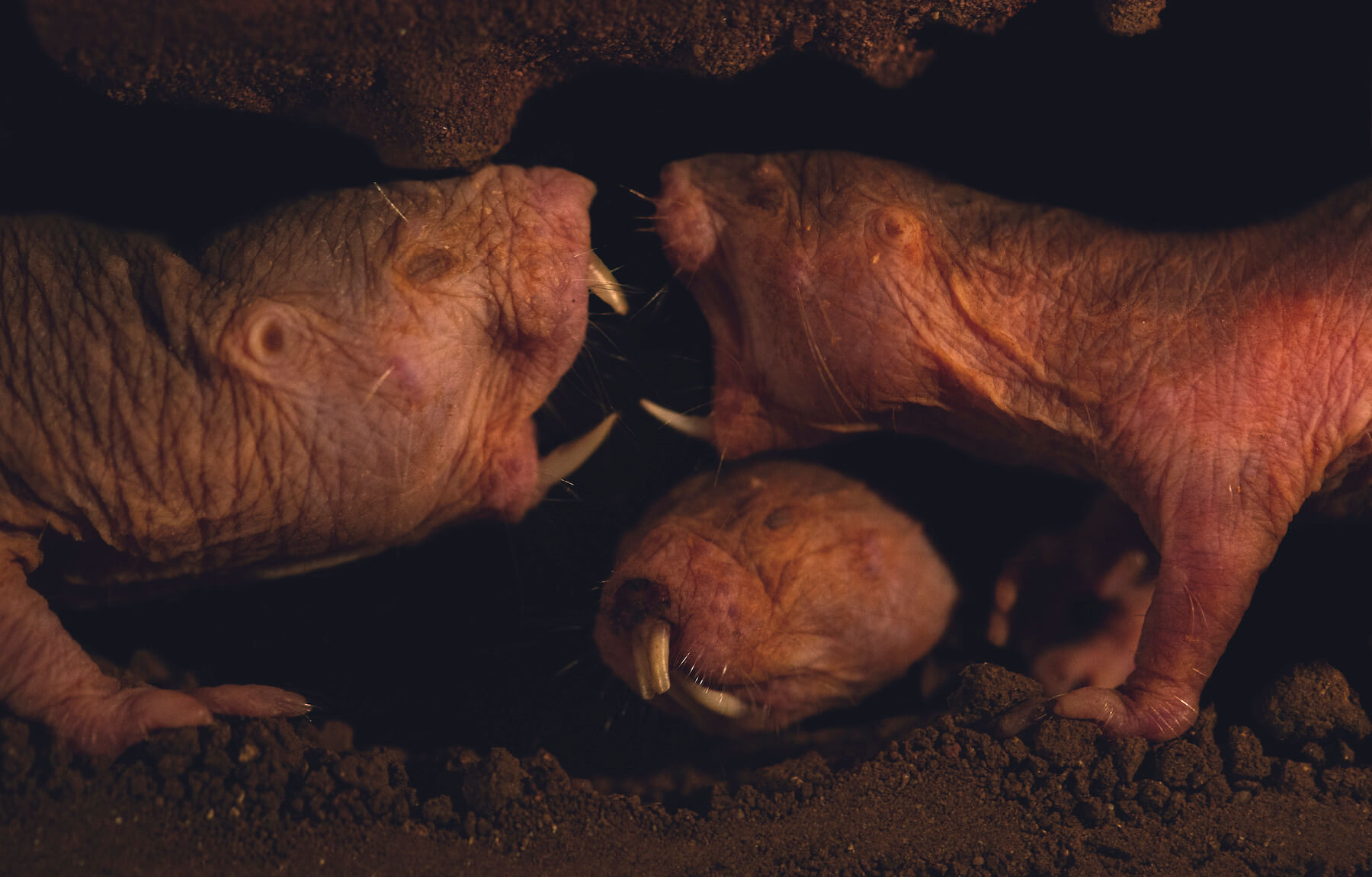
A new study explores the molecular traces of age in the long-lived naked mole rat. Here, naked mole rats engage in characteristic “open mouthed gaping” during an encounter in a tunnel of their burrow system. This behavior is often associated with contests over dominance within their social hierarchy.
Thank you! Your submission has been received!
Oops! Something went wrong while submitting the form.

in this article

table of contents will display on published page only
set h2 to populate the table of contents here

authors

Rachel Tompa
Senior Editor

Naked mole rats are freaking weird.

These hairless, wrinkly, bucktoothed rodents hail from East Africa, where they live in insect-like underground colonies of 100 or more animals headed by a single reproducing queen mole rat. They can survive without oxygen for a full 18 minutes. They can run backward just as quickly as they can run forward — imagine you’re a snake, diving into an underground tunnel for a tasty rodent snack, only to see a pink, fanged face zooming away from you into the dark.

“They just draw you in; they’re obviously really, really cute,” said Chris Faulkes, Ph.D., a biologist at the Queen Mary University of London who’s been studying the bizarre social dynamics of the naked mole rat for decades.

His colleague, UCLA aging researcher and Allen Distinguished Investigator Steve Horvath, Ph.D., interrupted: “I hope that’s sarcasm — they’re quite ugly!”

While naked mole rats may enter the world looking like wrinkled old men, the similarity ends there. Perhaps the weirdest thing about naked mole rats is that they don’t seem to age, at least not in the way we understand aging. They live very long lives — the oldest known naked mole rat in captivity is now pushing 40, whereas most rodents live on the order of 2-5 years. They are remarkably resistant to age-related diseases, including cancer and heart disease. And there are reports that old naked mole rats aren’t any more prone to dying than younger animals, a finding that seems to defy natural laws of mortality.

Given that they appear impervious to the ravages of age, scientists weren’t sure whether they could find any form of biological aging in the rodents. A new study, published today in the journal Nature Aging, shows that, indeed, they can: Naked mole rats’ DNA reveals their age through special molecular marks known as an “epigenetic clock.”

With funding from his 2017 Allen Distinguished Investigator award, Horvath developed clocks that accurately predict the age of more than 325 different species of mammals, including humans and naked mole rats. The epigenetic clocks track a small modification on animals’ DNA known as methylation, a chemical signature that changes in predictable ways as we age.

“I was really hoping that this would be the one rodent where we cannot measure age,” said Horvath, who led the study together with Faulkes and University of Rochester biologist Vera Gorbunova, Ph.D. But by carefully analyzing naked mole rats’ blood and several other tissues, the scientists were able to develop seven different molecular clocks that accurately track the rodents’ age — two of these clocks even work on humans too. The clocks also showed that queens age even more slowly than the average naked mole rat. The researchers hope they and others in the community could use these tools to better understand how the animals age in the wild, and what underlies their incredibly long lifespans.

The secrets of old age

Naked mole rats’ longevity was discovered relatively recently, in the late 1990s, when scientists studying them in the lab noticed that the animals just… kept living. Those findings drew the attention of aging researchers like Gorbunova, who wants to understand the naked mole rat’s secret in the hopes of applying it to humans.

It turns out that humans are also exceptionally long-lived, compared to your average mammal. There are a few other outliers with us — elephants and some species of bats are exceptionally long-lived, for example. But unlike naked mole rats, the rest of us are prone to age-related diseases and conditions as we reach the tail end of our lives.

“Naked mole rats are a model of healthy aging,” Gorbunova said. She and her laboratory team have found one possible explanation behind the rodents’ exceptional health: a sticky molecule known as hyaluronic acid which the mole rats produce in abundance. The molecule seems to have anti-tumor activity and is also a popular ingredient in skincare products, for those who wish to emulate naked mole rats’ exceptionally soft skin.

Whether the naked mole rat harbors additional molecular tricks to healthy aging remains to be seen. The scientists hope the new molecular clock will enable field researchers to better study the rodent’s aging in its natural habitat. It’s possible that the mole rat is so long-lived that scientists simply haven’t captured the full range of its natural lifespan, Horvath said. And while it might seem counterintuitive that an animal that appears not to age in the traditional sense still shows age-related changes on its DNA, Horvath thinks these marks could reflect protection from old age rather than signs of decrepitude.

“A totally different perspective would be that the reason the naked mole rat lives so long is because its epigenome is well-protected,” he said. And that could explain why some of the molecular clocks work for both naked mole rats and humans, even though our genomes are so different. “It may be that the same protective mechanism is active in both species,” Horvath said.

Rachel Tompa is Senior Writer at the Allen Institute. She covers news from all scientific divisions at the Institute. Get in touch at rachelt@alleninstitute.org.

Citations
No items found.

about the allen institute

The Allen Institute is an independent, 501(c)(3) nonprofit research organization founded by philanthropist and visionary, the late Paul G. Allen. The Allen Institute is dedicated to answering some of the biggest questions in bioscience and accelerating research worldwide. The Institute is a recognized leader in large-scale research with a commitment to an open science model. For more information, visit alleninstitute.org.


related news

all news
No articles for the category
we acceleratedevelopcatalyzeimpact

science done differently. shared with the world.

explore our accelerators

brain science

Mapping every cell, connection, and circuit in the brain—openly shared with the world.

cell science

Decoding how cells become tissues, then programming that knowledge into powerful new research tools.

neural dynamics

Revealing the brain's hidden algorithms that transform neural activity into real-world behavior.

immunology

Creating the deepest open reference for the healthy human immune system ever built.

synthetic biology

Engineering cells to record their own histories, transforming how we understand disease over time.

research

Big questions, open answers, and science built to be shared.

education

Inspiring the next generation of scientists through open science resources.

impact

Our science is empowering researchers and advancing health worldwide.
advancing science through open, collaborative research
Get the allen institute newsletter
Stay informed on the latest breakthroughs in neuroscience, bioscience, and AI-driven research.
allen institute
impactpeople & teamscareers & opportunitiesalumnihistory & founder
science resources
allencell.orgallenimmunology.orgallenneuraldynamics.orgbrain-bican.orgbrain-map.orgmicrons-explorer.org
research
brain sciencecell scienceneural dynamicsimmunologysynthetic biologypublications
education
science educationfield tripsprofessional developmenteducation resources
quick links
newseventsopen sciencepodcastscience resourceshuman brain donationvisit uscontact
follow us/

allen institute, 615 Westlake Ave North, Seattle, WA 98109 +12065487055

© 0000 allen institute. all rights reserved.
privacy policyterms of usecitation policyemployee portalpolicy & compliance


