impact
about
our story
explore our impact
careers and opportunities
join us
open science
sharing science to speed discovery
open science week
celebrating open science
team science
people & teams
discovery is a team effort
allenites
the people who make our work possible
advisors
their input shapes our science
board of directors
they help us fulfill our mission
shanahan foundation fellowship
at the interface of data and neuroscience
next generation leaders
fostering emerging leaders in bioscience
research
overview
our approach
science at the scale of greatest impact
publications
explore our publications
open science
sharing science to speed discovery
science accelerators
brain science
building a blueprint of the brain
cell science
understanding how cells become organs
neural dynamics
revealing the brain’s hidden algorithms
immunology
creating the ultimate immune system reference
synthetic biology
seattle hub for synthetic biology
education
overview
science education
science is for everyone
open science
sharing science speeds discovery
engagement
education resources
real science. real skills.
field trips
experience science where it happens
educator development
empowering educators
news
overview
all news
explore the latest news
podcast
the human stories behind discovery
sign up for our newsletter
stay connected to our science
events
overview
all events
public engagement, workshops, seminars and more
conferences
connect with us
science resources
science resources
allencell.org
allenimmunology.org
allenneuraldynamics.org
brain-bican.org
brain-map.org
microns-explorer.org
impact
back to menu
team science
our story
explore our impact
careers and opportunities
join us
open science
sharing science to speed discovery
open science week
celebrating open science
team science
people & teams
discovery is a team effort
allenites
the people who make our work possible
advisors
their input shapes our science
board of directors
they help us fulfill our mission
shanahan foundation fellowship
at the interface of data and neuroscience
next generation leaders
fostering emerging leaders in bioscience
research
back to menu
overview
our approach
science at the scale of greatest impact
publications
explore our publications
open science
sharing science to speed discovery
science accelerators
brain science
building a blueprint of the brain
cell science
understanding how cells become organs
neural dynamics
revealing the brain’s hidden algorithms
immunology
creating the ultimate immune system reference
synthetic biology
seattle hub for synthetic biology
education
back to menu
overview
science education
science is for everyone
open science
sharing science speeds discovery
engagement
education resources
real science. real skills.
field trips
experience science where it happens
educator development
empowering educators
news
back to menu
overview
all news
explore the latest news
podcast
the human stories behind discovery
newsletter
stay connected to our science
events
back to menu
overview
all events
public engagement, workshops, seminars and more
conferences
connect with us
science resources
back to menu
science resources
allencell.org
allenimmunology.org
allenneuraldynamics.org
brain-bican.org
brain-map.org
microns-explorer.org
search
news

New grants to study the aging brain and build better tools to access brain cells

NIH funding will support an atlas of aging mouse brain cell types and a toolkit to light up specific brain cell types

October 8, 2019
 min read
share/
Allen Institute scientists have received new grants to investigate how the brain changes with age and to develop improved technologies for accessing and studying specific brain cell types.
Thank you! Your submission has been received!
Oops! Something went wrong while submitting the form.

in this article

table of contents will display on published page only
set h2 to populate the table of contents here
Red and brown glowing crab viewed from above against a black background.

Allen Institute researchers are embarking on two new projects to better understand the building blocks of the mammalian brain, its cell types.

Funded by the National Institutes of Health, the projects will advance our knowledge of how our brains age and build a suite of new tools to label brain cell types.

Both studies will lay the groundwork for the scientific community to better understand the brain in health and disease, the lead researchers say. Many human brain diseases are associated with or accelerated by old age, such as Alzheimer’s and Parkinson’s diseases, but scientists don’t understand the cellular-level details of how the brain changes in normal aging or in diseases. The new tools will accelerate and refine studies of brain cells, reducing the number of animals needed for experiments and enabling researchers anywhere in the world to follow a “recipe book” to study specific cell types in the mouse brain.

The aging brain

The research team studying the aging brain will generate a complete atlas of brain cell types from the elderly mouse. Researchers at the Allen Institute and around the world are already developing similar atlases from young adult animals, as well as from human and non-human primate brains, through the NIH’s BRAIN Initiative Cell Census Network, but nobody has yet tackled such a census to describe brain aging at the single-cell level.

Understanding how brain cell types change with age is critical to understanding the biology behind our own brain aging, said Hongkui Zeng, Ph.D., Executive Director of Structured Science at the Allen Institute for Brain Science, a division of the Allen Institute, who is leading the aging project.

“Neurodegenerative diseases, such as Alzheimer’s and Parkinson’s, are increasingly prevalent in modern society,” Zeng said. “So many cognitive functions of the brain change with age, but we don’t know how these changes are reflected at brain cell level; that hasn’t been studied. We need foundational studies in animal models to tease out specific age-related changes in the mammalian brain.”

The project, which is funded by the National Institute on Aging of the NIH at $5.9M over five years, will look at cell types across the entire mouse brain, and zero in on areas of the brain most vulnerable to aging or age-related diseases for more detailed analyses. The team will study 18-month old mice, which are roughly equivalent to humans in their 60s. Mice exhibit cognitive decline with age just as we do, Zeng said, losing their capacity to learn and remember as they age.

A recipe book to light up cells in the brain

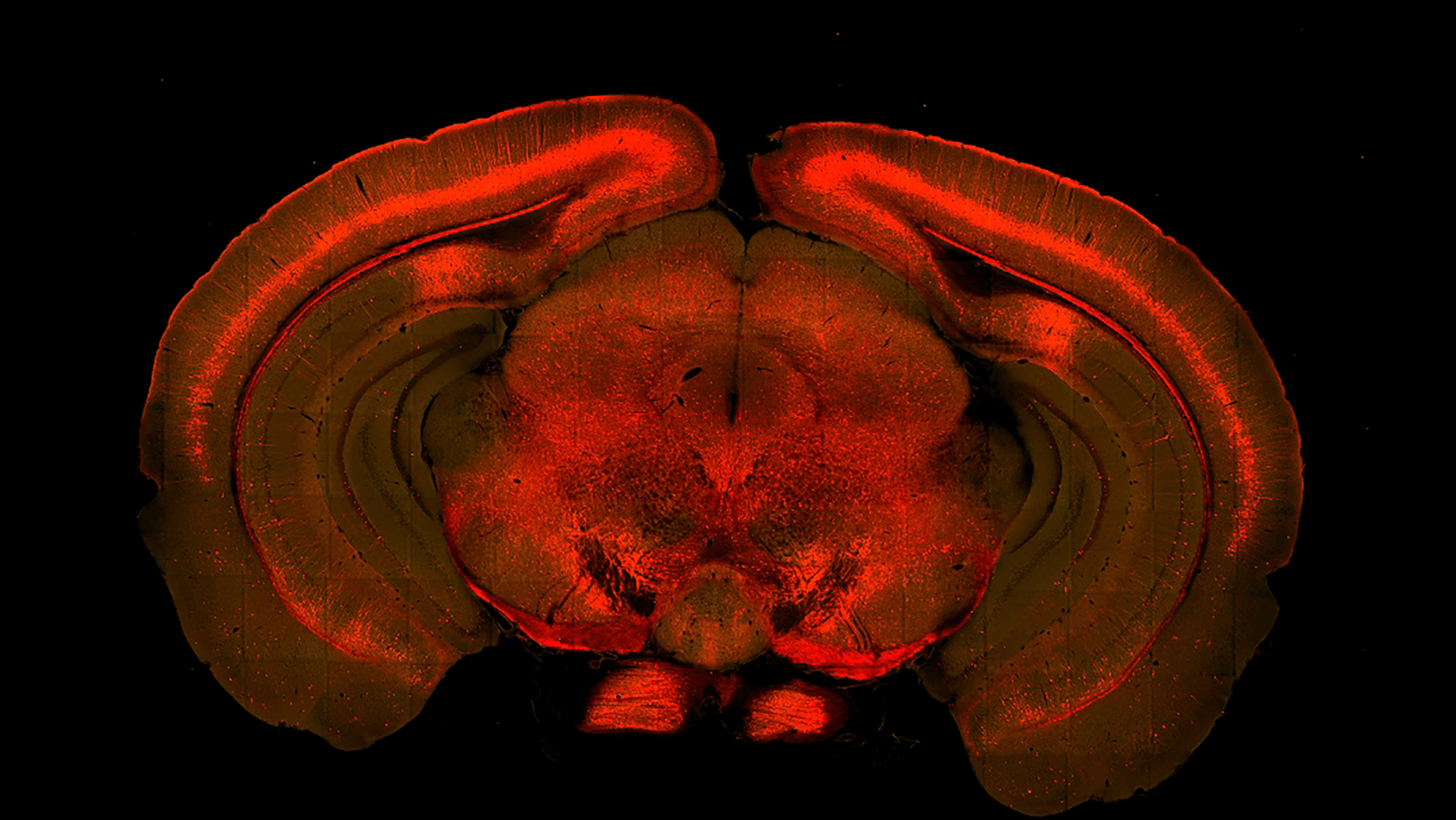
Viral tools developed by Allen Institute for Brain Science researchers cause specific brain cells to glow under fluorescence microscopes.

Another Allen Institute team is building hundreds of new tools to light up brain cells in glowing colors. This technique relies on a modified virus that targets and harmlessly infects brain cells in the mouse, bringing with it a genetic payload that will cause only one brain cell type to glow under the microscope, letting researchers pick out one cell type among a sea of gray matter in the mouse brain.

For neuroscientists who want to study specific kinds of cells in the brain, being able to see where it is and what it looks like is a key first step to understanding what that particular cell does — and how it might change in disease. Bosiljka Tasic, Ph.D., Associate Director of Molecular Genetics at the Allen Institute for Brain Science, is leading a team that will engineer and test 300 of these modified viruses, each to target a different brain cell type.

Tasic and her colleagues have already shown the technique works, testing it on a few cell types. Through the three-year project funded by the National Institute of Mental Health of the NIH at $2.6M, they hope to generate and publicly share a “recipe book” for labeling hundreds of different brain cell types, recipes that any researcher in the world can follow to use the technique in their own lab.

Research reported in this publication was supported by the National Institute On Aging of the National Institutes of Health under Award Number R01AG066027, and by the National Institute Of Mental Health of the National Institutes of Health under Award Number RF1MH121274. The content is solely the responsibility of the authors and does not necessarily represent the official views of the National Institutes of Health.

Citations
No items found.

about the allen institute

The Allen Institute is an independent, 501(c)(3) nonprofit research organization founded by philanthropist and visionary, the late Paul G. Allen. The Allen Institute is dedicated to answering some of the biggest questions in bioscience and accelerating research worldwide. The Institute is a recognized leader in large-scale research with a commitment to an open science model. For more information, visit alleninstitute.org.


related news

all news
No articles for the category
we acceleratedevelopcatalyzeimpact

science done differently. shared with the world.

explore our accelerators

brain science

Mapping every cell, connection, and circuit in the brain—openly shared with the world.

cell science

Decoding how cells become tissues, then programming that knowledge into powerful new research tools.

neural dynamics

Revealing the brain's hidden algorithms that transform neural activity into real-world behavior.

immunology

Creating the deepest open reference for the healthy human immune system ever built.

synthetic biology

Engineering cells to record their own histories, transforming how we understand disease over time.

research

Big questions, open answers, and science built to be shared.

education

Inspiring the next generation of scientists through open science resources.

impact

Our science is empowering researchers and advancing health worldwide.
advancing science through open, collaborative research
Get the allen institute newsletter
Stay informed on the latest breakthroughs in neuroscience, bioscience, and AI-driven research.
allen institute
impactpeople & teamscareers & opportunitiesalumnihistory & founder
science resources
allencell.orgallenimmunology.orgallenneuraldynamics.orgbrain-bican.orgbrain-map.orgmicrons-explorer.org
research
brain sciencecell scienceneural dynamicsimmunologysynthetic biologypublications
education
science educationfield tripsprofessional developmenteducation resources
quick links
newseventsopen sciencepodcastscience resourceshuman brain donationvisit uscontact
follow us/

allen institute, 615 Westlake Ave North, Seattle, WA 98109 +12065487055

© 0000 allen institute. all rights reserved.
privacy policyterms of usecitation policyemployee portalpolicy & compliance


