
impact
about
our story
explore our impact
careers and opportunities
join us
open science
sharing science to speed discovery
open science week
celebrating open science
team science
people & teams
discovery is a team effort
allenites
the people who make our work possible
advisors
their input shapes our science
board of directors
they help us fulfill our mission
shanahan foundation fellowship
at the interface of data and neuroscience
next generation leaders
fostering emerging leaders in bioscience
research
overview
our approach
science at the scale of greatest impact
publications
explore our publications
open science
sharing science to speed discovery
science accelerators
brain science
building a blueprint of the brain
cell science
understanding how cells become organs
neural dynamics
revealing the brain’s hidden algorithms
immunology
creating the ultimate immune system reference
synthetic biology
seattle hub for synthetic biology
education
overview
science education
science is for everyone
open science
sharing science speeds discovery
engagement
education resources
real science. real skills.
field trips
experience science where it happens
educator development
empowering educators
news
overview
all news
explore the latest news
podcast
the human stories behind discovery
sign up for our newsletter
stay connected to our science
events
overview
all events
public engagement, workshops, seminars and more
conferences
connect with us
science resources
science resources
allencell.org
allenimmunology.org
allenneuraldynamics.org
brain-bican.org
brain-map.org
microns-explorer.org
impact
back to menu
team science
our story
explore our impact
careers and opportunities
join us
open science
sharing science to speed discovery
open science week
celebrating open science
team science
people & teams
discovery is a team effort
allenites
the people who make our work possible
advisors
their input shapes our science
board of directors
they help us fulfill our mission
shanahan foundation fellowship
at the interface of data and neuroscience
next generation leaders
fostering emerging leaders in bioscience
research
back to menu
overview
our approach
science at the scale of greatest impact
publications
explore our publications
open science
sharing science to speed discovery
science accelerators
brain science
building a blueprint of the brain
cell science
understanding how cells become organs
neural dynamics
revealing the brain’s hidden algorithms
immunology
creating the ultimate immune system reference
synthetic biology
seattle hub for synthetic biology
education
back to menu
overview
science education
science is for everyone
open science
sharing science speeds discovery
engagement
education resources
real science. real skills.
field trips
experience science where it happens
educator development
empowering educators
news
back to menu
overview
all news
explore the latest news
podcast
the human stories behind discovery
newsletter
stay connected to our science
events
back to menu
overview
all events
public engagement, workshops, seminars and more
conferences
connect with us
science resources
back to menu
science resources
allencell.org
allenimmunology.org
allenneuraldynamics.org
brain-bican.org
brain-map.org
microns-explorer.org
search
news

New research reveals how location influences how our immune system fights disease

Findings could pave the way for improved immunotherapies and vaccines.

January 22, 2025
 min read
share/
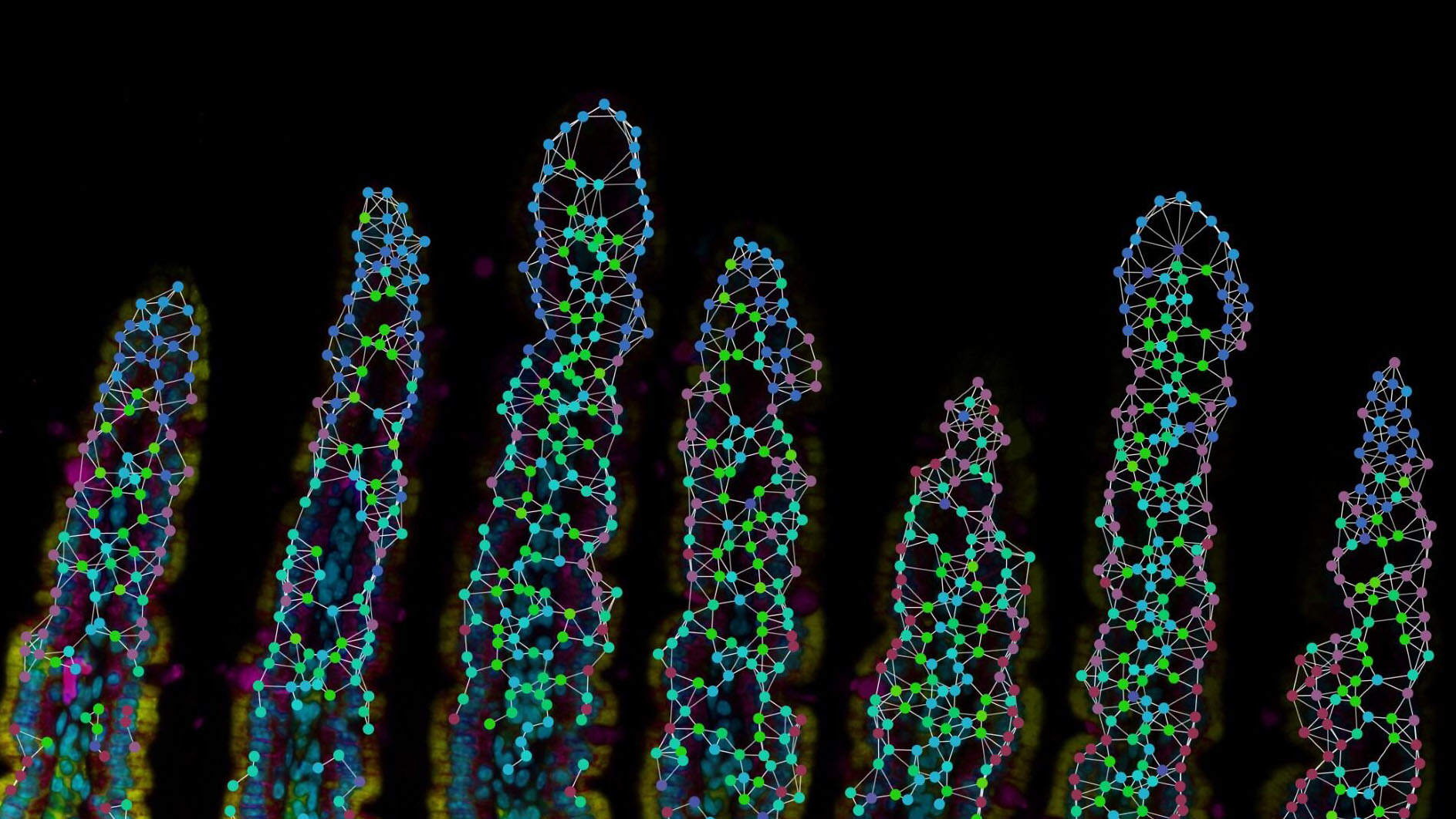
Villi of the small mouse intestine. The dots and lines represent cellular networks. (Photo credit: Elena Lin, UCSD)
Findings could pave the way for improved immunotherapies and vaccines.
Thank you! Your submission has been received!
Oops! Something went wrong while submitting the form.

in this article

table of contents will display on published page only
set h2 to populate the table of contents here

authors

Liz Dueweke
Communications and Media Relations Specialist

The human immune system is like an army of specialized soldiers (immune cells) each with a unique role to play in fighting disease. In a new study published in Nature, led by scientists at the Allen Institute, La Jolla Institute for Immunology, and UC San Diego, researchers reveal how cells known as tissue-resident memory CD8 T cells, play unique and specialized roles based on where they are located within the small intestine. Tissue-resident memory cells provide a local first line of defense against re-infection and call for “backup” from other immune cells and are also critical for maintaining peace in a tissue exposed to many outside pathogens.

This new knowledge of how the immune system works in tissues is game changing as we explore how to enhance immune protection while avoiding damaging inflammation

Ananda Goldrath, Ph.D., Executive Vice President of the Allen Institute for Immunology

This discovery sheds light on how tissue-resident memory CD8 T cells adapt to their location in the body, ensuring a coordinated and effective immune response and how microenvironments and cellular interactions shape this location-specific adaptation. Ultimately, location matters, and this understanding could also lead to improved immunotherapy and vaccines.

Specialized Roles Based on Location

The study shows that tissue-resident memory CD8 T cells in the small intestine are diverse with distinct responsibilities, and their position inside the gut’s architecture dictates what they do.

  1. The frontline: At the villus tips, a subset of tissue-resident memory CD8 T cells with a higher killing capacity are positioned like guards in watchtowers. These cells are designed to attack invading pathogens immediately, preventing infections from spreading further.
  2. Reinforcements: In a pocket of cells called the crypts, a different subset of tissue-resident memory CD8 T cells, which act as reserve forces, stand ready to respond should the body encounter the same pathogen in the future. These cells provide long-lasting immunity.

“What really struck me is that we have been able to see that immune cells in distinct locations have these special functions,” said Maximilian Heeg, M.D., one of the study’s lead co-authors and investigator at the Allen Institute. “They’re strategically positioned in the small intestine to fulfill their function, and this is the key finding from the paper.”

These differences ensure the immune system can react quickly to immediate threats while simultaneously maintaining a backup defense for long term protection.

“In response to infection, immune cells stream into tissues to fight infection and help repair damage. Importantly, these cells ‘talk to’ the tissue cells to coordinate the immune response. In this study, we can now visualize how the functional state of an immune cell relates to which cells and signals are found in different neighborhoods or regions of the tissues. This new knowledge of how the immune system works in tissues is game changing as we explore how to enhance immune protection while avoiding damaging inflammation,” said Ananda W. Goldrath, Ph.D., executive vice president of the Allen Institute for Immunology.

Understanding Microenvironments and Cellular Interactions

Using advanced transcriptional profiling techniques, the researchers mapped the genetic instructions that instruct the behavior of tissue-resident memory CD8 T cells based on their location.

“I am most excited about the possibilities our new approaches bring: Studying immune cells in their unperturbed natural environments at high plex, throughput and resolution,” said Miguel Reina-Campos, Ph.D., study co-author and assistant professor at La Jolla Institute for Immunology.

The findings provide insight for designing better immunotherapies and vaccines. By targeting the mechanisms that direct tissue-resident memory CD8 T cells to specific sites inside a tissue and enhance their capabilities, researchers hope to develop treatments to boost the immune system’s effectiveness and keep us healthy.

“One part of this work was discovering causal relationships between well-characterized genes and CD8 T cell spatial and transcriptional phenotypes,” said study co-first author Alex Monell, a UC San Diego graduate student working with Goldrath. “We are expanding our CRISPR pooled spatial screening to profile the impacts of many types of genetic perturbations at once within CD8 T cells with an overarching goal of finding and manipulating modulatory mechanisms of tissue-specific immunity.”

Future Research Goals

‍
This work highlights the importance of anatomical niches in shaping immune responses and establishes a framework for studying how immune cells interact with their environment. It presents new approaches in treating chronic diseases, infections, and inflammatory disorders by leveraging the unique dynamics of tissue-resident memory immune cells in barrier tissues.

Moving forward, the group is focused on understanding how this knowledge can be used to therapeutically target our immune responses.

Citations
No items found.

about the allen institute

The Allen Institute is an independent, 501(c)(3) nonprofit research organization founded by philanthropist and visionary, the late Paul G. Allen. The Allen Institute is dedicated to answering some of the biggest questions in bioscience and accelerating research worldwide. The Institute is a recognized leader in large-scale research with a commitment to an open science model. For more information, visit alleninstitute.org.


related news

all news
No articles for the category
we acceleratedevelopcatalyzeimpact

science done differently. shared with the world.

explore our accelerators

brain science

Mapping every cell, connection, and circuit in the brain—openly shared with the world.

cell science

Decoding how cells become tissues, then programming that knowledge into powerful new research tools.

neural dynamics

Revealing the brain's hidden algorithms that transform neural activity into real-world behavior.

immunology

Creating the deepest open reference for the healthy human immune system ever built.

synthetic biology

Engineering cells to record their own histories, transforming how we understand disease over time.

research

Big questions, open answers, and science built to be shared.

education

Inspiring the next generation of scientists through open science resources.

impact

Our science is empowering researchers and advancing health worldwide.
advancing science through open, collaborative research
Get the allen institute newsletter
Stay informed on the latest breakthroughs in neuroscience, bioscience, and AI-driven research.
allen institute
impactpeople & teamscareers & opportunitiesalumnihistory & founder
science resources
allencell.orgallenimmunology.orgallenneuraldynamics.orgbrain-bican.orgbrain-map.orgmicrons-explorer.org
research
brain sciencecell scienceneural dynamicsimmunologysynthetic biologypublications
education
science educationfield tripsprofessional developmenteducation resources
quick links
newseventsopen sciencepodcastscience resourceshuman brain donationvisit uscontact
follow us/

allen institute, 615 Westlake Ave North, Seattle, WA 98109 +12065487055

© 0000 allen institute. all rights reserved.
privacy policyterms of usecitation policyemployee portalpolicy & compliance


