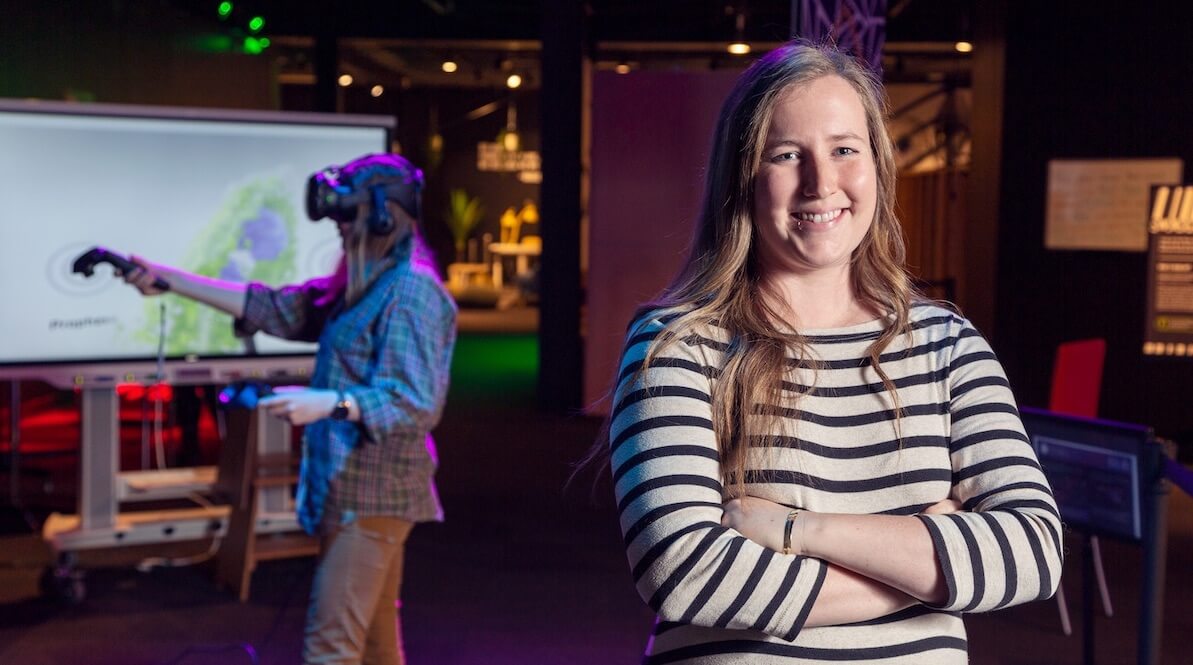

If you slip on a virtual reality headset to play the Allen Institute for Cell Science’s latest app, you’ll find yourself inside a simulated, circular room with targets on the walls all around you. Several 3D, watermelon-sized human cells fall from the sky and land at your feet, jostling gently to find their place on the ground.
In the VR game, users learn the different stages of cell division, or mitosis, by picking up the cells and pitching them at the correctly labeled target on the wall.
In mitosis, cells go through visually distinct stages as they carry out the complicated steps of turning one cell into two daughter cells. The goal of the game is to find and sort five different stages in the pile of cells at your feet by tossing them at the right targets as a virtual clock ticks on the wall.
The first app that game developer Blair Lyons created for the Allen Institute didn’t involve throwing cells. Lyons and the rest of the Animated Cell team wanted a new way for users to interact with the Allen Institute for Cell Science’s 3D images and models of human stem cells.
“The data is really hard to appreciate in 2D,” Lyons said.
They put together a quick VR app that allowed users to pick up and hold 3D models of the cells to intuitively rotate them or zoom in and out to see highlighted structures inside the cells. The targets and the cell tossing, added in the second iteration, layered a game element on top of the cell exploration to increase engagement for broader audiences. What Lyons and her colleagues made is almost like 3D versions of flash cards, she said. Rather than the traditional classroom mode of learning cell division by memorizing a linear sequence of events, the game allows users to learn the stages more actively by sorting the cells themselves – with a bonus of showing them what real cells look like in the process, rather than textbook cartoons.
“In the game, you’re shuffling everything up and trying to match it again, and I think that helps people retain information better,” Lyons said.
The game — provisionally named miTOSSis — first debuted in December at the 2018 American Society for Cell Biology meeting. One of their primary goals was merely to get people engaged in cell biology, and the Allen Institute for Cell Science’s data specifically.
“Across all the fancy platforms like 3D printed models or VR apps, the obvious application is just getting people excited to experience something like cell biology that might be new to them, where they might not otherwise give it the time,” said Graham Johnson, Ph.D., Director of the Animated Cell team at the Allen Institute for Cell Science.
Gaming for education
Exploring Human Cells with VR
Since mid-January, the game has also been part of the regular rotation of VR experiences in Pacific Science Center’s What is Reality exhibit. The Allen Institute team wasn’t targeting children when they first made the game, but they have been approached by a number of educators who want to use the app in their classroom. They’re hoping to eventually develop a mobile version with more self-contained lessons that teachers could use in the classroom without needing to purchase expensive VR equipment.
“I’ve seen a lot of people say they understand cells now better than they ever did in any school biology class,” said Hilary Standish, a lead educator at Pacific Science Center. “I think this could be really powerful for classrooms. Turning things into a game is so much better than just reading about in a textbook, and this is a topic that can be notoriously difficult to engage students on.”
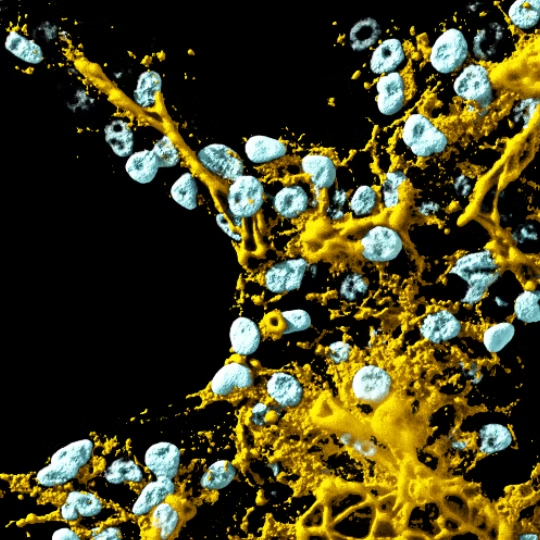
Cell biology teachers have told Allen Institute researchers that their students often need help understanding the difference between a textbook representation of a cell and what cells look like in real life. While illustrations are ideal for teaching specific concepts, it can be difficult to capture and convey the 3D reality of cells and the relationships of their internal structures in a 2D book or even on an interactive computer screen, Johnson said.
“There’s no better way of conveying that digital data is 3D than in a well lit VR world, where it feels like you have an actual physical object with dimensionality that’s taking up space in front of you,” Johnson said. “The fact that even thin cells are three dimensional and packed with internal compartments seems like a simple lesson, but we biologists often take it for granted when describing cells to new learners.”
Even biologists can learn something from the game. The research team did some internal user testing with other Allen Institute scientists before the app was ready to debut at the conference, and it was clear that not everyone knew what the stages of cell division look like in realistic, data-driven models.
“In the short time people played the game, it did seem like even those of us who know the process of mitosis learned something,” said Lisa Schaefbauer, a UX Designer at the Allen Institute for Cell Science who helped develop the app.
It was also fun to see how the researchers interacted with the cells, she said.
“People would try not to step on the cells that looked like they were on the floor,” Schaefbauer said. “Some of our users would pick up each cell and really examine them, almost revering them.”
Down the road, Lyons and her colleagues want to build more extensive VR apps, including some that will immerse the user in the world of a real 3D human cell, with pertinent structures highlighted and explorable to address specific learning goals. Right now, the mitosis game shows cells with their outer membranes and the edges of just one structure inside at a time, such as the mitochondria, the cell’s powerhouse.
“That’s my dream for the future, that you could zoom into a cell and be inside it, seeing all the molecules around you,” Lyons said.
Citations
about the allen institute
The Allen Institute is an independent, 501(c)(3) nonprofit research organization founded by philanthropist and visionary, the late Paul G. Allen. The Allen Institute is dedicated to answering some of the biggest questions in bioscience and accelerating research worldwide. The Institute is a recognized leader in large-scale research with a commitment to an open science model. For more information, visit alleninstitute.org.