in this article

For nearly 15 years, Hongkui Zeng, Ph.D., has been working to decipher the different types of cells that make up the brain.
Now, a major hurdle in this race is in sight. Researchers at the Allen Institute for Brain Science, a division of the Allen Institute which is newly helmed by Zeng as Executive Vice President and Director, together with other neuroscientists around the world, are working their way down a parts list of the entire mouse brain. Once complete, this list of the brain’s component cell types will be the first ever for any mammal.
There are caveats to that list, of course: how the cell types are described and defined, the “completeness” of the list, how comparable the brain of a lab mouse is to any other mammalian brain.
For Zeng, this looming milestone raises at least as many questions as it answers. Some of these questions dovetail with new areas of focus for the Allen Institute for Brain Science in the coming years: Where do brain cell types come from? How do they work together to produce everything the brain can do? How do they go wrong in brain diseases and disorders?
And what about the human brain?
We recently sat down with Zeng to pick her brain about brain science — where she will guide the Allen Institute’s oldest division in its next research phase, what’s next for the field of neuroscience in general, and why she’s so fascinated with the brain’s cellular makeup.
The following conversation has been lightly edited for length and clarity.
Why do you and so many other neuroscientists focus on understanding brain cell types? Why is this important?
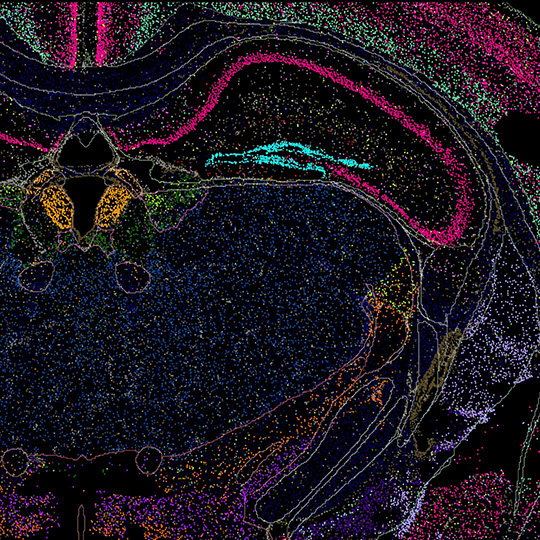
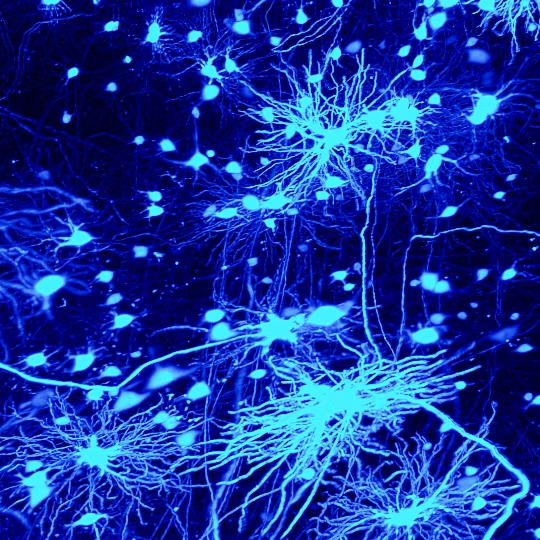
Cells are the units of the brain. To understand the function of the brain, how it processes information and generates behavior, it’s essential to have a foundational knowledge of the parts list of the brain, the cell types, and how those types are interconnected to form circuits.
I like to use the analogy that cells and cell types are like the individuals in our society. If you want to understand how society functions, you need to understand human behavior, how people are different from each other, how they work with each other, and how people interact with each other at individual levels and at the population level. That’s how the network of our society works, and that’s how the brain works.
What’s our current status around defining brain cell types?
Obtaining a complete list of cell types in the mammalian brain has been a major endeavor in the neuroscience field for a century now. It’s a huge challenge, because there are many millions to billions of cells in each brain and these cells have tremendously diverse properties. With the recent advent of high-throughput single-cell technologies, we now have the opportunity to systematically tackle this problem and, for the first time, obtain something close to a comprehensive catalog of cell types, the so-called “periodic table” of the brain. That’s extremely exciting for every neuroscientist.
What are the future areas of focus for the Allen Institute for Brain Science?
We’re going to build on the foundational knowledge that we have already generated about cell types in mouse and human brains to investigate cell-type related questions in evolution, development, connectivity and function. That is, we want to use our knowledge of brain cell types to understand these concepts: how the brains compare among animal species, how the brain develops (and where development goes awry in disease), the wiring diagram of brain circuits, and what different types of cells do in the brain.
We can also think about it by posing big questions we want to answer: How are the different brain cell types made; where do they come from? What do they do, and how do they do it? Are cell types stable, or do they change over time or under certain conditions? Addressing these questions will give us important insights into how the brain works and how it malfunctions in diseases.
Can you talk a bit more about how Allen Institute research will tie into brain diseases and disorders?
The primary goal of our Institute is to provide foundational datasets and resources to facilitate research across the neuroscience community. However, the data that we’re generating will also have some immediate relevance to certain diseases. As we’re looking at normal brain development, that will have close relevance to neurodevelopmental disorders, as I mentioned. And we’re also generating cell-type targeting tools that may have the potential to meet certain therapeutic needs, in terms of repairing genes or circuits in specific genetic brain diseases.
At the other end of the spectrum, we are studying cell type changes in the aging brain, which will be relevant to age-related neurodegenerative diseases. We have a new major effort to study brain cell types in Alzheimer’s disease, and that will continue and can feed into other neurodegenerative diseases as well. We also want to look at addiction to understand how brain circuits are hijacked by or chronically changed by drugs of abuse.
This year saw some structural changes for the Allen Institute’s neuroscience research. Do these changes signal a shift for the division’s research as well?
There is a shift, for the purpose of innovation, but we also want to continue our tradition. We do big science, team science and open science. We take a large-scale, open-ended approach. This is a unique and complimentary approach to the predominantly hypothesis-driven research that’s happening in most of neuroscience. We’ll expand the scientific questions and areas we are working on, but the core mission is the same.
I would say that there is one major shift from our history, though, which is that we’re moving to a research program that’s getting closer and closer to the human brain. Our previous 10-year plan had a major focus on the mouse brain as a model system. We are continuing rodent studies, but we want to both expand our work on the human brain and explore other animal models that are better able to replicate human conditions, including human intelligence, cognition and diseases.
Do you think that’s where the broader field of neuroscience is moving?
Yes, the field really needs that kind of foundational knowledge across multiple mammalian species. People need to see, at the cell-type level, where similarities and differences exist between mouse and human brains, or between the brains of other animals. We need detailed, cell-type by cell-type comparisons — across the entire brain and central nervous system. The devil is in the details. The field needs such information to model human diseases more accurately.
In the course of your career, what are the major changes you’ve seen in the field of neuroscience?
Changes in neuroscience are very much driven by ground-level technology advances. Whenever a new technology emerges, it opens the door for new discoveries. In the recent past, the discovery of a fluorescent protein, GFP, led to transformative technologies allowing us to literally “see” the brain’s structure and its action. Multi-photon microscopy and optogenetics were also major advances. Currently, single-cell genomics technologies are revolutionizing the field, along with machine learning on the computational side.
The other way the field can transform is new theory, new ideas about how brain operates and computes. However, I think those have been relatively few in neuroscience.
Do you think there will ever be a time in neuroscience where more new theories will drive the field?
I hope so. I think new theories may arise out of new data, better data. For example, connectomics could bring transformative theories about brain circuits. It’s already happening in fruit flies, where whole-brain-level wiring diagrams help guide and constrain computational models. These are biologically realistic models, so discoveries from those models are much more likely to be real and predictive of what happens in the living brain. So those could become new theories.
Citations
about the allen institute
The Allen Institute is an independent, 501(c)(3) nonprofit research organization founded by philanthropist and visionary, the late Paul G. Allen. The Allen Institute is dedicated to answering some of the biggest questions in bioscience and accelerating research worldwide. The Institute is a recognized leader in large-scale research with a commitment to an open science model. For more information, visit alleninstitute.org.