impact
about
our story
explore our impact
careers and opportunities
join us
open science
sharing science to speed discovery
open science week
celebrating open science
team science
people & teams
discovery is a team effort
allenites
the people who make our work possible
advisors
their input shapes our science
board of directors
they help us fulfill our mission
shanahan foundation fellowship
at the interface of data and neuroscience
next generation leaders
fostering emerging leaders in bioscience
research
overview
our approach
science at the scale of greatest impact
publications
explore our publications
open science
sharing science to speed discovery
science accelerators
brain science
building a blueprint of the brain
cell science
understanding how cells become organs
neural dynamics
revealing the brain’s hidden algorithms
immunology
creating the ultimate immune system reference
synthetic biology
seattle hub for synthetic biology
education
overview
science education
science is for everyone
open science
sharing science speeds discovery
engagement
education resources
real science. real skills.
field trips
experience science where it happens
educator development
empowering educators
news
overview
all news
explore the latest news
podcast
the human stories behind discovery
sign up for our newsletter
stay connected to our science
events
overview
all events
public engagement, workshops, seminars and more
conferences
connect with us
science resources
science resources
allencell.org
allenimmunology.org
allenneuraldynamics.org
brain-bican.org
brain-map.org
microns-explorer.org
impact
back to menu
team science
our story
explore our impact
careers and opportunities
join us
open science
sharing science to speed discovery
open science week
celebrating open science
team science
people & teams
discovery is a team effort
allenites
the people who make our work possible
advisors
their input shapes our science
board of directors
they help us fulfill our mission
shanahan foundation fellowship
at the interface of data and neuroscience
next generation leaders
fostering emerging leaders in bioscience
research
back to menu
overview
our approach
science at the scale of greatest impact
publications
explore our publications
open science
sharing science to speed discovery
science accelerators
brain science
building a blueprint of the brain
cell science
understanding how cells become organs
neural dynamics
revealing the brain’s hidden algorithms
immunology
creating the ultimate immune system reference
synthetic biology
seattle hub for synthetic biology
education
back to menu
overview
science education
science is for everyone
open science
sharing science speeds discovery
engagement
education resources
real science. real skills.
field trips
experience science where it happens
educator development
empowering educators
news
back to menu
overview
all news
explore the latest news
podcast
the human stories behind discovery
newsletter
stay connected to our science
events
back to menu
overview
all events
public engagement, workshops, seminars and more
conferences
connect with us
science resources
back to menu
science resources
allencell.org
allenimmunology.org
allenneuraldynamics.org
brain-bican.org
brain-map.org
microns-explorer.org
search
news

The neurons that respond to novelty

When mice see unfamiliar images, certain neurons in the visual part of their brains kick into high gear. Scientists think these neurons could be...

February 20, 2020
 min read
share/
When mice see unfamiliar images, certain neurons in the visual part of their brains kick into high gear. Scientists think these neurons could be...
Thank you! Your submission has been received!
Oops! Something went wrong while submitting the form.

in this article

table of contents will display on published page only
set h2 to populate the table of contents here
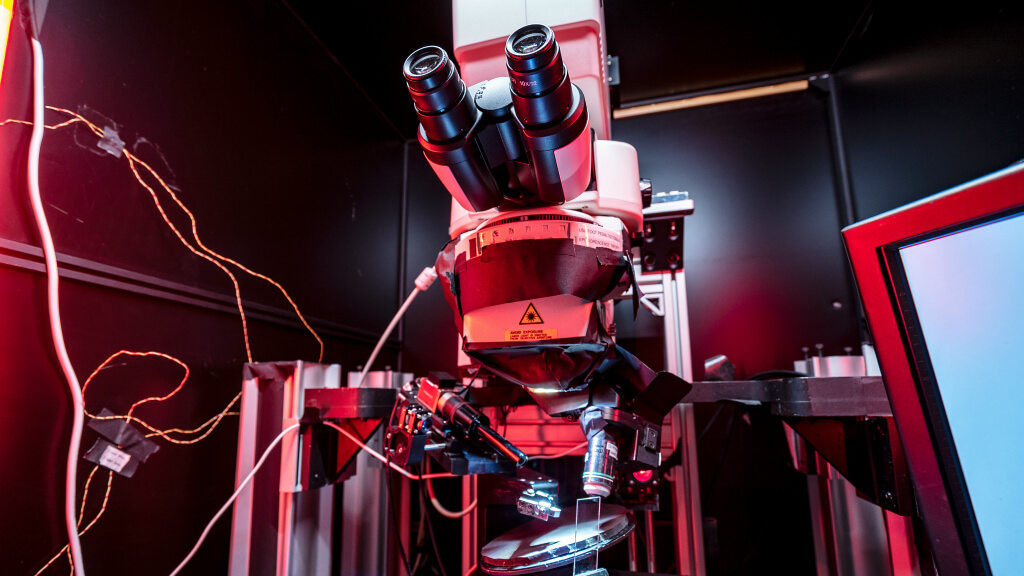
This microscope in the Allen Brain Observatory enables scientists to study live brain activity in mice.

The mice that are part of the Allen Brain Observatory have a difficult task. A series of images flashes in front of their eyes, and the animals must signal when that image changes identity by licking a tiny waterspout dangling in front of them.

“The mouse is effectively playing a video game. It’s seeing images on a screen and making decisions, but instead of clicking a button on a video game controller, it’s licking a little spout,” said Marina Garrett, Ph.D., Assistant Investigator at the Allen Institute for Brain Science, a division of the Allen Institute. “The images are repeated in a sequence that will go something like flower, flower, flower, bear. That’s what they have to detect, the change from flower to bear, and they have to respond very quickly.”

Before the mice are put to the test, the research team trains them on the task. And before that training, the animals were genetically engineered so that certain neurons will glow under a fluorescent microscope when those cells kick into action.

Garrett and her colleagues want to understand which neurons are active, and when they’re active, as the animals learn to perceive the world around them. Recently, they found that a class of neurons, known as VIP interneurons, switch on when the animals see unfamiliar images. The researchers published a study describing the details of these novelty-detecting neurons in the journal eLife Wednesday.

The mice are trained on one series of images (say, the flower-and-bear sequence) and then are tested both with those familiar images and with a second set of new-to-them photos. They have to lick the spout right after the image changes, whether it’s a familiar or a new series, or they don’t get the reward (a drink of water). It’s an artificial set-up — mice didn’t evolve to recognize photos in a video-game-playing context, of course — but the researchers are trying to understand the basic principles of how the brain perceives our environment, and how our neurons’ activity changes during behavior and learning.

“Detection of novelty is critical for an animal’s survival,” said Shawn Olsen, Ph.D., Associate Investigator at the Allen Institute for Brain Science, who led the study along with Garrett. “The most important thing to be aware of in your environment is when something is unexpected.”

From novelty to learning

VIP interneurons are a type of inhibitory neuron, the general class of neurons whose job it is to suppress other neurons’ activity. They sit in the outermost shell of the brain known as the cortex. But VIP interneurons silence other inhibitory neurons, so the cumulative result is more brain activity, not less — the neural equivalent of a double negative.

It’s not completely clear what the end result of all this activity is in the brain, but the researchers hypothesize that VIP interneurons may be gatekeepers of novelty or general importance, pointing other neurons toward the most important thing to focus on.

Think about the brainpower difference between a task you do every day — say, brushing your teeth — and something you’re trying for the first time, like a new hobby. Your brain doesn’t exactly ignore the rote task, but it doesn’t take as much mental effort as something completely novel.

“We think this difference has to do with learning,” Garrett said. “When something’s familiar, you know what to expect. You can rely on your internal predictions and past knowledge. When something’s new, you need to pay more attention to it to learn more about it.”

To test that hypothesis, the researchers are now asking how the VIP interneurons’ activity changes over time. With repeated exposure, at some point the new images will become familiar. What happens in the brain at that tipping point? And do VIP interneurons play a similar role in other parts of the brain?

The current study is the first stage in a much larger Allen Institute project to study how different kinds of visual neurons in different sections of the brain react when mice are performing this task. The larger project should generate enough data to allow the researchers to address these questions more comprehensively and to understand how VIP neurons work together with other cell types, they said.

As for whether human VIP interneurons also recognize novelty, that’s impossible to test in the same way — researchers obviously can’t genetically engineer a human to study their neurons under a microscope. But there’s reason to think the general concept might apply to more than just mice seeing photos, Olsen said.

“I would not be surprised if you saw a similar phenomenon in the mouse auditory system or the part of the brain that senses touch,” he said. “To me, this result is less about mouse vision than it is about the core circuitry of the cortex, which we know is conserved between mice and humans.”

Citations
No items found.

about the allen institute

The Allen Institute is an independent, 501(c)(3) nonprofit research organization founded by philanthropist and visionary, the late Paul G. Allen. The Allen Institute is dedicated to answering some of the biggest questions in bioscience and accelerating research worldwide. The Institute is a recognized leader in large-scale research with a commitment to an open science model. For more information, visit alleninstitute.org.


related news

all news
No articles for the category
we acceleratedevelopcatalyzeimpact

science done differently. shared with the world.

explore our accelerators

brain science

Mapping every cell, connection, and circuit in the brain—openly shared with the world.

cell science

Decoding how cells become tissues, then programming that knowledge into powerful new research tools.

neural dynamics

Revealing the brain's hidden algorithms that transform neural activity into real-world behavior.

immunology

Creating the deepest open reference for the healthy human immune system ever built.

synthetic biology

Engineering cells to record their own histories, transforming how we understand disease over time.

research

Big questions, open answers, and science built to be shared.

education

Inspiring the next generation of scientists through open science resources.

impact

Our science is empowering researchers and advancing health worldwide.
advancing science through open, collaborative research
Get the allen institute newsletter
Stay informed on the latest breakthroughs in neuroscience, bioscience, and AI-driven research.
allen institute
impactpeople & teamscareers & opportunitiesalumnihistory & founder
science resources
allencell.orgallenimmunology.orgallenneuraldynamics.orgbrain-bican.orgbrain-map.orgmicrons-explorer.org
research
brain sciencecell scienceneural dynamicsimmunologysynthetic biologypublications
education
science educationfield tripsprofessional developmenteducation resources
quick links
newseventsopen sciencepodcastscience resourceshuman brain donationvisit uscontact
follow us/

allen institute, 615 Westlake Ave North, Seattle, WA 98109 +12065487055

© 0000 allen institute. all rights reserved.
privacy policyterms of usecitation policyemployee portalpolicy & compliance


