impact
about
our story
explore our impact
careers and opportunities
join us
open science
sharing science to speed discovery
open science week
celebrating open science
team science
people & teams
discovery is a team effort
allenites
the people who make our work possible
advisors
their input shapes our science
board of directors
they help us fulfill our mission
shanahan foundation fellowship
at the interface of data and neuroscience
next generation leaders
fostering emerging leaders in bioscience
research
overview
our approach
science at the scale of greatest impact
publications
explore our publications
open science
sharing science to speed discovery
science accelerators
brain science
building a blueprint of the brain
cell science
understanding how cells become organs
neural dynamics
revealing the brain’s hidden algorithms
immunology
creating the ultimate immune system reference
synthetic biology
seattle hub for synthetic biology
education
overview
science education
science is for everyone
open science
sharing science speeds discovery
engagement
education resources
real science. real skills.
field trips
experience science where it happens
educator development
empowering educators
news
overview
all news
explore the latest news
podcast
the human stories behind discovery
sign up for our newsletter
stay connected to our science
events
overview
all events
public engagement, workshops, seminars and more
conferences
connect with us
science resources
science resources
allencell.org
allenimmunology.org
allenneuraldynamics.org
brain-bican.org
brain-map.org
microns-explorer.org
impact
back to menu
team science
our story
explore our impact
careers and opportunities
join us
open science
sharing science to speed discovery
open science week
celebrating open science
team science
people & teams
discovery is a team effort
allenites
the people who make our work possible
advisors
their input shapes our science
board of directors
they help us fulfill our mission
shanahan foundation fellowship
at the interface of data and neuroscience
next generation leaders
fostering emerging leaders in bioscience
research
back to menu
overview
our approach
science at the scale of greatest impact
publications
explore our publications
open science
sharing science to speed discovery
science accelerators
brain science
building a blueprint of the brain
cell science
understanding how cells become organs
neural dynamics
revealing the brain’s hidden algorithms
immunology
creating the ultimate immune system reference
synthetic biology
seattle hub for synthetic biology
education
back to menu
overview
science education
science is for everyone
open science
sharing science speeds discovery
engagement
education resources
real science. real skills.
field trips
experience science where it happens
educator development
empowering educators
news
back to menu
overview
all news
explore the latest news
podcast
the human stories behind discovery
newsletter
stay connected to our science
events
back to menu
overview
all events
public engagement, workshops, seminars and more
conferences
connect with us
science resources
back to menu
science resources
allencell.org
allenimmunology.org
allenneuraldynamics.org
brain-bican.org
brain-map.org
microns-explorer.org
search
news

These brain cells named for stars contribute to Alzheimer’s

Mouse study reveals many new types of cells known as astrocytes and narrows their role in neurodegenerative disease

November 3, 2022
 min read
share/
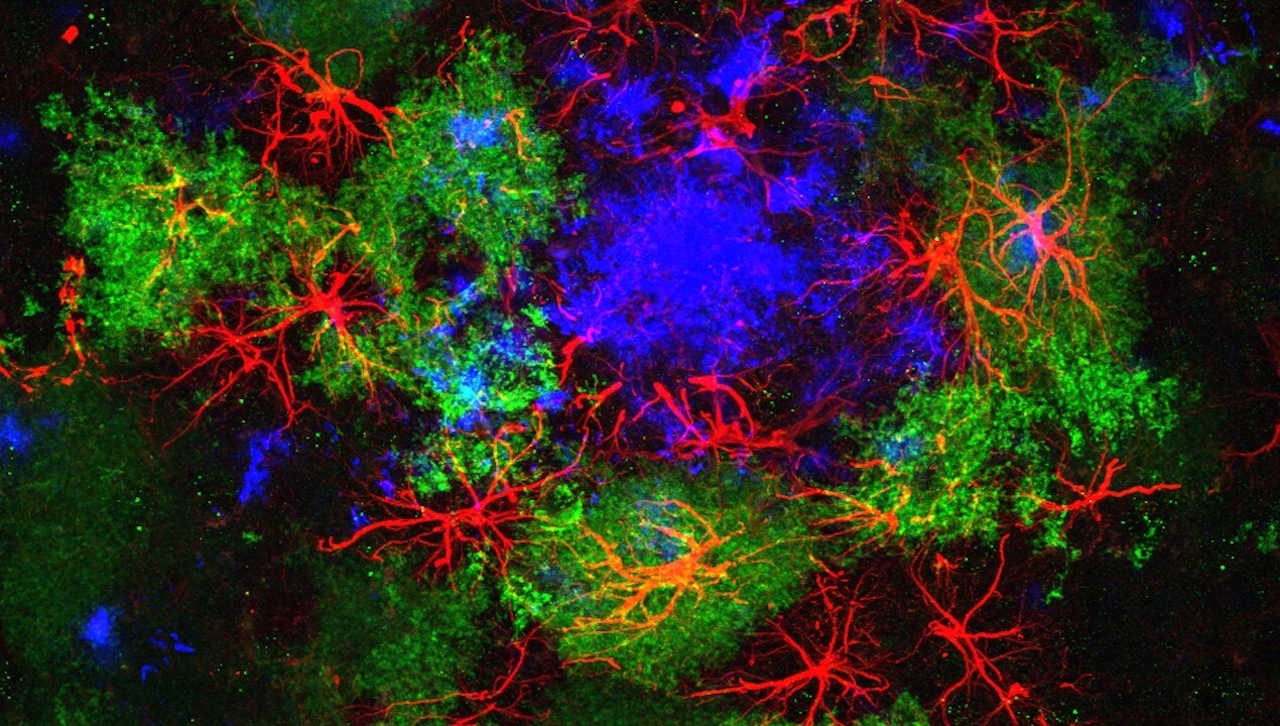
Brain cells named for stars seem to play a role in Alzheimer’s disease, a new study finds. Here, the star-shaped astrocytes shown in red surround an amyloid plaque (blue) in a mouse’s brain. Amyloid plaques are a hallmark of Alzheimer’s. All images courtesy of Baljit Khakh, Ph.D. / UCLA.
Mouse study reveals many new types of cells known as astrocytes and narrows their role in neurodegenerative disease
Thank you! Your submission has been received!
Oops! Something went wrong while submitting the form.

in this article

table of contents will display on published page only
set h2 to populate the table of contents here

Your brain contains multitudes.

The spongy, folded mass is made up of hundreds or thousands of different kinds of cells, many of which remain at least partly a mystery to scientists. The more researchers look, the more they uncover.

Now, a team of neuroscientists from the University of California, Los Angeles, led by Allen Distinguished Investigator Baljit Khakh, Ph.D., has found even more multitudes within one specific class of brain cell, known as astrocytes. These cells, which are smaller than neurons but visually just as complex, were originally discovered more than 150 years ago and named after stars for their radiating, starburst shapes.

Khakh and his colleagues found that not only are there several different types of astrocytes that are specialized for different regions of the brain, but that their very complexity may be important in keeping brains healthy. Khakh and his colleagues published a study describing their results in the journal Science today.
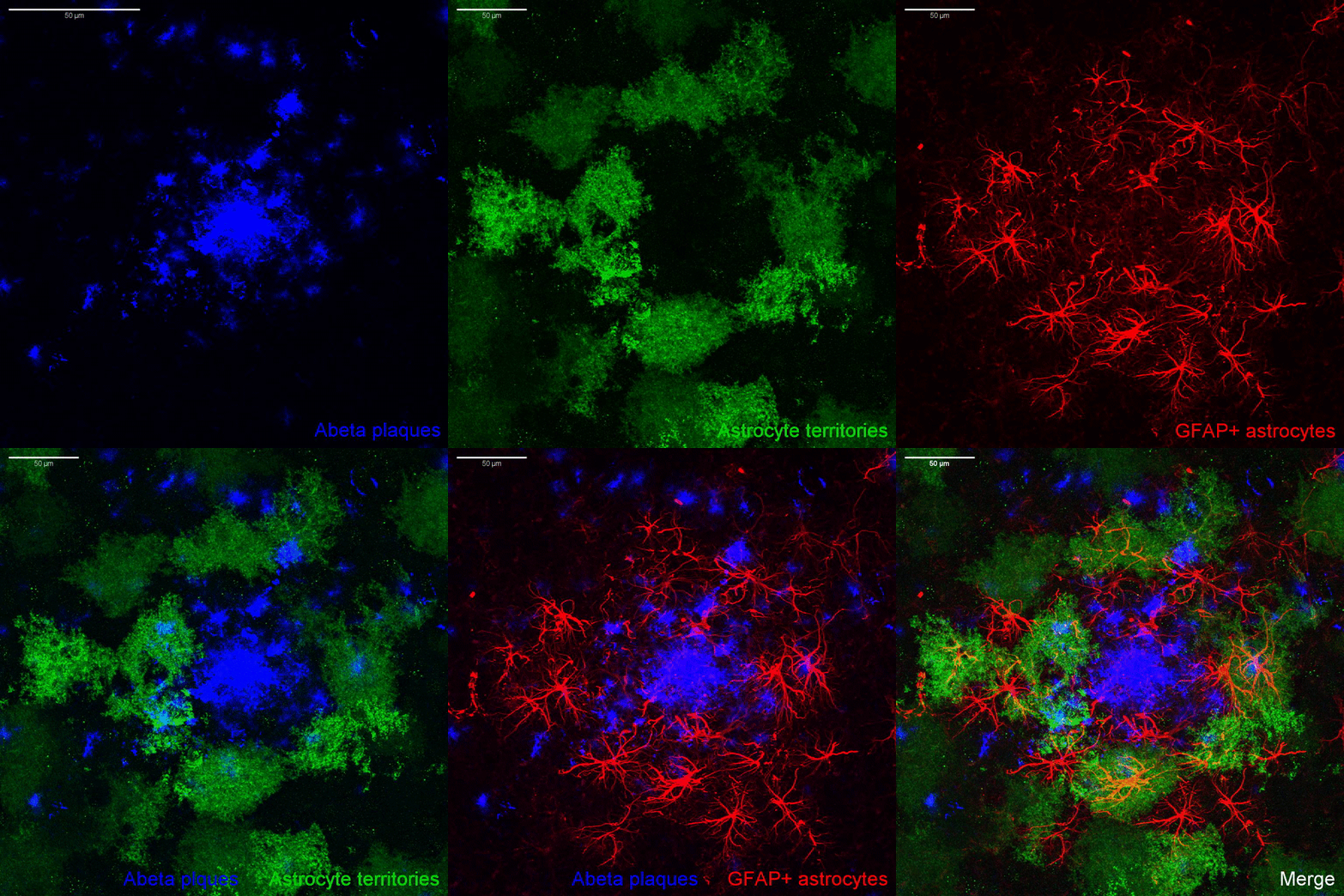
Fluorescent microscopy image showing blue Abeta plaques aggregates on black background with scale bar
This movie highlights the “territories” astrocytes occupy in green, the astrocyte processes themselves in red, and amyloid plaques in blue.

Some of the genes known to be linked with Alzheimer’s disease in humans turn out to underlie astrocytes’ complex, bushy shapes. When the team artificially removed such genes in astrocytes in the laboratory mouse, the astrocytes became visually simpler, and the mice performed more poorly on a memory task. They also found that in a mouse model of Alzheimer’s disease, astrocytes have a simpler, less branching shape.

Scientists have long thought that astrocytes play a role in Alzheimer’s — as well as in many other brain diseases — but this is the first time that their 3D shape, or morphology, has been implicated in the disease. This finding points to a potential avenue for a new kind of Alzheimer’s therapy, Khakh said, one aimed at restoring astrocytes’ normal functions in the brain by attempting to restore their complex shapes.

“If these morphologies get simpler in Alzheimer’s disease, then if we could restore that morphology, this may restore the cells’ normal support functions,” he said.

Maintaining signal fidelity

While all of astrocytes’ jobs are not fully understood, the cells are thought to act as regulators in the brain. They appear to help maintain the brain’s signal fidelity by cleaning up extra signaling molecules at synapses, the specialized connections between neurons. When one neuron sends these molecules to another neuron, the astrocytes form a physical barrier, keeping those chemical signals contained so they only reach their target neuron without accidentally broadcasting that signal farther than intended. If astrocytes were missing, the signaling molecules could diffuse through the brain, potentially activating many other neurons and muddling what was once a precise message.
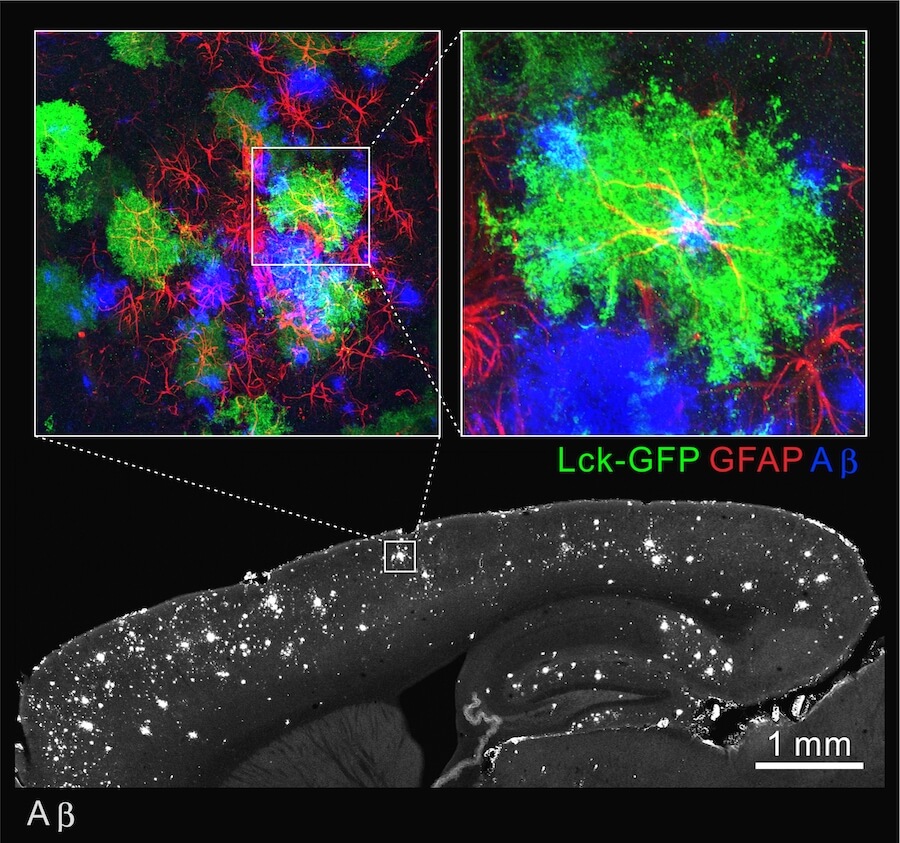
Zooming in on astrocytes interacting with amyloid in the mouse brain.

Despite their complexity and their importance, little was understood about how astrocytes might vary across the brain. Different brain regions carry out different functions and it’s known that types of neurons vary from region to region.

“Historically, astrocytes have been viewed as a universal glue, almost like a homogenous morass of cells that exists everywhere in the brain, but everywhere is the same morass,” Khakh said. “We found that view unsatisfactory, so we decided to test it.”

The team used a method known as transcriptomics that assesses genes switched on in individual astrocytes to categorize them into discrete types, studying cells from 13 different regions of the mouse brain. This technique has been used extensively at the Allen Institute and elsewhere to categorize neurons and other kinds of brain cells into discrete types.

The scientists found that astrocytes from different parts of the brain indeed had different gene signatures. They were able to group the mouse astrocytes, based on the genes the cells switched on, into seven different kinds.

Currently, the scientists are working to understand how Alzheimer’s-risk genes are tied to astrocyte shape complexity. Ideally, they’d identify a molecule involved in astrocyte complexity that could be targeted by new drugs, Khakh said. But because the brain — and its associated diseases — is so complex, it’s unlikely that a single drug targeting astrocytes will work on its own against Alzheimer’s.

“The brain is a highly evolved, complex, multicellular organ. Our exploration of how the brain works must also include a multicellular understanding of how it’s built,” Khakh said. “Complex diseases like Alzheimer’s that affect multiple parts of the brain, and multiple kinds of cells, will likely also require a multi-prong attack.”

‍

Citations
No items found.

about the allen institute

The Allen Institute is an independent, 501(c)(3) nonprofit research organization founded by philanthropist and visionary, the late Paul G. Allen. The Allen Institute is dedicated to answering some of the biggest questions in bioscience and accelerating research worldwide. The Institute is a recognized leader in large-scale research with a commitment to an open science model. For more information, visit alleninstitute.org.
related news

all news
video
Where does Alzheimer's begin?
Pinpointing the cellular roots of Alzheimer's disease to find new targets for treatments and therapies.
we acceleratedevelopcatalyzeimpact

science done differently. shared with the world.

explore our accelerators

brain science

Mapping every cell, connection, and circuit in the brain—openly shared with the world.

cell science

Decoding how cells become tissues, then programming that knowledge into powerful new research tools.

neural dynamics

Revealing the brain's hidden algorithms that transform neural activity into real-world behavior.

immunology

Creating the deepest open reference for the healthy human immune system ever built.

synthetic biology

Engineering cells to record their own histories, transforming how we understand disease over time.

research

Big questions, open answers, and science built to be shared.

education

Inspiring the next generation of scientists through open science resources.

impact

Our science is empowering researchers and advancing health worldwide.
advancing science through open, collaborative research
Get the allen institute newsletter
Stay informed on the latest breakthroughs in neuroscience, bioscience, and AI-driven research.
allen institute
impactpeople & teamscareers & opportunitiesalumnihistory & founder
science resources
allencell.orgallenimmunology.orgallenneuraldynamics.orgbrain-bican.orgbrain-map.orgmicrons-explorer.org
research
brain sciencecell scienceneural dynamicsimmunologysynthetic biologypublications
education
science educationfield tripsprofessional developmenteducation resources
quick links
newseventsopen sciencepodcastscience resourceshuman brain donationvisit uscontact
follow us/

allen institute, 615 Westlake Ave North, Seattle, WA 98109 +12065487055

© 0000 allen institute. all rights reserved.
privacy policyterms of usecitation policyemployee portalpolicy & compliance