impact
about
our story
explore our impact
careers and opportunities
join us
open science
sharing science to speed discovery
open science week
celebrating open science
team science
people & teams
discovery is a team effort
allenites
the people who make our work possible
advisors
their input shapes our science
board of directors
they help us fulfill our mission
shanahan foundation fellowship
at the interface of data and neuroscience
next generation leaders
fostering emerging leaders in bioscience
research
overview
our approach
science at the scale of greatest impact
publications
explore our publications
open science
sharing science to speed discovery
science accelerators
brain science
building a blueprint of the brain
cell science
understanding how cells become organs
neural dynamics
revealing the brain’s hidden algorithms
immunology
creating the ultimate immune system reference
synthetic biology
seattle hub for synthetic biology
education
overview
science education
science is for everyone
open science
sharing science speeds discovery
engagement
education resources
real science. real skills.
field trips
experience science where it happens
educator development
empowering educators
news
overview
all news
explore the latest news
podcast
the human stories behind discovery
sign up for our newsletter
stay connected to our science
events
overview
all events
public engagement, workshops, seminars and more
conferences
connect with us
science resources
science resources
allencell.org
allenimmunology.org
allenneuraldynamics.org
brain-bican.org
brain-map.org
microns-explorer.org
impact
back to menu
team science
our story
explore our impact
careers and opportunities
join us
open science
sharing science to speed discovery
open science week
celebrating open science
team science
people & teams
discovery is a team effort
allenites
the people who make our work possible
advisors
their input shapes our science
board of directors
they help us fulfill our mission
shanahan foundation fellowship
at the interface of data and neuroscience
next generation leaders
fostering emerging leaders in bioscience
research
back to menu
overview
our approach
science at the scale of greatest impact
publications
explore our publications
open science
sharing science to speed discovery
science accelerators
brain science
building a blueprint of the brain
cell science
understanding how cells become organs
neural dynamics
revealing the brain’s hidden algorithms
immunology
creating the ultimate immune system reference
synthetic biology
seattle hub for synthetic biology
education
back to menu
overview
science education
science is for everyone
open science
sharing science speeds discovery
engagement
education resources
real science. real skills.
field trips
experience science where it happens
educator development
empowering educators
news
back to menu
overview
all news
explore the latest news
podcast
the human stories behind discovery
newsletter
stay connected to our science
events
back to menu
overview
all events
public engagement, workshops, seminars and more
conferences
connect with us
science resources
back to menu
science resources
allencell.org
allenimmunology.org
allenneuraldynamics.org
brain-bican.org
brain-map.org
microns-explorer.org
search
news

These neurons are tied to one of multiple sclerosis’ most dramatic effects: Brain shrinkage

Multiple sclerosis begins with a maddening back and forth.

July 17, 2019
 min read
share/
Multiple sclerosis begins with a maddening back and forth.
Thank you! Your submission has been received!
Oops! Something went wrong while submitting the form.

in this article

table of contents will display on published page only
set h2 to populate the table of contents here
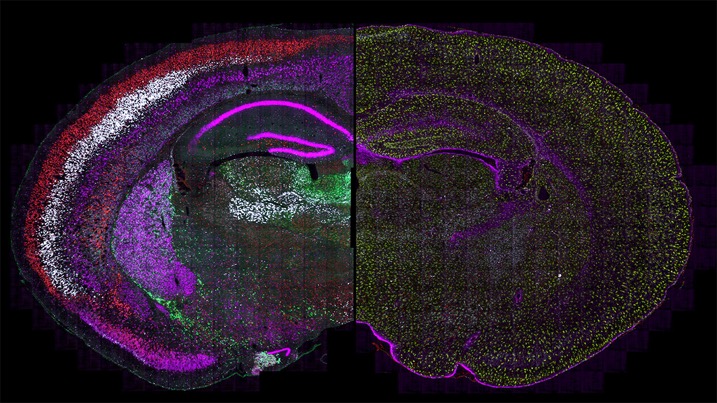
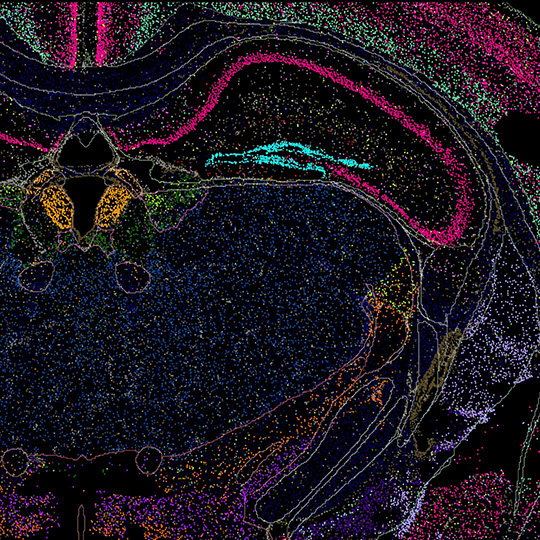
A new study has identified a specific type of human brain cell, known as a projection neuron, that is most vulnerable in late-stage multiple sclerosis. Here, projection neurons are shown in dark red in the mouse brain on the left, with astrocytes (another type of brain cell) on the right side of the image. Image courtesy of David Rowitch.

In its later phases, multiple sclerosis, or MS, shifts to a steady decline, with no relief of worsening symptoms. In this second, progressive phase, the outer shell of the brain — the cortex — actually shrinks away from the skull. Researchers still don’t understand why that shrinkage happens, nor which of the disease’s symptoms are caused by the atrophy.

Now, a team of scientists led by researchers at the University of California, San Francisco, and the University of Cambridge has discovered that one particular type of neuron receives the brunt of the damage in this phase of the neurological disease.

That finding not only provides an explanation for why brains shrink in MS patients in late stages of the disease — the brains seem to be losing this type of neuron in particular — but also points to therapeutic avenues to halt the atrophy, said David Rowitch, M.D., Ph.D., a neuroscientist at UCSF and the University of Cambridge who led the study, which was published today in the journal Nature, along with UCSF’s Arnold Kriegstein, M.D., Ph.D. Their findings indicate that the newest types of treatment for early-stage MS, known as biologics, might also halt this late-stage brain shrinkage.

“Lots of arrows were pointing to this particular cell,” which is a type of human neuron known as a projection neuron, said Rowitch, who is also an Allen Distinguished Investigator. “That hadn’t been understood before for MS, that there was a particular cell type that was vulnerable. But the data just really screamed out: This neuron is in trouble.”

Looking for the missing neurons

To get a better grasp on what causes the dramatic brain shrinkage, Rowitch, Kriegstein and their colleagues used post-mortem brains from people with and without MS who had died and donated their bodies to science. They looked at the genes these brain cells switch on, cell by cell, to capture differences between people with MS and those with healthy brains.

They weren’t actually expecting to find large differences in neurons, Rowitch said. The early stages of MS are caused by autoimmune-triggered damages to a type of brain “support cell” that forms an insulating layer around nerve fibers. When that protective layer is lost, the underlying nerves sustain damage. The team thought they might find differences in support cells in late-stage disease as well.

The researchers also used a technique that shows changes in gene expression, or the genes that are switched on, in cells in their natural environment in the brain. That technique, which Rowitch and his colleagues developed through support directed from The Paul G. Allen Frontiers Group via his Allen Distinguished Investigator award, allowed the researchers to verify that the projection neurons were missing in large quantities from the brains of patients with MS.

“If you look for these neurons in the layer of the cortex where they’re supposed to live, we can show that they’re missing,” Rowitch said. “Seeing it in the tissue makes it much more convincing.”

Implications for treatment

The researchers also found that a type of immune cell known as B cells seemed to be invading the brains of late-stage MS patients, remaining behind where projection neurons were lost. Newly developed biological therapies for early-stage MS target these immune cells, so their findings suggest that these new therapies could also protect against brain shrinkage, Rowitch said. The patients in their study had all received other, older therapies.

Their study uncovered differences in one gene, ATF4, in the damaged neurons in MS patients which could point to a new avenue for a different type of MS treatment. In an earlier study of brain cells from people with autism spectrum disorder, the researchers also found changes in the same projection neurons, even though MS and autism affect the brain very differently.

“We think that this is a very interesting and perhaps understudied type of neuron that could be susceptible in a number of brain conditions,” Rowitch said. “Why would the same neuron be popping up in these two very different situations? We’re really interested in exploring that further.”

Citations
No items found.

about the allen institute

The Allen Institute is an independent, 501(c)(3) nonprofit research organization founded by philanthropist and visionary, the late Paul G. Allen. The Allen Institute is dedicated to answering some of the biggest questions in bioscience and accelerating research worldwide. The Institute is a recognized leader in large-scale research with a commitment to an open science model. For more information, visit alleninstitute.org.
related news

all news
No articles for the category
we acceleratedevelopcatalyzeimpact

science done differently. shared with the world.

explore our accelerators

brain science

Mapping every cell, connection, and circuit in the brain—openly shared with the world.

cell science

Decoding how cells become tissues, then programming that knowledge into powerful new research tools.

neural dynamics

Revealing the brain's hidden algorithms that transform neural activity into real-world behavior.

immunology

Creating the deepest open reference for the healthy human immune system ever built.

synthetic biology

Engineering cells to record their own histories, transforming how we understand disease over time.

research

Big questions, open answers, and science built to be shared.

education

Inspiring the next generation of scientists through open science resources.

impact

Our science is empowering researchers and advancing health worldwide.
advancing science through open, collaborative research
Get the allen institute newsletter
Stay informed on the latest breakthroughs in neuroscience, bioscience, and AI-driven research.
allen institute
impactpeople & teamscareers & opportunitiesalumnihistory & founder
science resources
allencell.orgallenimmunology.orgallenneuraldynamics.orgbrain-bican.orgbrain-map.orgmicrons-explorer.org
research
brain sciencecell scienceneural dynamicsimmunologysynthetic biologypublications
education
science educationfield tripsprofessional developmenteducation resources
quick links
newseventsopen sciencepodcastscience resourceshuman brain donationvisit uscontact
follow us/

allen institute, 615 Westlake Ave North, Seattle, WA 98109 +12065487055

© 0000 allen institute. all rights reserved.
privacy policyterms of usecitation policyemployee portalpolicy & compliance