impact
about
our story
explore our impact
careers and opportunities
join us
open science
sharing science to speed discovery
open science week
celebrating open science
team science
people & teams
discovery is a team effort
allenites
the people who make our work possible
advisors
their input shapes our science
board of directors
they help us fulfill our mission
shanahan foundation fellowship
at the interface of data and neuroscience
next generation leaders
fostering emerging leaders in bioscience
research
overview
our approach
science at the scale of greatest impact
publications
explore our publications
open science
sharing science to speed discovery
science accelerators
brain science
building a blueprint of the brain
cell science
understanding how cells become organs
neural dynamics
revealing the brain’s hidden algorithms
immunology
creating the ultimate immune system reference
synthetic biology
seattle hub for synthetic biology
education
overview
science education
science is for everyone
open science
sharing science speeds discovery
engagement
education resources
real science. real skills.
field trips
experience science where it happens
educator development
empowering educators
news
overview
all news
explore the latest news
podcast
the human stories behind discovery
sign up for our newsletter
stay connected to our science
events
overview
all events
public engagement, workshops, seminars and more
conferences
connect with us
science resources
science resources
allencell.org
allenimmunology.org
allenneuraldynamics.org
brain-bican.org
brain-map.org
microns-explorer.org
impact
back to menu
team science
our story
explore our impact
careers and opportunities
join us
open science
sharing science to speed discovery
open science week
celebrating open science
team science
people & teams
discovery is a team effort
allenites
the people who make our work possible
advisors
their input shapes our science
board of directors
they help us fulfill our mission
shanahan foundation fellowship
at the interface of data and neuroscience
next generation leaders
fostering emerging leaders in bioscience
research
back to menu
overview
our approach
science at the scale of greatest impact
publications
explore our publications
open science
sharing science to speed discovery
science accelerators
brain science
building a blueprint of the brain
cell science
understanding how cells become organs
neural dynamics
revealing the brain’s hidden algorithms
immunology
creating the ultimate immune system reference
synthetic biology
seattle hub for synthetic biology
education
back to menu
overview
science education
science is for everyone
open science
sharing science speeds discovery
engagement
education resources
real science. real skills.
field trips
experience science where it happens
educator development
empowering educators
news
back to menu
overview
all news
explore the latest news
podcast
the human stories behind discovery
newsletter
stay connected to our science
events
back to menu
overview
all events
public engagement, workshops, seminars and more
conferences
connect with us
science resources
back to menu
science resources
allencell.org
allenimmunology.org
allenneuraldynamics.org
brain-bican.org
brain-map.org
microns-explorer.org
search
news

Allen Institute for Cell Science launches first disease-specific cell line collections

New tools will advance study-and hopefully treatment-of common genetic heart conditions.

June 4, 2024
 min read
share/
New tools will advance study—and hopefully treatment—of common genetic heart conditions.
Thank you! Your submission has been received!
Oops! Something went wrong while submitting the form.

in this article

table of contents will display on published page only
set h2 to populate the table of contents here

authors

Jake Siegel

For every 500 people reading this, one likely has a disease called hypertrophic cardiomyopathy (HCM). It is the most common genetic heart condition in the world, primarily caused by mutations that thicken heart muscle and, in rare cases, lead to heart failure and cardiac arrest.

Today, the Allen Institute for Cell Science launched a set of tools to accelerate research into this global health issue: six new cell line collections, each carrying a different mutation associated with HCM. These cells will help scientists worldwide investigate the impact of specific mutations in myosin, a protein that powers heart contractions, on heart function.

Severe thickening of the heart muscle in a child with hypertrophic cardiomyopathy. Video credit: Daniel Bernstein, Stanford University

The Institute also released cell line collections targeting skeletal muscle disorders, specifically those related to a myosin mutation, and laminopathies, rare diseases caused by mutations in proteins that maintain a cell’s nucleus.

“Providing researchers with these robust tools paves the way for the discovery of new treatments and insights into disease progression,” said Ru Gunawardane, Ph.D., Executive Director of the Allen Institute for Cell Science. “These cell lines are a perfect bridge between our expertise and the efforts of leading scientists to tackle disease.”

Gene-edited tools

The Allen Cell Catalog’s latest offerings are known as human induced pluripotent stem cells (hiPSCs). These are adult skin cells that have been reprogrammed back into their stem cell form. Using CRISPR/Cas9 technology, Allen Institute scientists introduced disease-associated mutations into these cells along with fluorescent tags that illuminate the structures that drive heart contractions.

Researchers can use these cells to generate cardiac muscle cells, providing a dynamic model to investigate the intricate biomechanics of heart disease.
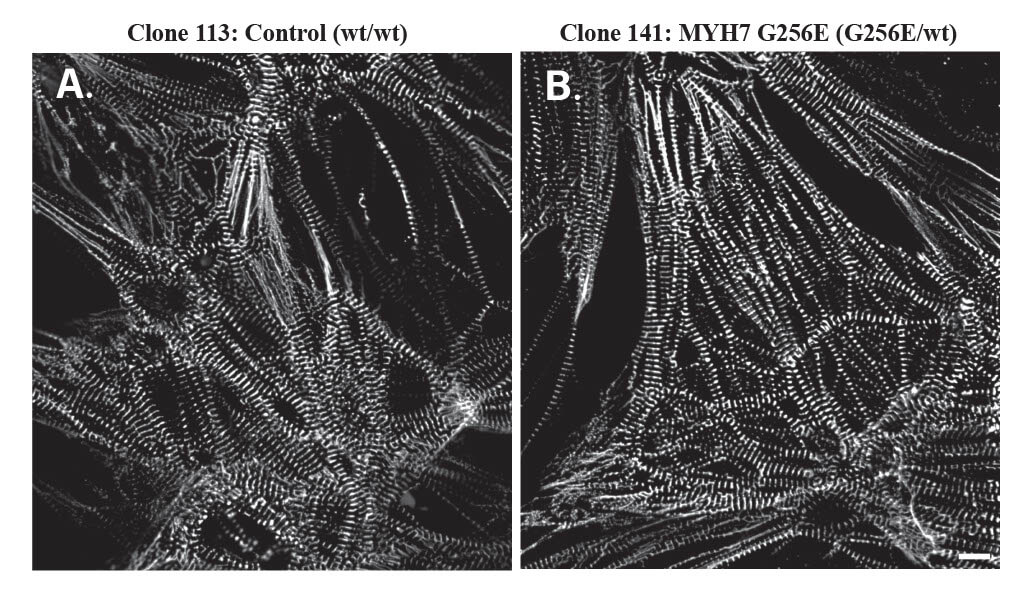
Microscopic comparison of Clone 113 control versus Clone 141 MYH7 G256E mutation tissue structure
Live imaging of cardiomyocytes from the new cardiomyopathy collection. The cell on the right has a mutation in the MYH7 gene, vital for the formation of heart muscle fibers. This mutation is tagged with a fluorescent protein that illuminates the structures that drive heart contractions.

The Allen Institute has long used CRISPR to insert fluorescent molecules into a cell’s genome. These fluorescent tags allow scientists to visualize and track proteins within cells. Developing the HCM tools offered an opportunity to try a new technique: altering single base pairs of DNA.

The combination of these gene editing methods enabled Allen Institute scientists to rapidly create a series of disease-specific cell lines, said Brock Roberts, Ph.D., a Scientist at the Allen Institute.

“This is the beginning of a different era in human health, where the scalpels and implements of surgery have become molecular,” he said. “We’re still quite a ways from regularly doing that in patients, but this was an exciting opportunity to get into the early stages of research in a human cell.”

Partnering in the lab to make progress in the clinic

Today’s release of the HCM cell lines stems from a collaboration among scientists at the University of Washington, Stanford, and the University of California, Santa Barbara. Their goal was to explore why the mutations linked to HCM cause varying symptoms in patients: some display few or no symptoms, while others, even within the same family, suffer from severe illness.

The team turned to the Allen Institute for Cell Science, which leveraged their decade of experience making gene-edited stem cell lines to generate a robust suite of cells that could be used for this sensitive research.

Healthy human iPS cell-derived cardiomyocytes that were culture in a petri dish. The cells were allowed to beat spontaneously and were video imaged under bright field microscopy. Video credit: Alison Schroer, Soah Lee, Daniel Bernstein, Sean M. Wu, Stanford University

“Working with the Allen Institute for Cell Science, we knew we were getting high-quality stem cells,” said Stanford University’s Daniel Bernstein, M.D. “If we did this on our own, it would have taken us several years and would have been extraordinarily expensive, and it would have eaten up a large part of the budget of the grant we had gotten from the NIH.”

The cell lines serve as a platform to study myosin mutations across molecular, cellular, and tissue levels, offering a comprehensive understanding of their impact on heart function.

The approach has already proven effective. The researchers’ first study confirmed that a specific rare mutation causes abnormal heart function at all biological levels, countering prior skepticism about its clinical significance.

“Being able to study this in the dish was really important because some cardiologists were beginning to doubt whether this mutation really caused the disease,” said Bernstein, the senior author on the study.

The cells lines also provide opportunities to observe how the disease develops over time, potentially revealing critical phases where targeted interventions might alter or halt its progression.

“Most of the studies we do in human tissue are at the end stage of disease,” said Michael Regnier, Ph.D., a professor of bioengineering at the University of Washington involved with the study. “But what we really want to know is: how is the disease initiated, and how does it progress over time? These cell lines let us do that.”
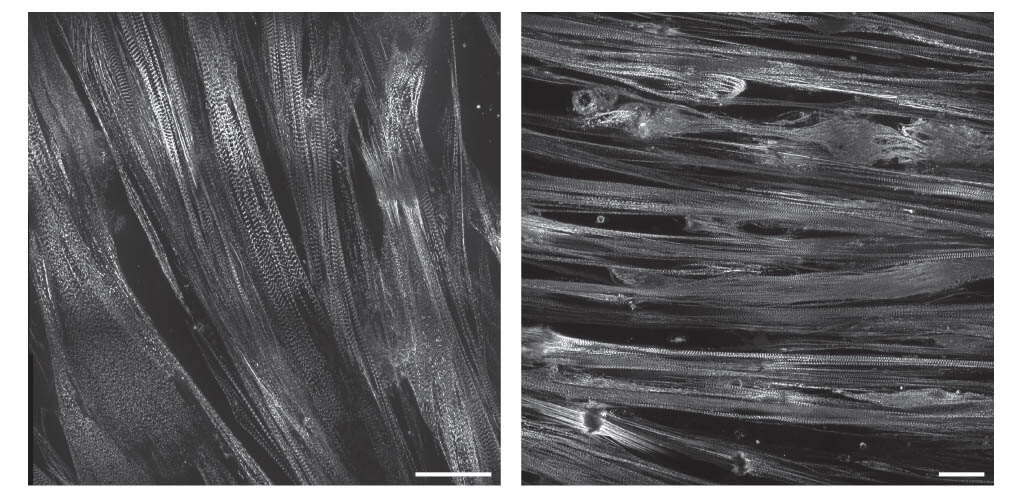
Black and white microscopic images showing fibrous textile structures with detailed woven patterns.
Live imaging of skeletal muscle cells from the new skeletal myopathy collection. These cells have mutations in the MYH3 gene, which is crucial for muscle development. These mutations are tagged with a fluorescent protein that illuminates the structures that drive muscle contractions. Image courtesy Alina Greimal, BS; Christian Mandrycky, PhD; and David Mack, PhD / Institute for Stem Cell & Regenerative Medicine (ISCRM) at the University of Washington

‘An invaluable resource’

Today’s releases introduce the first disease-specific cell line collections in the Allen Cell Catalog, with hopefully more to come, said Jacqueline Smith, M.S., a senior research associate.

“As an institute, we’ve been really focused on how normal cells function,” Smith said. “Now we’re exploring them in a diseased state to deepen our understanding of these genetic conditions and hopefully lead to new treatments.”

For now, Allen Institute researchers hope these cell lines will illuminate how subtle changes in myosin lead to disfunction at the cellular and tissue levels.

At least one collaborator confirms they already are.

“Studies of cardiomyocytes derived from the Allen Institute for Cell Science’s cell lines enable us to understand how those molecular changes manifest at the sarcomeric and cellular levels,” said Kathleen Ruppel, M.D., Ph.D., a pediatric cardiologist and investigator at Stanford University. “These lines are an invaluable resource to the cardiac muscle community and will lead to important insights into hypertrophic cardiomyopathy.”

Citations
No items found.

about the allen institute

The Allen Institute is an independent, 501(c)(3) nonprofit research organization founded by philanthropist and visionary, the late Paul G. Allen. The Allen Institute is dedicated to answering some of the biggest questions in bioscience and accelerating research worldwide. The Institute is a recognized leader in large-scale research with a commitment to an open science model. For more information, visit alleninstitute.org.
related news

all news
video
Simularium: Accelerating discovery by animating insight
Simularium is an innovative online tool designed by the Allen Institute’s Cell Science team that visualizes 4D simulations (animations) of complex...
news
Allen Institute cells blast off into outer space
Researchers from Cedars-Sinai are using Allen Institute cell lines to grow organoids in space, which could help design better drugs for disease
video
What Are the Parts of a Cell?
From mitochondria to endoplasmic reticulum, this educational video explores the major cell organelles and their functions.
news
Allen Institute names Sarah Norris Hall as next Chief Financial Officer
Norris Hall’s experience and insight into financial operations will help enable and propel transformative science at the Allen Institute.
video
CellScapes: Launching a new era of cellular biology
CellScapes introduces a groundbreaking approach that will combine cutting-edge imaging and powerful computer models to track how cells change, communicate, and organize.
video
A Decade of Discovery at the Allen Institute for Cell Science
Celebrating 10 Years of Impact
we acceleratedevelopcatalyzeimpact

science done differently. shared with the world.

explore our accelerators

brain science

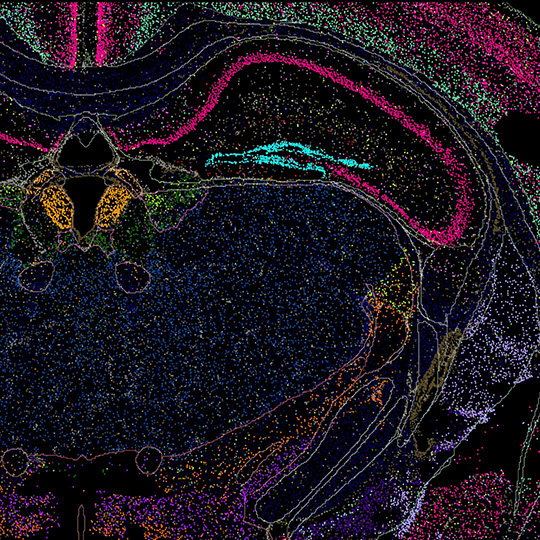
Mapping every cell, connection, and circuit in the brain—openly shared with the world.

cell science

Decoding how cells become tissues, then programming that knowledge into powerful new research tools.

neural dynamics

Revealing the brain's hidden algorithms that transform neural activity into real-world behavior.

immunology

Creating the deepest open reference for the healthy human immune system ever built.

synthetic biology

Engineering cells to record their own histories, transforming how we understand disease over time.

research

Big questions, open answers, and science built to be shared.

education

Inspiring the next generation of scientists through open science resources.

impact

Our science is empowering researchers and advancing health worldwide.
advancing science through open, collaborative research
Get the allen institute newsletter
Stay informed on the latest breakthroughs in neuroscience, bioscience, and AI-driven research.
allen institute
impactpeople & teamscareers & opportunitiesalumnihistory & founder
science resources
allencell.orgallenimmunology.orgallenneuraldynamics.orgbrain-bican.orgbrain-map.orgmicrons-explorer.org
research
brain sciencecell scienceneural dynamicsimmunologysynthetic biologypublications
education
science educationfield tripsprofessional developmenteducation resources
quick links
newseventsopen sciencepodcastscience resourceshuman brain donationvisit uscontact
follow us/

allen institute, 615 Westlake Ave North, Seattle, WA 98109 +12065487055

© 0000 allen institute. all rights reserved.
privacy policyterms of usecitation policyemployee portalpolicy & compliance