impact
about
our story
explore our impact
careers and opportunities
join us
open science
sharing science to speed discovery
open science week
celebrating open science
team science
people & teams
discovery is a team effort
allenites
the people who make our work possible
advisors
their input shapes our science
board of directors
they help us fulfill our mission
shanahan foundation fellowship
at the interface of data and neuroscience
next generation leaders
fostering emerging leaders in bioscience
research
overview
our approach
science at the scale of greatest impact
publications
explore our publications
open science
sharing science to speed discovery
science accelerators
brain science
building a blueprint of the brain
cell science
understanding how cells become organs
neural dynamics
revealing the brain’s hidden algorithms
immunology
creating the ultimate immune system reference
synthetic biology
seattle hub for synthetic biology
education
overview
science education
science is for everyone
open science
sharing science speeds discovery
engagement
education resources
real science. real skills.
field trips
experience science where it happens
educator development
empowering educators
news
overview
all news
explore the latest news
podcast
the human stories behind discovery
sign up for our newsletter
stay connected to our science
events
overview
all events
public engagement, workshops, seminars and more
conferences
connect with us
science resources
science resources
allencell.org
allenimmunology.org
allenneuraldynamics.org
brain-bican.org
brain-map.org
microns-explorer.org
impact
back to menu
team science
our story
explore our impact
careers and opportunities
join us
open science
sharing science to speed discovery
open science week
celebrating open science
team science
people & teams
discovery is a team effort
allenites
the people who make our work possible
advisors
their input shapes our science
board of directors
they help us fulfill our mission
shanahan foundation fellowship
at the interface of data and neuroscience
next generation leaders
fostering emerging leaders in bioscience
research
back to menu
overview
our approach
science at the scale of greatest impact
publications
explore our publications
open science
sharing science to speed discovery
science accelerators
brain science
building a blueprint of the brain
cell science
understanding how cells become organs
neural dynamics
revealing the brain’s hidden algorithms
immunology
creating the ultimate immune system reference
synthetic biology
seattle hub for synthetic biology
education
back to menu
overview
science education
science is for everyone
open science
sharing science speeds discovery
engagement
education resources
real science. real skills.
field trips
experience science where it happens
educator development
empowering educators
news
back to menu
overview
all news
explore the latest news
podcast
the human stories behind discovery
newsletter
stay connected to our science
events
back to menu
overview
all events
public engagement, workshops, seminars and more
conferences
connect with us
science resources
back to menu
science resources
allencell.org
allenimmunology.org
allenneuraldynamics.org
brain-bican.org
brain-map.org
microns-explorer.org
search
news

Two years of glowing cells for science

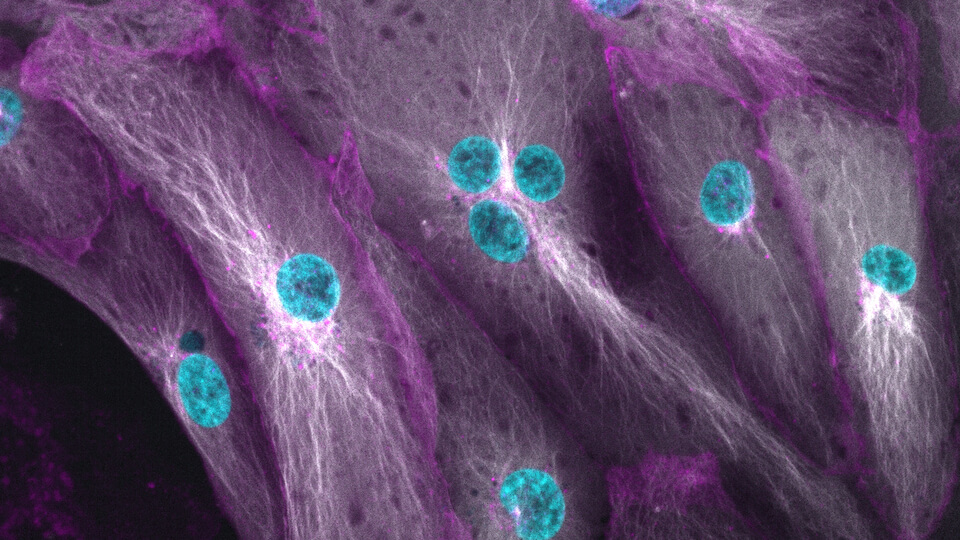
Cells that have been engineered to pinpoint specific parts with glowing molecular labels, part of the Allen Cell Collection.

December 6, 2018
 min read
share/
Cells that have been engineered to pinpoint specific parts with glowing molecular labels, part of the Allen Cell Collection.
Thank you! Your submission has been received!
Oops! Something went wrong while submitting the form.

in this article

table of contents will display on published page only
set h2 to populate the table of contents here
Fluorescent microscopy showing cells with cyan nuclei and purple filament network structures

They started with a handful of cells taken from a volunteer’s skin.

The cells were engineered in two different laboratories, first to revert the skin cells back to a nascent state, known as pluripotent stem cells, and then to highlight different parts of the cells with glowing fluorescent labels. Nearly 400 vials are now at home in 17 different countries to empower research in foundational cell biology as well as in disease and regenerative medicine.

They are the cells that make up the Allen Cell Collection, a suite of engineered stem cells built for discovery and translation both at the Allen Institute for Cell Science and for the broader research community.

This month, the collection is 2 years old, and the cells are now for the first time available to scientists doing research in industry. They’ve been available for non-profit and academic use since the collection’s inception in 2016.

“Our team is all about foundational cell biology,” said Rick Horwitz, Ph.D., Executive Director of the Allen Institute for Cell Science, a division of the Allen Institute. “We’re now expanding accessibility by offering these cell lines to the entire research community.”

The researchers who generate these cells have three overlapping end goals in generating this collection: to create an image-based cell atlas, understand the principles of cell organization, and determine how cells transition from state to state. In doing this, they are using highly reproducible and standardized procedures that are shared openly with the scientific community, along with their reagents, data, and methods, and the cell lines themselves.

The research world benefits from a solid baseline for study and comparison, said Ruwanthi Gunawardane, Ph.D., Director of Stem Cells and Gene Editing at the Allen Institute for Cell Science, the team of researchers who generate the Allen Cell Collection cell lines by gene-editing them to highlight different microscopic structures with glowing fluorescent labels.

“You have to start with good data to build good models. Part of generating good data is having high quality cells that are made in a standardized and well characterized way,” Gunawardane said. “These cells also allow people to compare data from lab to lab. Everybody’s going to benefit, not just us.”

Converging technologies

The Allen Cell Collection represents a shift in the cell biology field toward studying cells that are more representative of healthy human cells. Traditionally, cell biologists have used cancerous cells in their studies, not just for understanding the biology of cancer, but because the cells are much easier to keep alive in the lab. Cancer cells differ from normal human cells in a lot of ways, but researchers didn’t have a good method to study normal human cells in a petri dish until relatively recently.

A little over a decade ago, the Japanese cell biologist Shinya Yamanaka, M.D., Ph.D., spearheaded a new method to generate stem cells from mature human cells, making possible the technology that eventually led to the Allen Cell Collection. These stem cells start their lives in the connective tissue of the skin. Yamanaka figured out how to make a few genetic tweaks in these adult skin cells that reverts them back to an immature stage.

These stem cells are known as pluripotent, meaning with the right manipulations in the lab, they can give rise to muscle, nerve, kidney and other types of human cells that scientists may want to study. And they are relatively easy to grow and handle in the lab.

One of Yamanaka’s colleagues, Bruce Conklin, M.D., a stem cell researcher at the Gladstone Institutes, used the technique to generate a stable population of stem cells, known as a cell line, that his research team made from a volunteer who donated a small skin biopsy. That cell line later became the foundation for the Allen Cell Collection.

The Allen Institute for Cell Science researchers use a method of gene editing that relies on the CRISPR technology, a newly developed method for easily changing a cell’s genes. The convergence of these two technologies allowed the creation of the Allen Cell Collection, Gunawardane said.

Cardiomyocytes generated from human stem cells. This cell line was edited to fluorescently tag a protein that only shows up in cardiomyocytes.

Writing the next cell biology textbook

The research team has now generated and made available 31 cell lines with fluorescent tags for 28 different subcellular structures, with more coming down the pike. Five of those lines include glowing labels that can only be seen when the stem cells are manipulated to change into cardiomyocytes, or heart muscle cells. The cell lines are distributed to research labs through the Coriell Institute for Medical Research.

Many of those tags mark very well-known structures in the cell, such as the nucleus, which houses the cell’s DNA blueprint.

“Marking those well-known structures provides a scaffolding for understanding cell biology,” Conklin said. “By choosing these classic ‘textbook’ markers, the Allen Institute is providing the foundation for people who are trying to write the unwritten chapters of the next textbook.”

The lines are being used to study heart cells, brain cells, and kidney disease, and the researchers hope that opening up their availability for research in industry will also accelerate disease research and drug discovery.

“If researchers who are developing new drugs or testing drugs have a more relevant system to do that in, then they might be able to better predict what’s going to happen in a human,” Gunawardane said. “To me that’s really exciting.”

Citations
No items found.

about the allen institute

The Allen Institute is an independent, 501(c)(3) nonprofit research organization founded by philanthropist and visionary, the late Paul G. Allen. The Allen Institute is dedicated to answering some of the biggest questions in bioscience and accelerating research worldwide. The Institute is a recognized leader in large-scale research with a commitment to an open science model. For more information, visit alleninstitute.org.
related news

all news
video
Simularium: Accelerating discovery by animating insight
Simularium is an innovative online tool designed by the Allen Institute’s Cell Science team that visualizes 4D simulations (animations) of complex...
news
Allen Institute cells blast off into outer space
Researchers from Cedars-Sinai are using Allen Institute cell lines to grow organoids in space, which could help design better drugs for disease
video
What Are the Parts of a Cell?
From mitochondria to endoplasmic reticulum, this educational video explores the major cell organelles and their functions.
news
Allen Institute names Sarah Norris Hall as next Chief Financial Officer
Norris Hall’s experience and insight into financial operations will help enable and propel transformative science at the Allen Institute.
video
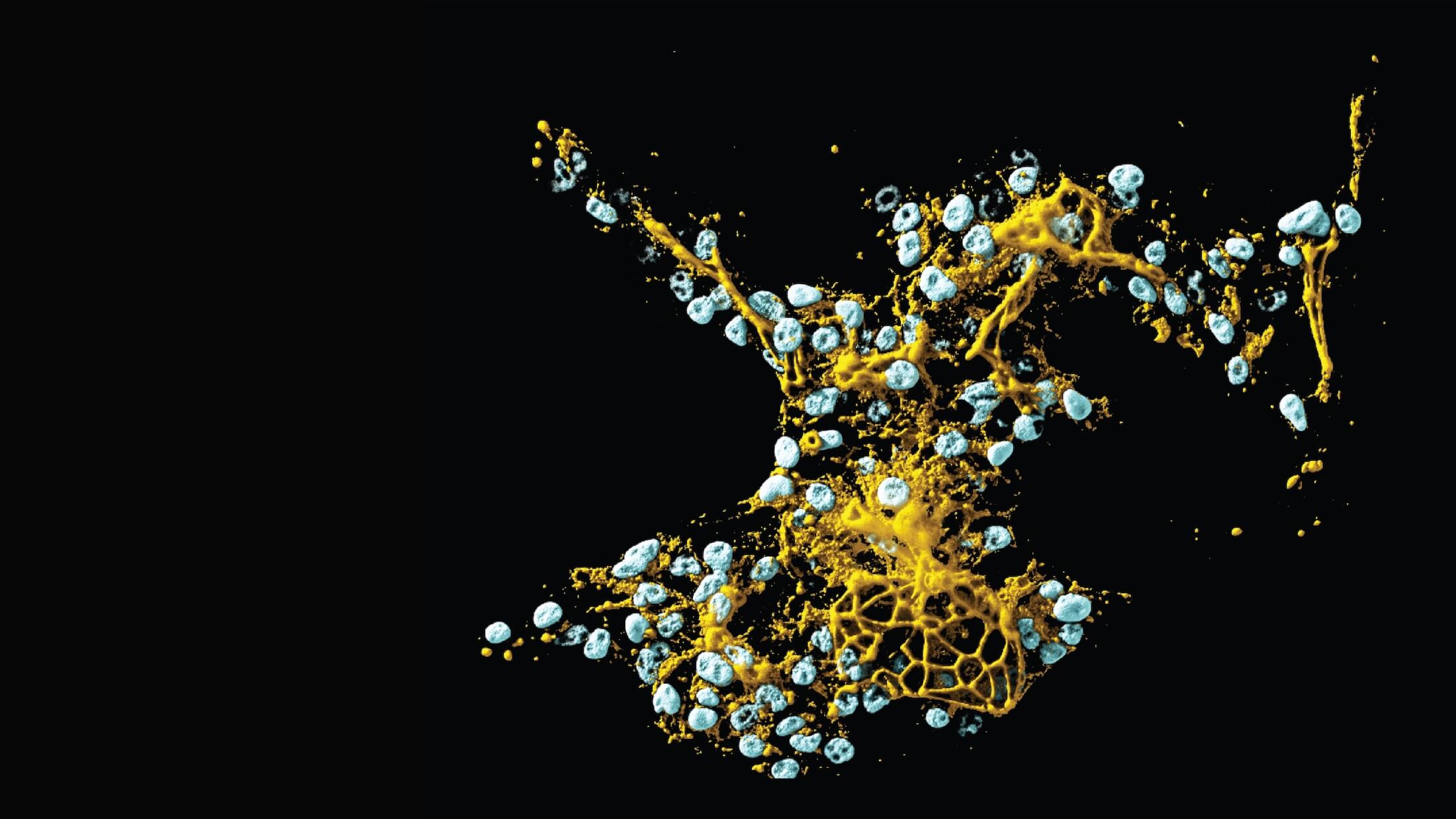
CellScapes: Launching a new era of cellular biology
CellScapes introduces a groundbreaking approach that will combine cutting-edge imaging and powerful computer models to track how cells change, communicate, and organize.
video
A Decade of Discovery at the Allen Institute for Cell Science
Celebrating 10 Years of Impact
we acceleratedevelopcatalyzeimpact

science done differently. shared with the world.

explore our accelerators

brain science

Mapping every cell, connection, and circuit in the brain—openly shared with the world.

cell science

Decoding how cells become tissues, then programming that knowledge into powerful new research tools.

neural dynamics

Revealing the brain's hidden algorithms that transform neural activity into real-world behavior.

immunology

Creating the deepest open reference for the healthy human immune system ever built.

synthetic biology

Engineering cells to record their own histories, transforming how we understand disease over time.

research

Big questions, open answers, and science built to be shared.

education

Inspiring the next generation of scientists through open science resources.

impact

Our science is empowering researchers and advancing health worldwide.
advancing science through open, collaborative research
Get the allen institute newsletter
Stay informed on the latest breakthroughs in neuroscience, bioscience, and AI-driven research.
allen institute
impactpeople & teamscareers & opportunitiesalumnihistory & founder
science resources
allencell.orgallenimmunology.orgallenneuraldynamics.orgbrain-bican.orgbrain-map.orgmicrons-explorer.org
research
brain sciencecell scienceneural dynamicsimmunologysynthetic biologypublications
education
science educationfield tripsprofessional developmenteducation resources
quick links
newseventsopen sciencepodcastscience resourceshuman brain donationvisit uscontact
follow us/

allen institute, 615 Westlake Ave North, Seattle, WA 98109 +12065487055

© 0000 allen institute. all rights reserved.
privacy policyterms of usecitation policyemployee portalpolicy & compliance