in this article
1) The Institute began as a team of four people and one (big) project
In September 2003, the Allen Institute – at the time, the Allen Institute for Brain Science – launched with just four employees, three-year job contracts, one small rented laboratory space, and one big project: to map gene expression across the entire mouse brain.
2) Allen Institute data has been used in research ranging from Alzheimer’s disease to eating disorders to alcohol abuse
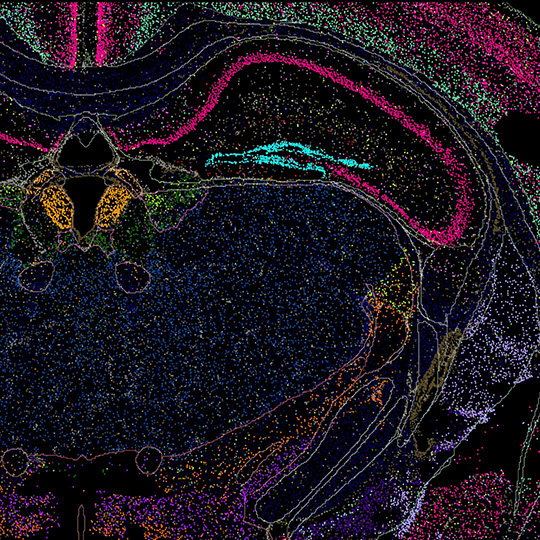
The Allen Institute’s inaugural project, the Allen Mouse Brain Atlas, mapped gene expression for more than 20,000 genes across the entire brain of the adult mouse. Publicly released in 2006, the atlas continues to be one of the Institute’s most widely used resources. Overall, data and resources on brain-map.org are accessed and used for research by tens of thousands of individuals every month.
3) Halloween is kind of a big deal
From classic and creepy to crafty and creative, Allen Institute staff takes great pride in their Halloween costumes. Every year, the Institute social committee plans a festive brunch and costume contest.
4) Live human brain tissue is used in Allen Institute research
Allen Institute researchers formed unique collaborations with Seattle-area neurosurgeons to obtain, with patient consent, small samples of healthy human brain tissue that is removed during tumor or epilepsy surgeries. This live tissue is put on ice and sent to the Allen Institute, where, within about 20 minutes, researchers carefully analyze the samples to learn more about the human brain.
5) Allen Institute cell biologists use CRISPR to create glowing stem cells
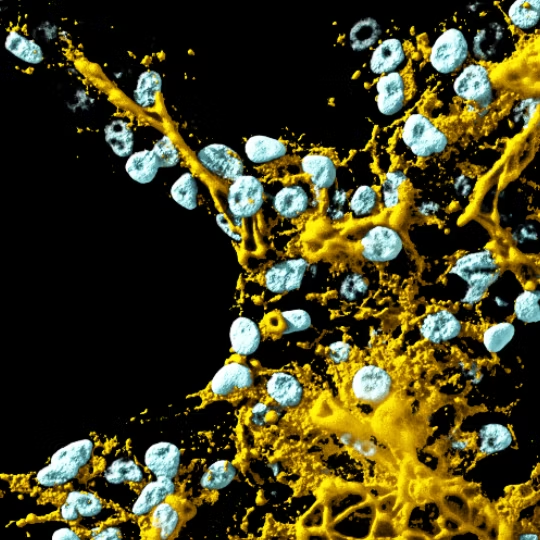
CRISPR-Cas/9, a recently discovered gene-editing tool, has been referred to as one of the most revolutionary and transformational science tools in recent decades. This tool allows scientists to make precise cuts and edits to DNA, and it has been used in research on cancer-curing medicines, climate-resistant crops, wiping out malaria-bearing mosquitoes, and more. Researchers at the Allen Institute for Cell Science are using this tool to make cellular sub-structures glow under fluorescence microscopes to help researchers better understand what makes cells healthy, and what goes wrong in disease.
6) Heat generated in the Allen Institute server room is used to warm other parts of the building
The energy-efficient, high-performance Allen Institute building is LEED GOLD – a considerable accomplishment for a research facility – as well as Salmon Safe certified. Developed by Vulcan Real Estate, the headquarters maximizes natural light, fresh air, and even diverts heat from the server room to heat other spaces of the building.
7) The Allen Institute is a leading bike to work company in Seattle
According to a 2016 survey by Commute Seattle, the Allen Institute had the most commute trips made by bicycle of any Seattle employer. The building’s location across the street from a protected bike lane helps spur the more than 20 percent of employees who commute by bike. In spring of 2018, the Institute was awarded GOLD level recognition as a Bicycle Friendly Business by The League of Bicycle Friendly America.
8) Leading neuroscientist met with His Holiness the Dalai Lama
As part of The Mind and Life XXVI conference in 2013, Christof Koch, Ph.D., the Chief Scientist and President of the Allen Institute for Brain Science, and His Holiness the Dalai Lama met to discuss topics that included the historical sweep of science and the revolutions in the understanding of our physical universe and the nature of the mind.
9) Every Thursday, researchers and staff meet for “Tea and Treats”
At the Allen Institute, microwaves and coffee and tea machines are centrally located on the sixth floor, to encourage cross-team mingling and collaboration throughout the Institute. To further build on this idea, every Thursday afternoon, employees are invited to the sixth-floor café to enjoy “Tea and Treats” with a featured tea, as well as sweet and savory snacks, served in British high tea style
10) The Paul G. Allen Frontiers Group supports leading scientists around the world
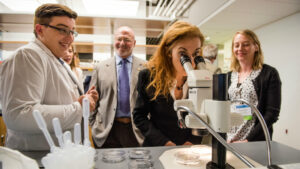
11) The Allen Institute for Cell Science developed the first predictive and comprehensive 3D model of a live human stem cell
Until recently, the ability to see what’s going on inside human cells has been very limited. That’s why researchers at the Allen Institute for Cell Science developed the Allen Integrated Cell: the first predictive and comprehensive 3D model of a live human cell that allows researchers to see multiple structures inside a living cell simultaneously.
12) The Allen Institute building is decorated with inspiring sculptures, drawings and paintings
Thanks to founder Paul G. Allen’s appreciation and passion for the arts, inspiring sculptures, paintings, and drawings can be found throughout our building.
13) The concept for the Allen Brain Observatory began as a sketch on a napkin
The first plans for the Allen Brain Observatory were sketched on a napkin by Institute scientists R. Clay Reid, M.D., Ph.D., John Phillips, Ph.D., and Amy Bernard, Ph.D. in 2013. The idea was to image activity throughout the mouse visual cortex in response to visual stimuli. From napkin to website — the first data from the observatory was shared with the world in 2016.
14) Mouse sculptures can be found “hiding” throughout the building
Seven life-sized solid bronze mouse sculptures, commissioned by award winning artist Steve Worthington, can be found “hiding” throughout the Allen Institute building to honor these diminutive rodents’ contributions to science. Tucked under the stairs, lingering on a railing, or cozied up in the library – staff and guests enjoy finding them in their creative homes.
15) Allen institute headquarters includes Seattle historic landmarks in the façade
The building design incorporates historic elements of the site’s previous inhabitants, the William O. McKay Ford and Pacific Lincoln Mercury auto showrooms built in 1923, including the terra cotta facades that were located on the site previously and have been disassembled, restored and reinstalled.
Citations
about the allen institute
The Allen Institute is an independent, 501(c)(3) nonprofit research organization founded by philanthropist and visionary, the late Paul G. Allen. The Allen Institute is dedicated to answering some of the biggest questions in bioscience and accelerating research worldwide. The Institute is a recognized leader in large-scale research with a commitment to an open science model. For more information, visit alleninstitute.org.