in this article
Today is my last day at the Allen Institute.
It was just 10 weeks ago that I had walked off the plane at SeaTac airport and thought, “Wow, it’s so green here! And the air feels so oddly…clean.” It was my first time in Seattle, and my first time living away from my hometown.
I was born and raised in Los Angeles, and the farthest I’ve ever lived from my parents was a 25-minute drive — at UCLA, where I’m now in my senior year as a microbiology major.
This summer, I’ve been an editorial intern at the Allen Institute, writing science stories about the Institute’s fascinating research. From a feature article on aging to a story about exercise as medicine for the mind to a podcast on bumblebee science, I’ve explored various genres of writing and got an inside view of careers in communications. But out of all the stories I’ve written here so far, I was the most nervous about this one.
As a science writer, I’m used to writing about science. But this time I’ll be introducing the people behind it. I was not the only one who joined the Allen Institute this summer. Alongside me, 22 additional amazing interns came here to be at the frontiers of research. It’s the Institute’s largest cohort yet, and the first on-site group of interns since 2019, before the pandemic shuttered labs and offices.
The curious neuroscientist
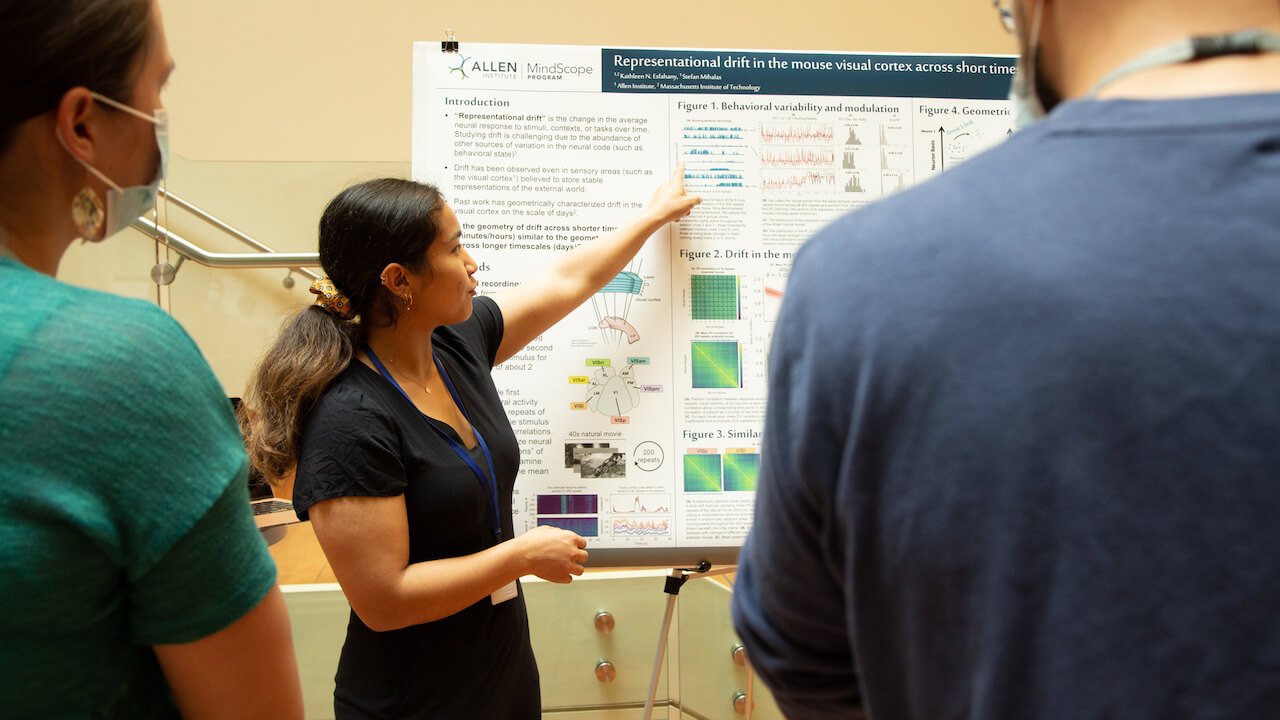
Kathleen Esfahany, a rising senior at MIT, joined the Allen Institute’s MindScope Program as a modeling and theory intern. Although it’s Esfahany’s first job at the Institute, it’s not her first time working with the Institute. Five years ago, she had the opportunity to use the Institute’s open data to publish her first research paper.
In 2017, Esfahany joined the Simons Summer Research Program, a competitive summer program designed to give high school juniors early research experience at Stony Brook University. She worked in a computational neuroscience lab and learned how to code for the first time. Curious about the visual processing regions of the brain, Esfahany implemented an algorithm to analyze the open-source Allen Brain Observatory — a dataset of neural activity from the visual cortex.
She published a paper on her results and presented her work at the COSYNE 2018 conference in Denver, where she also got to meet Allen Institute researchers, including computational neuroscientist Stefan Mihalas, Ph.D. Seeing the faces behind the massive dataset she had been analyzing for the past few months, Esfahany felt grateful.
“Getting the chance to do that as a high schooler was such a gift, and it would not have been possible without the amazing data and support from the Allen Institute,” she said.
To continue her growing interest, Esfahany chose to major in brain and cognitive sciences when she was accepted into MIT. But two years into college, 2020 hit. With the world in flux because of the COVID-19 pandemic, Esfahany took a gap year to explore other career options. During the pandemic, she worked as a communications intern, a software engineer for a 3D printing startup, and a researcher in a natural language processing lab. But she was always drawn back to neuroscience.
“I missed neurons. I missed asking questions about the brain,” she said.
Reminiscing over her high school research experience, Esfahany applied for an internship in the Allen Institute’s MindScope Program and, little did she know, her interview would be a mini-reunion. Her interviewer and internship mentor was Stefan Mihalas, whom Esfahany had met at the 2018 conference.
Once accepted and in Seattle, Esfahany saw the tremendous lab capacity and team effort that went into the datasets she’d drawn on five years earlier. Yet despite the larger-than-life scale of the work, Esfahany felt welcomed as part of a tight-knit community.
“The extremely vibrant research community is my favorite thing here. It’s very rare to have so many people around you who understand and care about the same sorts of problems,” she said. “In some academic research departments, scientists in different labs don’t necessarily know what the next-door lab is doing. But here, everything is so openly shared and communicated.”
During her internship, Esfahany studied how the brain’s response to the same stimulus changes over time, also known as representational drift. Current studies suggest that if you, for example, watched the same movie every day, your brain’s responses to that movie would change, or “drift”, over time; Esfahany’s desire to understand this phenomenon, and many others, underlies her aspiration to pursue a Ph.D. in neuroscience. Her fascination for the brain is never-ending.
“The brain is very important to forming who we are and how we’re able to connect with each other, speak to each other, love each other, and understand each other. Getting insight into how the brain does that is very special,” she said.
The spirited programmer
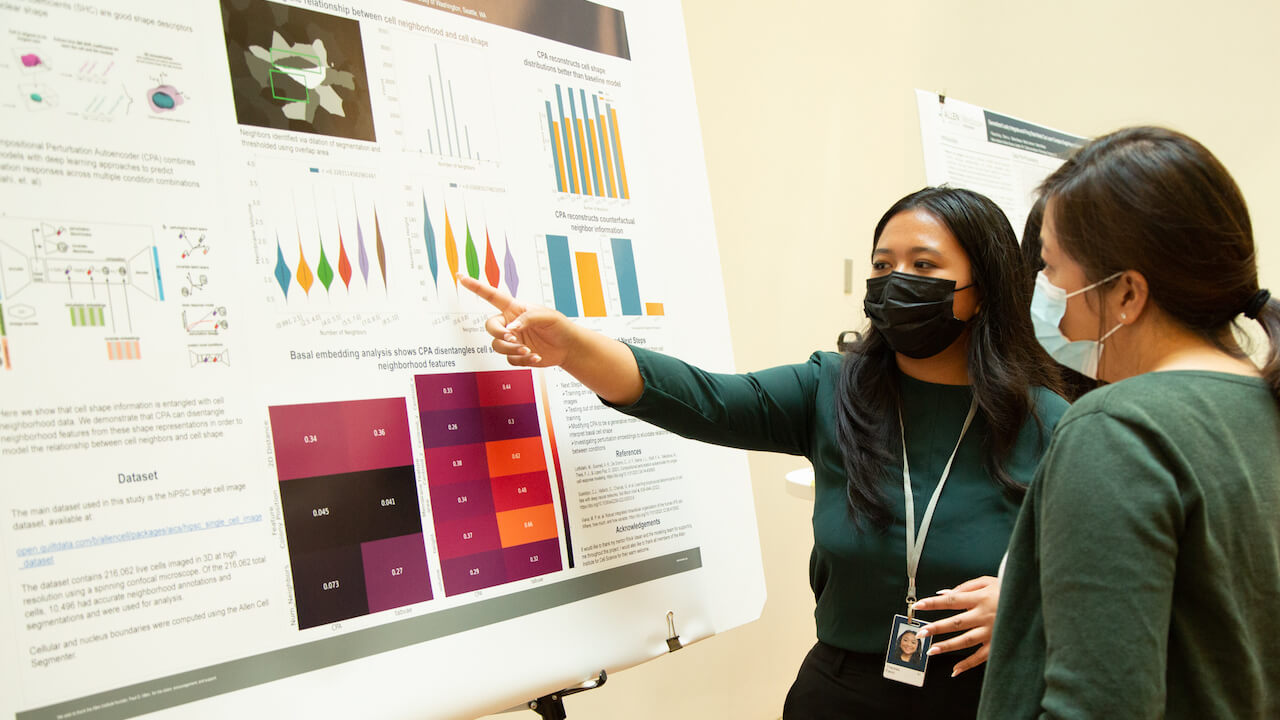
To Therese Pacio, a modeling intern at the Allen Institute for Cell Science, the gender diversity in the Allen Institute intern cohort is powerful. Sixteen out of this year’s 23 interns are women, and Pacio said she feels a sense of support and inclusivity with their shared experience as women in STEM.
“The scientific workforce currently doesn’t look like what this internship looks like. But I think it’s really exciting to think about how 20 years down the line, the face of science could look totally different from what we see today,” she said.
Pacio, a rising junior at the University of Washington, joined the Allen Institute to explore research careers. She used to imagine herself as a physician, but when she interned in a computer-based lab at Seattle Children’s in high school, she saw what an impactful career could look like without the “M.D.” — as a computational biologist.
“Computer science really has the power to make discoveries that may not have been possible without a computer. It has the power to change the way we do medicine and do research, and I think that is really exciting,” Pacio said.
At Seattle Children’s, Pacio learned how to code and perform image analysis. In fact, she was assigned an open-source tool from the Allen Institute for Cell Science — the Allen Cell and Structure Segmenter — that guided and enriched her programming experience.
“If an 18-year-old kid like me could learn how to code from these tools, then the Allen Institute is obviously doing open science really well,” she said.
As an intern at the Allen Institute, Pacio worked with modeling scientist Ritvik Vasan, Ph.D., to study how a cell’s surrounding neighbors could impact its shape. She modified a machine learning model to predict and reconstruct a cell’s shape in response to its environment and circumstances.
In addition to gaining practical research experience, Pacio learned the true meaning behind team science. Even the smallest interactions, like chatting with other scientists at the bank of four coffee machines, were meaningful.
“It’s like the coffee machines were specifically made just to have scientists walk up there and talk,” she said.
The impassioned educator
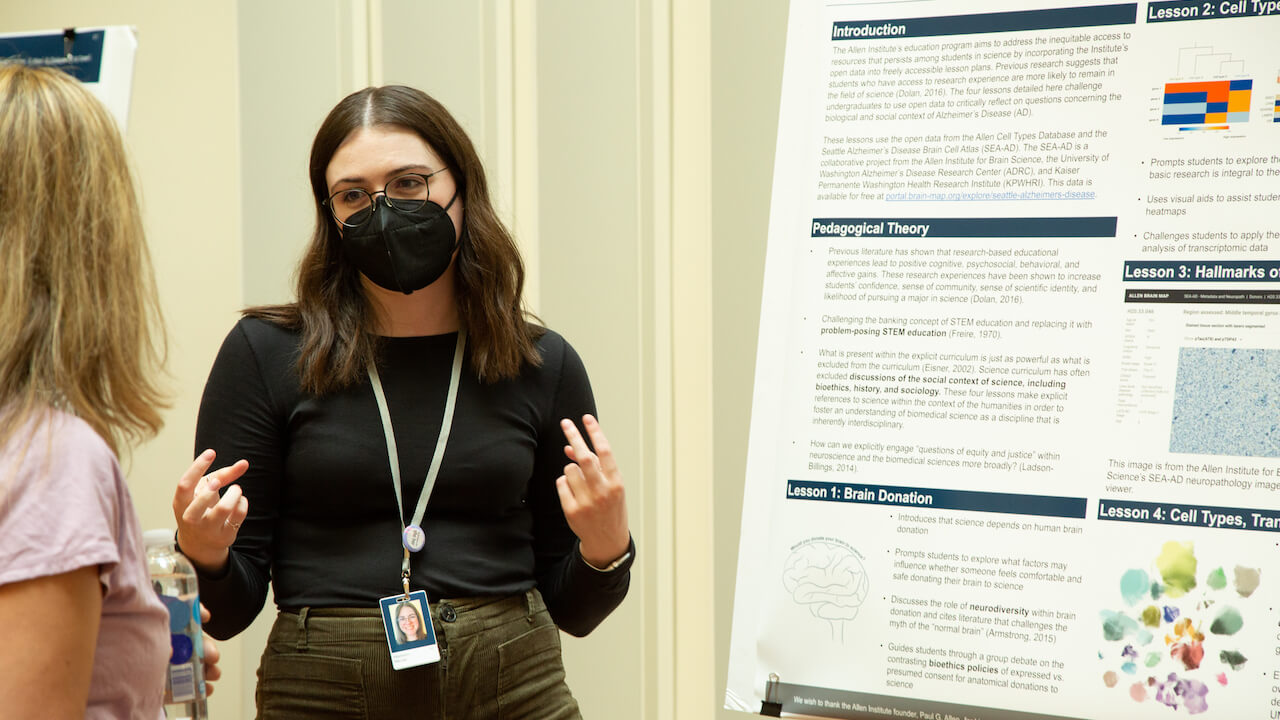
The Allen Institute’s open-science tools having reached the hands of high schoolers like Pacio and Esfahany is a testament to the Institute’s mission of providing students access to quality research experiences. To further promote equity in science education, my cubicle neighbor and fellow Communications intern Madison Meuler is a graduate student in science curriculum and instruction at the University of Washington who produced free lesson plans and teaching materials.
Meuler’s project was centered around the Seattle Alzheimer’s Disease Brain Cell Atlas, an open dataset that reveals how specific cell types are impacted by Alzheimer’s disease. She worked with Kaitlyn Casimo, Ph.D., who leads training, education, and outreach across the Allen Institute, to create a lesson plan that teaches students how to critically analyze and interact with the data. A big challenge for education is not only the shortage of resources but also the inequitable distribution of those resources to classrooms, Meuler said. With projects like this, she hopes to contribute to more accessible science education.
“Even if students don’t have access to a lab at their school, if they have access to a computer, they can still get the same research experience that a student at a more well-funded school would have,” she said.
Meuler didn’t always know she would go into education. She floated through many majors in college: English, psychology, public health, biology, and political science. She loved the sciences as much as the humanities and felt she couldn’t learn one without learning the other.
Hoping to find that interdisciplinary career, she decided to explore teaching. In 2020, she became a teaching assistant for a middle school science classroom in Newark, New Jersey through AmeriCorps, and she immediately enjoyed it. She watched her students develop a relationship with science, but she also saw the shortcomings of education. With the challenges of online school, some students were unable to connect with science and gave up. That left a mark.
“Overhearing students immediately writing themselves off as ‘I’m not a science person,’ really broke my heart because they’re only 12 or 13 years old, and they’re already eliminating themselves from the possibility of going into STEM,” Meuler said.
By the end of the academic year, Meuler was invested in the success of her students and realized that school is an incredibly formative time in a person’s life. She started a master’s program in science education at UW to work at the root of the problem.
Now with experience from the frontlines of education and behind the scenes creating educator resources, Meuler is in the middle of a career tug-of-war.
“I thought that one of my only options would be going into academia and being a professor, which is something I still very much want to do, but this internship has made me wonderfully confused in the sense that it has opened my eyes to other options,” she said.
But there is no doubt where her heart lies.
“I hope to be getting at the crux of how to help people, especially those who have historically been excluded from science, see science as a place that’s welcoming and a field that would really benefit from their input,” she said.
The enlightened author
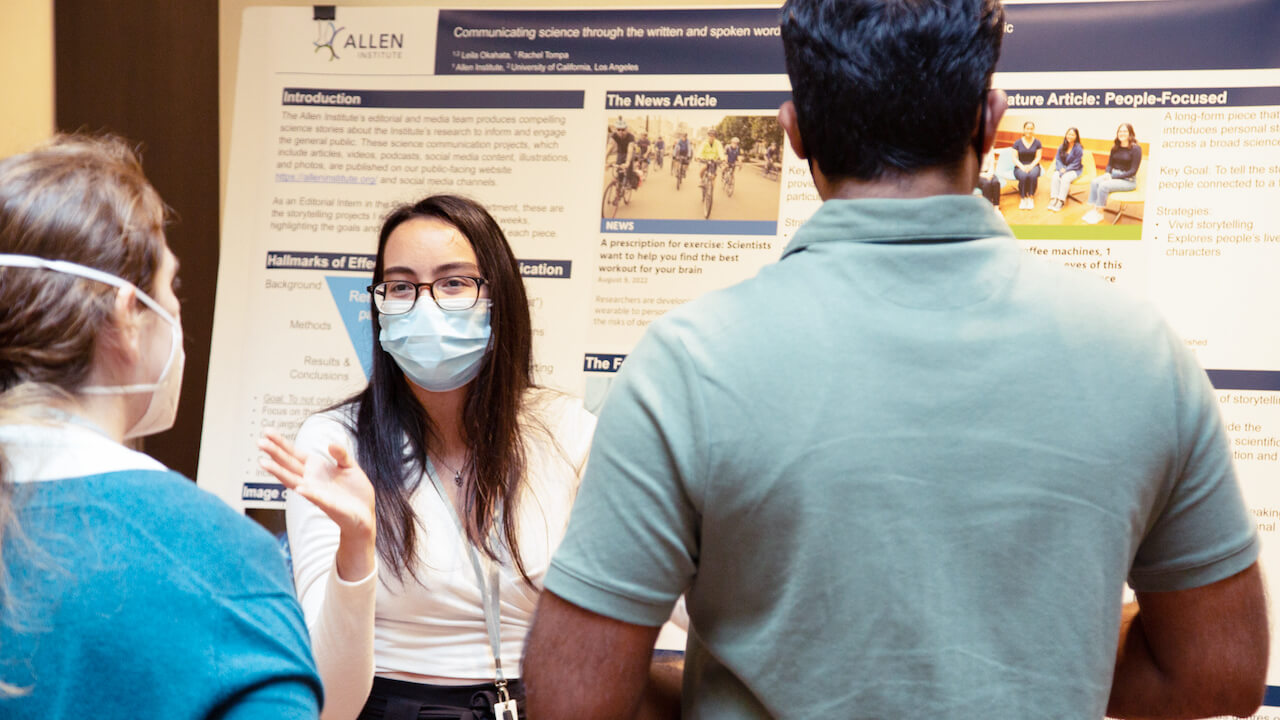
This is my first people story. Accustomed to writing about science, this article is a whole different beast for me. But as I continue along my science communication journey, I’ve come to realize that my favorite part of the writing process is interviewing: listening to scientists eagerly talking about their research findings, patients sharing their experiences, political officials advocating science policy, the public providing their opinions and thoughts on science. If you told my parents that, they would be absolutely shocked because Leila is a terribly shy person. Growing up, I would hide behind my parents at family parties just to avoid conversation. But after my first interview as a science reporter, I loved listening to my interviewee — their ambitions, their struggles, their life. I’m honored to be the one to tell their unique story to others.
Having the opportunity to work so closely with scientists is a special experience at the Allen Institute. From my desk, I could see my coworkers working tirelessly on microscopy images, 3D models, experiments, and many lines of code on computers. I’m not just on the outside looking in, I’m a communicator at the frontier of science alongside fellow researchers. Our work is inseparable.
As I return to Los Angeles, I won’t just be bringing back a now 10-pounds-heavier suitcase filled with Allen Institute merchandise and work supplies, but also a mental scrapbook of the beginnings of my career journey. My first published article, interviews with renowned scientists, and coffee chats with coworkers.
I wonder what will be on the next pages.
Citations
about the allen institute
The Allen Institute is an independent, 501(c)(3) nonprofit research organization founded by philanthropist and visionary, the late Paul G. Allen. The Allen Institute is dedicated to answering some of the biggest questions in bioscience and accelerating research worldwide. The Institute is a recognized leader in large-scale research with a commitment to an open science model. For more information, visit alleninstitute.org.