impact
impact
open science
subheadline
careers and opportunities
subheadline
people & teams
people & teams
subheadline
allenites
subheadline
allen institute advisors
subheadline
board of directors
subheadline
shanahan foundation fellowship
subheadline
next generation leaders
subheadline
research
overview
our approach
subheadline
publications
subheadline
open science
subheadline
accelerator
brain science
subheadline
cell science
subheadline
neural dynamics
subheadline
immunology
subheadline
synthetic biology
subheadline
education
education
science education
subheadline
education resources
subheadline
field trips
subheadline
open science
subheadline
open science quest
subheadline
news
news
stories
subheadline
podcast
subheadline
sign up for our newsletter
subheadline
events
events
all events
subheadline
conferences
subheadline
event code of conduct
subheadline
events
open science quest
subheadline
summer workshop on the dynamic brain
subheadline
open science week
subheadline
brain fest
subheadline
science resources
science resources
allencell.org
subheadline
allenimmunology.org
subheadline
allenneuraldynamics.org
subheadline
brain-bican.org
subheadline
brain-map.org
subheadline
microns-explorer.org
subheadline
impact
back to menu
impact
open science
subheading
careers and opportunities
subheading
people & teams
people & teams
subheading
allen institute advisors
subheading
board of directors
subheading
shanahan foundation fellowship
subheading
next generation leaders
subheading
research
back to menu
impact
Label
subheading
Label
subheading
people & teams
education
back to menu
research
Label
subheading
Label
subheading
Heading
news
back to menu
research
Label
subheading
Label
subheading
Heading
events
back to menu
research
Label
subheading
Label
subheading
Heading
science resources
back to menu
science resources
allencell.org
subheading
allenimmunology.org
subheading
allenneuraldynamics.org
subheading
brain-bican.org
subheading
brain-map.org
subheading
microns-explorer.org
subheading
search
stories
news

A day in the (neuroscience) life: Electron microscopy

Researchers on the EM team are viewing the brain in unprecedented detail

March 17, 2022
 min read
share/
Researchers on the EM team are viewing the brain in unprecedented detail
Thank you! Your submission has been received!
Oops! Something went wrong while submitting the form.

in this article

table of contents will display on published page only
set h2 to populate the table of contents here

Jenna Schardt spends her days dealing with beams of electrons. A researcher on the Allen Institute’s electron microscopy team, she and her colleagues capture the highest possible resolution pictures of neurons and other parts of the brain.
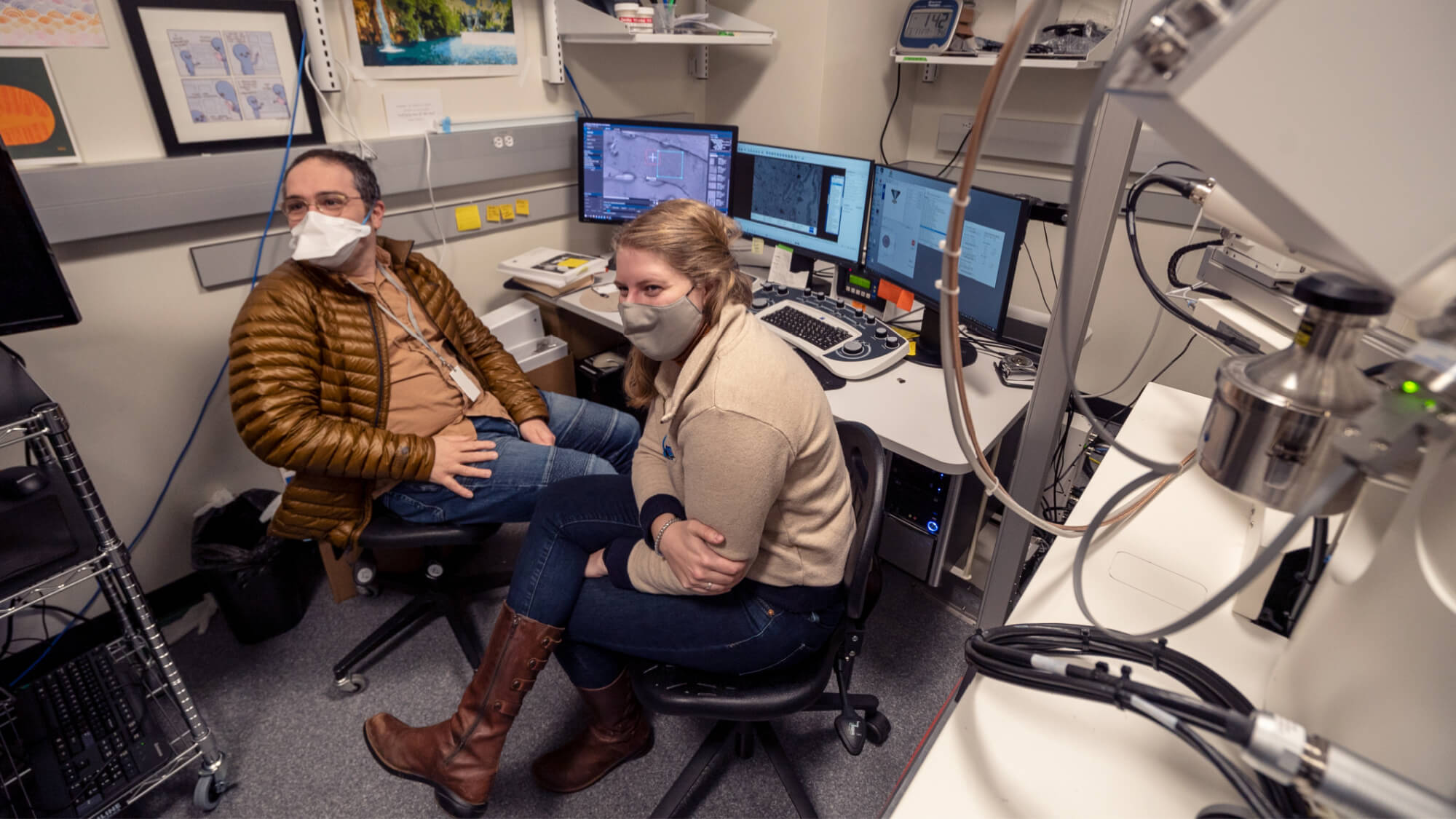
Two masked people in a high-tech laboratory with multiple computer monitors and scientific equipment
Nuno Maçarico da Costa, Ph.D. (left) and Jenna Schardt (right) in the Electron Microscopy lab at Allen Institute

When we drop in on Schardt, she and two other scientists on the EM team, Forrest Collman, Ph.D., and Nuno Maçarico da Costa, Ph.D., are in the preparation phase for a new project to map the brain at incredible detail. They’ve just switched on a special type of electron microscope and are watching images appear on the monitor.
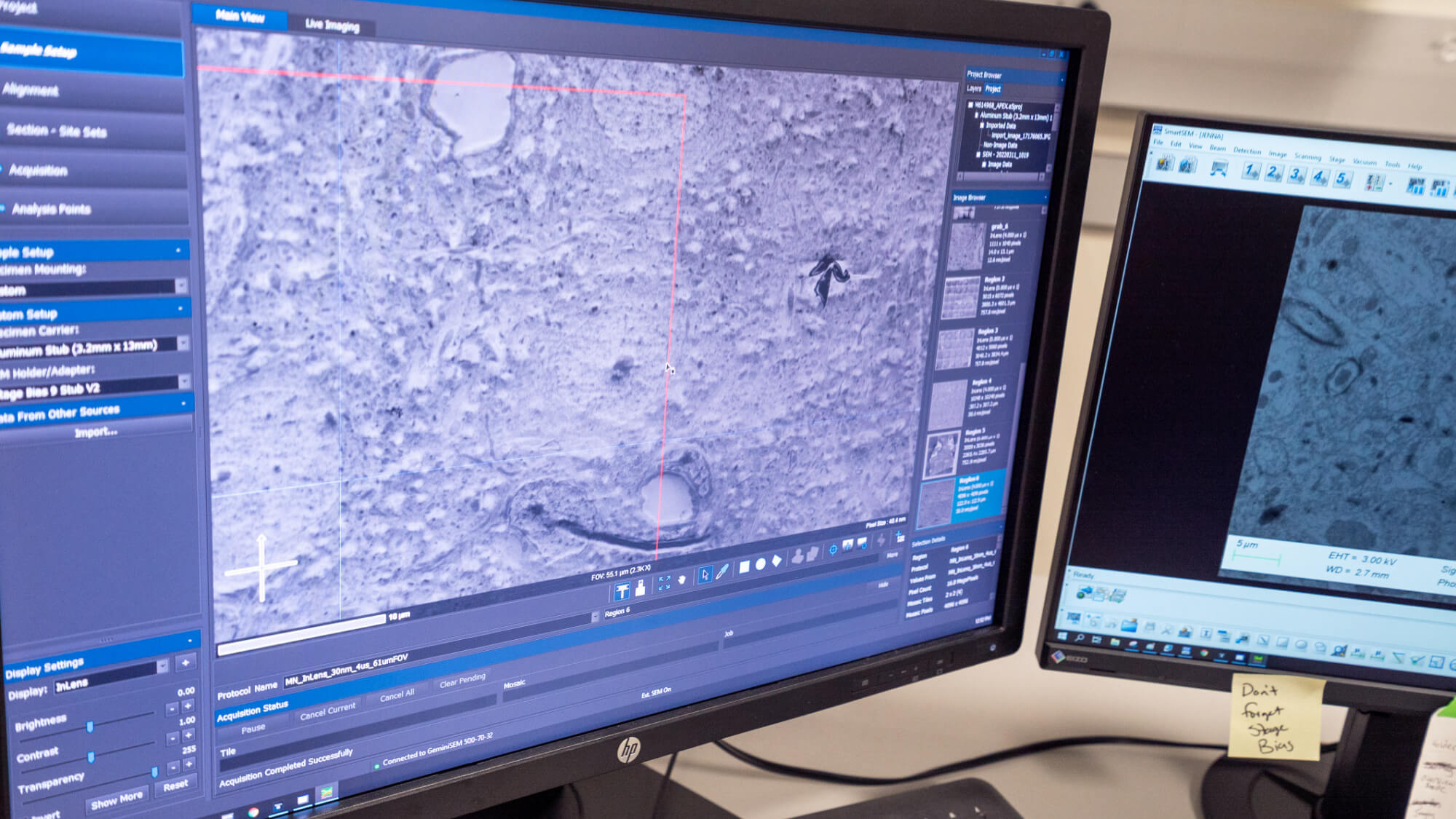
Geologic survey software showing aerial imagery with geological features and analysis tools.
Electron microscopy image collection at Allen Institute

Electron microscopes work by bombarding their subject — in the case of this team’s work, really really thin slices of mouse brain — with concentrated beams of electrons instead of visible or fluorescent light used in other kinds of microscopes. Because the wavelength of an electron is so much shorter than the wavelength of light, electron microscopes can get much finer grain details than light microscopes, magnifying a single neuron up to millions of times.
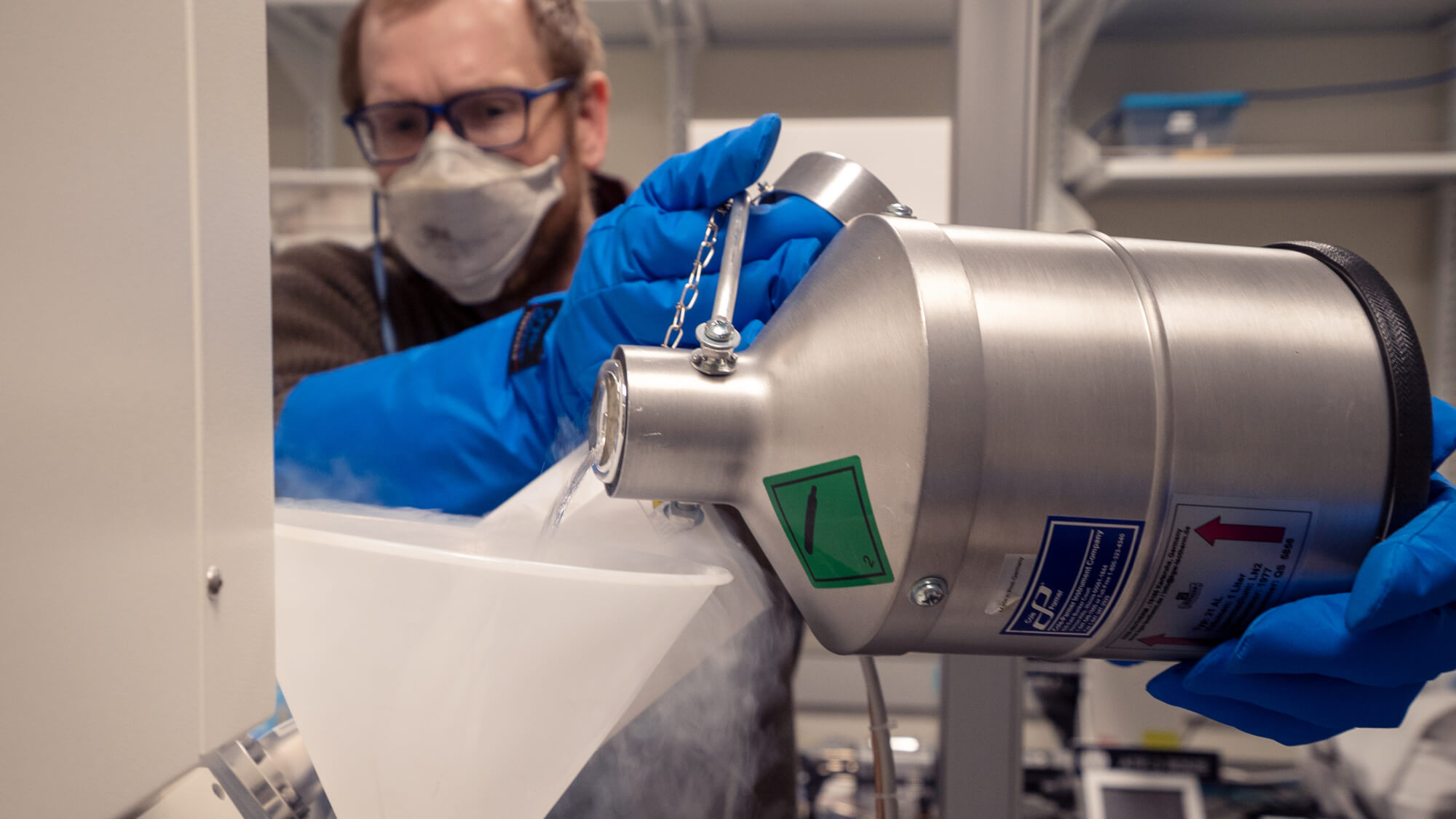
Person in blue gloves and mask examining metallic laboratory equipment in clean room
Forrest Collman, Ph.D. preparing for experimentation in the electron microscopy lab at Allen Institute

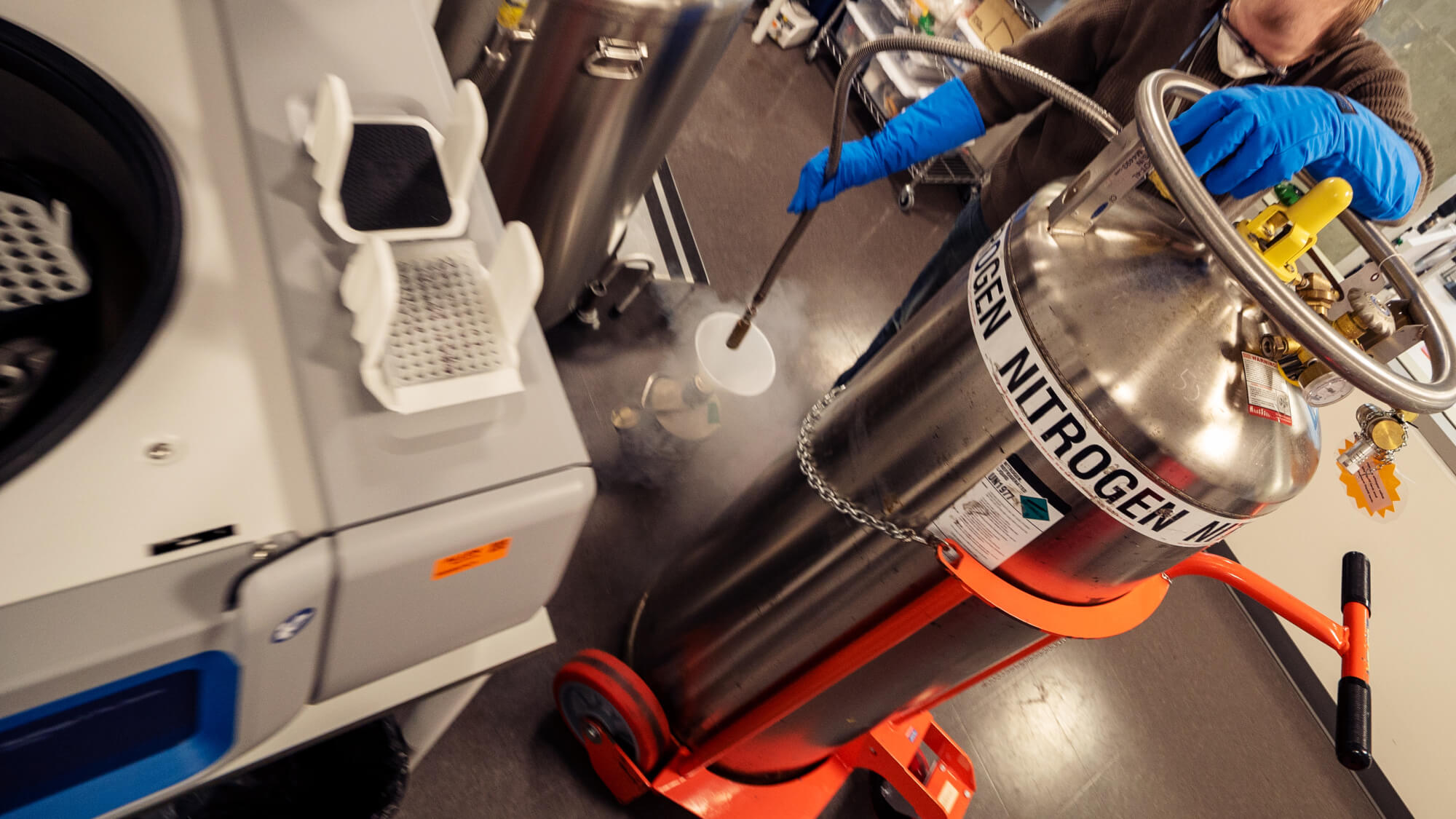
This particular electron microscope has a special attachment known as a cold finger (sadly, not named after the Bond villain), a thin vacuum pump cooled by liquid nitrogen that slurps microscopic impurities out of the sample of brain tissue. As Collman carefully pours the liquid nitrogen into a special container on the machine, da Costa and Schardt monitor the microscope’s progress.

“One of the cool things about this microscope is how much detail you can get when you zoom in or out, like Google Earth,” Schardt says, showing us the clear images on the monitor as she rapidly increases the magnification from a view of 3 centimeters, where we can see the entire petri dish with brain slices contained, down to 3 nanometers, zooming in on a tiny part of a single cell. “So that was like the equivalent of viewing the Earth from the heights Blue Origin [Jeff Bezos’ rocket company] reaches down to sea level.”
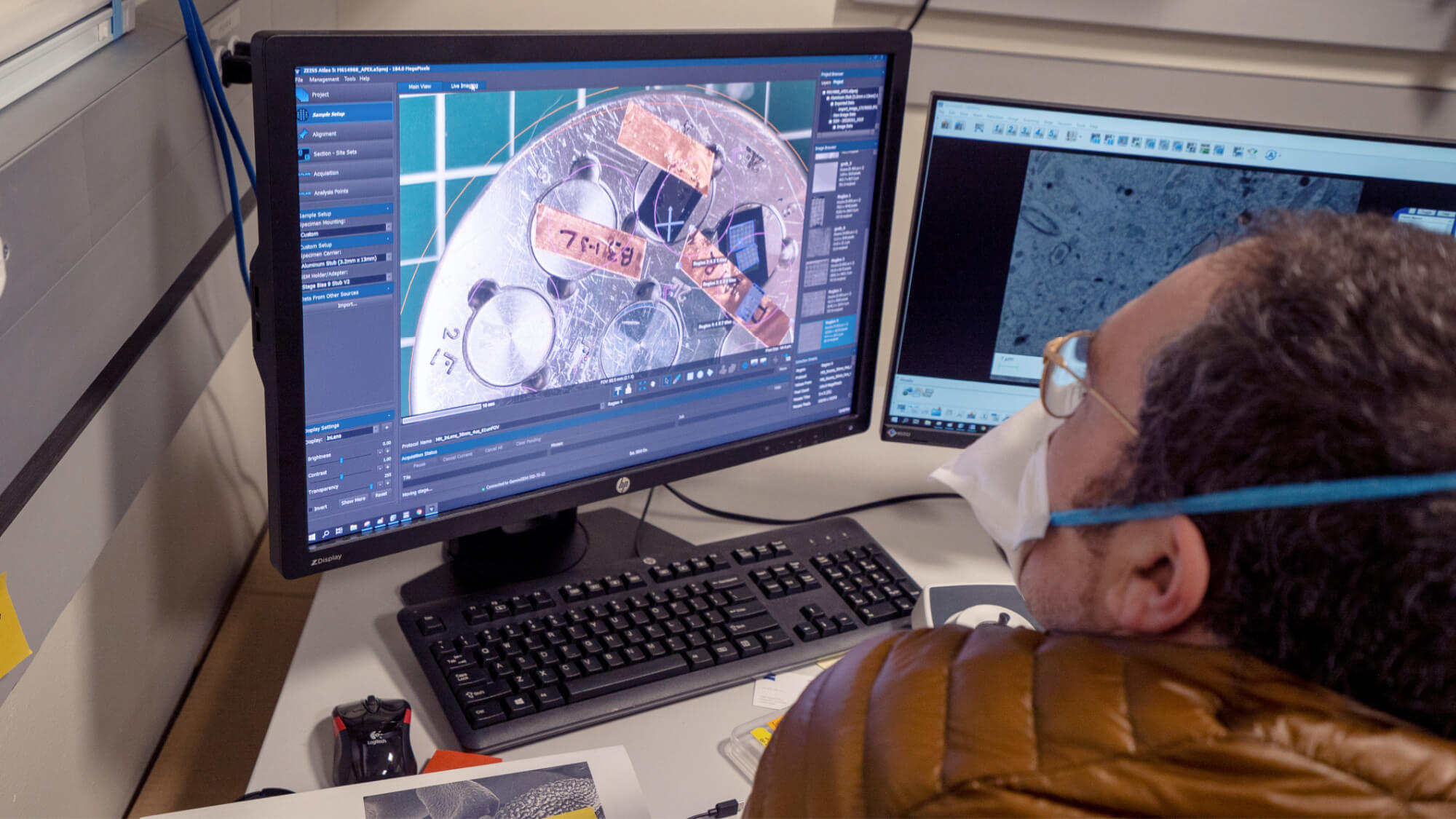
Person viewing aerial map software showing property layout on desktop computer monitor
Nuno Maçarico da Costa, Ph.D. working in the electron microscopy lab at Allen Institute

They’re working out techniques for a project that hasn’t yet begun — to trace the long-range connections from different types of cells in the brain at very high resolution. This work will build off a recently completed 5-year project to map every detail present in a cubic millimeter of mouse brain. The new project will use the same volume of a mouse brain with a special added staining technique that allows the scientists to see which kinds of neurons far away from the cubic millimeter are sending connections to make contact with cells in the tiny piece.

Photos by Erik Dinnel, Senior Producer at the Allen Institute, and text by Rachel Tompa, Senior Editor at the Allen Institute. Get in touch at press@alleninstitute.org.  

Citations
No items found.

about the allen institute

The Allen Institute is an independent, 501(c)(3) nonprofit research organization founded by philanthropist and visionary, the late Paul G. Allen. The Allen Institute is dedicated to answering some of the biggest questions in bioscience and accelerating research worldwide. The Institute is a recognized leader in large-scale research with a commitment to an open science model. For more information, visit alleninstitute.org.
explore related stories

explore more stories
No articles for the category
we acceleratedevelopcatalyzeimpact

science done differently. shared with the world.

explore our accelerators

brain science

Mapping every cell, connection, and circuit in the brain—openly shared with the world.

cell science

Decoding how cells become tissues, then programming that knowledge into powerful new research tools.

neural dynamics

Revealing the brain's hidden algorithms that transform neural activity into real-world behavior.

immunology

Creating the deepest open reference for the healthy human immune system ever built.

synthetic biology

Engineering cells to record their own histories, transforming how we understand disease over time.

research

Big questions, open answers, and science built to be shared.

education

Inspiring the next generation of scientists through open science resources.

impact

Our science is empowering researchers and advancing health worldwide.
advancing science through open, collaborative research
Get the allen institute newsletter
Stay informed on the latest breakthroughs in neuroscience, bioscience, and AI-driven research.
allen institute
impactpeople & teamscareers & opportunitiesalumnihistory & founder
science resources
allencell.orgallenimmunology.orgallenneuraldynamics.orgbrain-bican.orgbrain-map.orgmicrons-explorer.org
research
brain sciencecell scienceneural dynamicsimmunologysynthetic biologypublications
education
science educationfield tripsprofessional developmenteducation resources
quick links
newseventsopen sciencepodcastscience resourceshuman brain donationvisit uscontact
follow us/

allen institute, 615 Westlake Ave North, Seattle, WA 98109 +12065487055

© 0000 allen institute. all rights reserved.
privacy policyterms of usecitation policyemployee portalpolicy & compliance