in this article
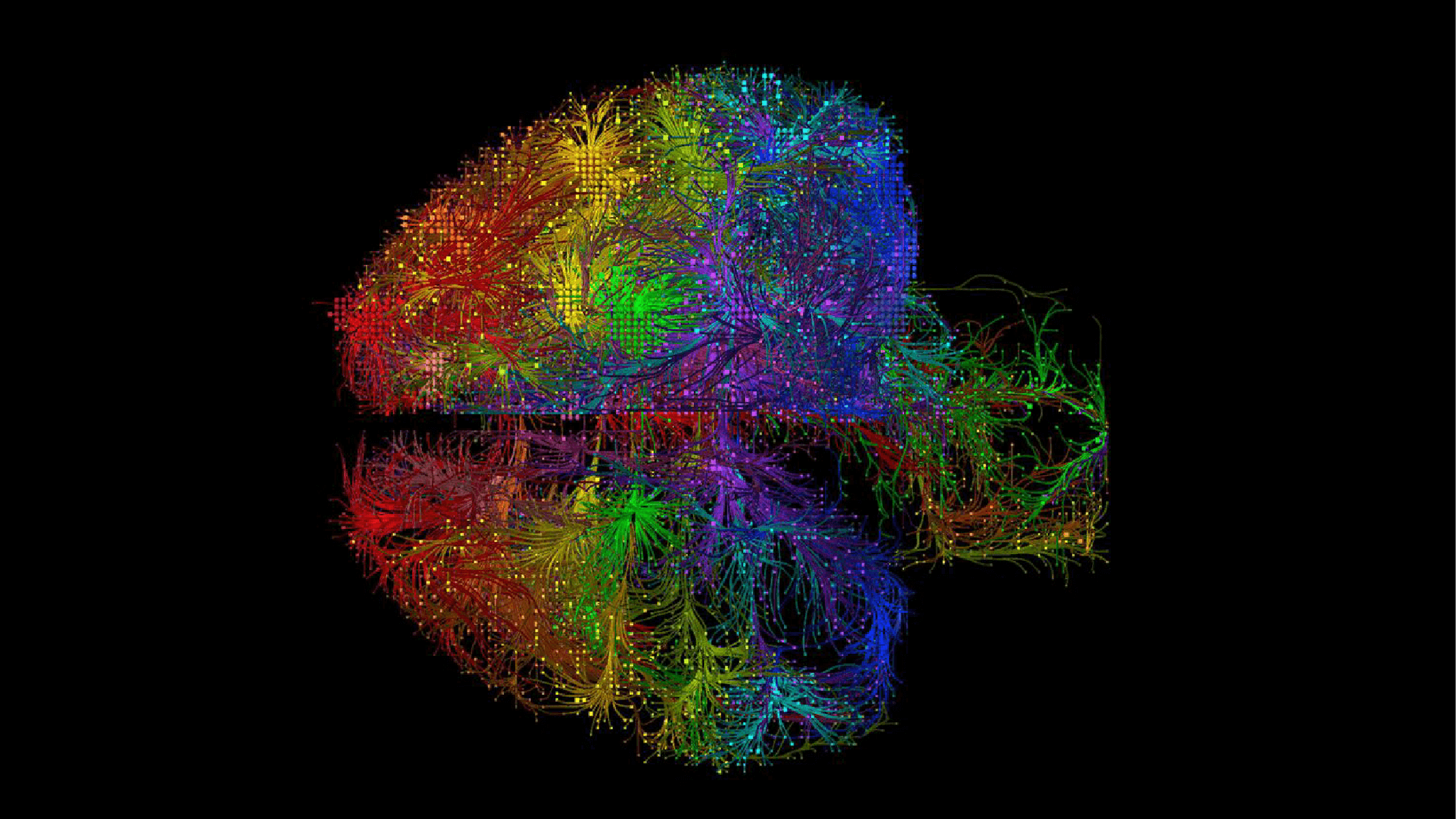
Researchers are only beginning to scratch the surface of how this complex wiring translates to the brain’s many abilities, but a new study modeling connectivity in the mouse brain has shed light on some particularly rare connections — those that span very long distances in the brain.
In a study published last month in the journal PLOS Computational Biology, Allen Institute computational neuroscientists describe a computational model that reveals that long-range connections in the mouse brain are important for neurons to work in sync with each other, and to break that synchrony when it’s no longer needed.
Researchers believe that the brain’s ability to synchronize — and rapidly switch between synchronous and asynchronous activity — is important for a wide range of different functions. Such rapid switching is often diminished in patients with Alzheimer’s disease, as are the long-range connections, so it’s also possible these connections are important for keeping our brains healthy.
“There’s a very unique complexity that’s present in the brain’s connection structure,” said Hannah Choi, Ph.D., a visiting scientist at the Allen Institute for Brain Science, a division of the Allen Institute, and co-author on the study. “Even with a relatively simple model, we needed to mimic that underlying structure to capture how the brain works.”
The missing neural links
The study used data from the Allen Mouse Brain Connectivity Atlas, a wiring diagram that traces the mouse’s “connectome,” a brain-wide map of the animal’s neural connections. The researchers used that data to build a model that simulates one aspect of brain function — neural activity synchrony.
Most strong connections in the brain happen between neurons that are close to each other. But a small percentage of the brain’s connections span longer distances, and those connections turned out to be necessary for the computational model to mimic the brain’s natural dynamics. Most previous modeling work had missed taking them into account, the researchers said.
“These connections are few and far between, but they are very important,” said Stefan Mihalas, Ph.D., Associate Investigator at the Allen Institute for Brain Science and study co-author. “It’s easy to miss them because you need to do a lot of measurements to capture them. The only reason we haven’t missed them is because the connectivity data in the atlas is very thorough.”
Why we synchronize
To explain why a brain would need to synchronize its activity, Mihalas poses some questions that sound more metaphysical than mathematical: “What makes a brain a whole, rather than the sum of pieces? If you put two brains together, why aren’t those one giant brain?”
It sounds like a ridiculous question, but consider the phenomenon of “split-brain syndrome,” in which some patients who have their left and right hemispheres severed (usually to treat severe epilepsy) seem to exhibit two separate consciousnesses in one person. To perform its many functions — sensory perception, processing, decision-making — the brain needs to act both locally and globally.
A computational model that mimics the connections seen in the mouse brain was able to change states of the virtual “brain,” swiftly desynchronizing its activity but without fragmenting its whole. If the researchers scrambled the connections at random, the model would instead break apart when stimulated, unable to come together and synchronize as one unit.
Switching between synchronization and desynchronization might also help us quickly change our focus when needed, Mihalas said. MRI studies of people who are asked not to focus on any particular thing reveal that daydreaming brains exhibit synced up waves that are quickly switched off in the presence of an external stimulus like a sudden noise. And regions of the brain responsible for sensory perception, like the visual cortex, will exhibit activity even when they aren’t being stimulated, like when a person’s eyes are closed.
“It’s like an engine waiting at a traffic light, and the time when it’s engaging, the oscillations need to change,” Mihalas said.
This model is just one step toward understanding how the brain’s intricate structure enables its vast array of abilities. Researchers at the Allen Institute are working on the next iterations of the mouse connectome, a dataset that takes into account many more complexities of the mammalian brain. The neuroscientists are also working to understand how and whether connections and synchrony are altered in a mouse model of Alzheimer’s disease, findings which could elucidate another piece of the altered biology that drives this largely mysterious form of dementia.
Citations
about the allen institute
The Allen Institute is an independent, 501(c)(3) nonprofit research organization founded by philanthropist and visionary, the late Paul G. Allen. The Allen Institute is dedicated to answering some of the biggest questions in bioscience and accelerating research worldwide. The Institute is a recognized leader in large-scale research with a commitment to an open science model. For more information, visit alleninstitute.org.