in this article

Down the hill, the workshop teachers – scientists and engineers by day – huddle on a small brown dock to confer about their 24 students. A seaplane skims to the surface in the harbor behind them. The instructors have to raise their voices to be heard over the wind and the waves.
It’s crunch time.
“OK, we’re getting down to the last hours,” says one of the instructors. “What do we need to tell the teams to help them out, with this little time remaining?”
“Don’t get bogged down in the details,” another replies. “Just get it done.”
It’s the evening before the students’ final projects must be complete, and they will present their findings to the audience of their peers, fellow graduate students and postdoctoral fellows in neuroscience, engineering, math and related fields from universities and research institutions around the world, and the crew of faculty and teaching assistants from the Allen Institute for Brain Science and the University of Washington, co-hosts of the workshop, now in its fifth year.
Excitement and caffeine levels are high. It will be a long night.
The workshop, which wrapped up on Sunday, combines programming instruction and intensive neuroscience research projects, interspersed with bouts of competitive ping-pong, rowing sojourns and composing scientific limericks.
Team coding
In small teams, the students propose and execute original projects over the two weeks that require new analyses of experimental data provided by the Allen Institute. This year, as in the preceding two years, the students are working with data from the Allen Brain Observatory, an experimental platform that captures real-time activity of mouse neurons as the animals see different images or movies.
Projects this year ranged from models to predict which neurons connect with each other in the mouse visual system, to looking for clues buried in the data that might signal epileptic seizures, to using machine learning approaches to “read” the images a mouse is seeing based on the patterns of its neurons’ activity.
For some, it’s their first experience with such collaborative coding. Sara Patterson, a University of Washington neuroscience doctoral student studying primate vision, uses programming in her current research – but it had always been a solitary experience, she said. For her project, Patterson and four other workshop students were trying to identify pathways of visual information processing in the mouse brain using the lag time of neurons’ responses to images the animals see.
“When you read someone else’s code, you learn so much,” Patterson said. “The way the organizers set it up from the beginning, teaching us how to work together in coding, that was really beneficial.”
That team atmosphere is a core tenet of the workshop, said Michael Buice, Ph.D., Assistant Investigator at the Allen Institute for Brain Science and one of the directors of the workshop.
“We’re trying to set up an environment where, instead of huddling in the corner on some solo mission, people have a common goal,” he said. “Together, they figure out how to collaborate on tools and ideas to make a project happen.”
“Doing science as a team is much, much better than doing science alone,” said Patterson’s teammate, Hebrew University of Jerusalem doctoral student Stav Hertz.
Teamwork is key, but there’s a modest amount of competition as well, and not just at the ping-pong table. The teams of students are up for three possible awards after their presentations: one for the best project as voted by the other students, one that is chosen by the workshop faculty — and one for the best limerick that encapsulates their project. This year’s winning limerick, from the team who worked on predicting how neurons connect in the mouse brain:
“When asking how our neurons connect
It’s hard to know unless you dissect.
But the correlations
can make estimations
of how links and our thinks intersect.”
Mutual benefit
The students learn the ins and outs of Python, an open-source programming language that is new to many of them, receive expert instruction in applying those new skills to real-world neuroscience questions, and get access to a bespoke dataset and programming environment (hosted on the cloud, thanks to a sponsorship program from Amazon Web Services). Some of the data they work with is from Allen Institute pilot projects, not yet available to the public.
Guiding this group of students through the data provides two key services to the Allen Institute. The students can become evangelists for the data and other resources, spreading the word to other researchers who might be interested in working with the Allen Institute’s open datasets and tools, Buice said. And the workshop is a testing ground of sorts. By giving the students early access to pilot data before they are ready for public release, Allen Institute investigators can make adjustments to make the resources easier to use when they’re ready for prime time, said Shawn Olsen, Ph.D., Associate Investigator at the Allen Institute for Brain Science, also a workshop director.
“That deep feedback that you only get when someone is digging into the data is really important,” Olsen said.
The workshop’s other co-directors are Adrienne Fairhall, Ph.D., professor of physiology and biophysics at the University of Washington, and Christof Koch, Ph.D., Chief Scientist and President of the Allen Institute for Brain Science.
“We always learn something from watching people analyze the data, and teaching them to analyze the data,” said Lydia Ng, Ph.D., Senior Director of Technology at the Allen Institute for Brain Science and a TA at the workshop. “We take home ideas to improve and enhance the way we deliver data and tools to the public.”
Brain data in action
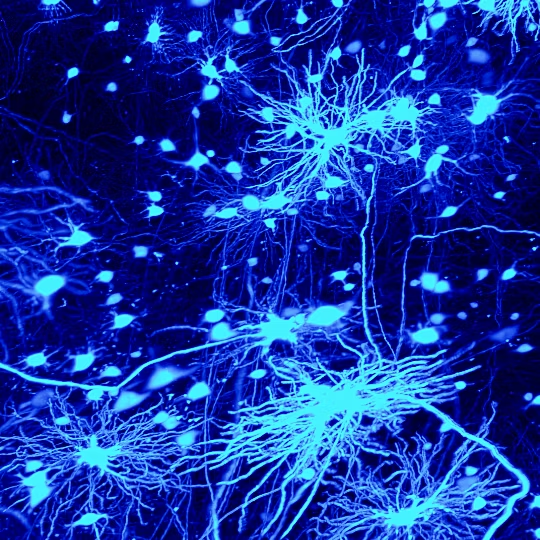
The pilot datasets workshop students accessed were related to the publicly available data from the Allen Brain Observatory, which relies on a technique known as two-photon microscopy to visualize the neurons in action.
“The amount of two-photon data the Allen Institute has, it’s totally crazy,” said Huriye Atilgan, Ph.D., a postdoctoral fellow in psychiatry at the Yale School of Medicine.
Before she came to the workshop, Atilgan was familiar with some of the Allen Institute’s projects, she said, but she didn’t realize the extent of the research projects and the amount of data available for researchers like her to use in their work. Her team’s project, which compared different types of computational models to predict how neurons connect in the mouse visual cortex, is not directly related to her current research, Atilgan said. But with the new computational skills she’s acquired, she is now thinking about taking a fresh look at datasets she generated during her doctoral work, when she studied the ferret visual system.
Vergil Haynes, a doctoral student in math and statistics at Arizona State University, and his partner tested predictions based on new theories about how animals make decisions under uncertain circumstances by looking at how mouse visual cortex neurons respond to new or familiar images. While the project doesn’t directly tie to his current research, the workshop has made him consider applying some of what he’s learned to the next step in his career after he finishes his degree, Haynes said.
“Having that opportunity to work with a dataset, work with people who understand this theory and how it applies, and being able to have that back and forth, is something I don’t get at my home institute,” he said.
Ryo Aoki, Ph.D., traveled from Japan to attend the workshop — he is a postdoctoral fellow at Riken, a research institute in Wako, near Tokyo. He came to the workshop because he wanted more experience with data-driven computational approaches, he said. His team’s project used machine learning approaches known as deep neural networks to predict what a mouse sees based on its neuron’s activity. Aoki was looking specifically at mice watching videos and trying to see if a computational model could reveal how neurons anticipate what comes next in a predictable series of images.
His lab in Japan doesn’t use Python as their primary programming language, he said, but he’s interested in following up the idea on his own time.
“Open science means I can run my analyses based on my own ideas,” Aoki said.
Citations
about the allen institute
The Allen Institute is an independent, 501(c)(3) nonprofit research organization founded by philanthropist and visionary, the late Paul G. Allen. The Allen Institute is dedicated to answering some of the biggest questions in bioscience and accelerating research worldwide. The Institute is a recognized leader in large-scale research with a commitment to an open science model. For more information, visit alleninstitute.org.