impact
impact
open science
subheadline
careers and opportunities
subheadline
people & teams
people & teams
subheadline
allenites
subheadline
allen institute advisors
subheadline
board of directors
subheadline
shanahan foundation fellowship
subheadline
next generation leaders
subheadline
research
overview
our approach
subheadline
publications
subheadline
open science
subheadline
accelerator
brain science
subheadline
cell science
subheadline
neural dynamics
subheadline
immunology
subheadline
synthetic biology
subheadline
education
education
science education
subheadline
education resources
subheadline
field trips
subheadline
open science
subheadline
open science quest
subheadline
news
news
stories
subheadline
podcast
subheadline
sign up for our newsletter
subheadline
events
events
all events
subheadline
conferences
subheadline
event code of conduct
subheadline
events
open science quest
subheadline
summer workshop on the dynamic brain
subheadline
open science week
subheadline
brain fest
subheadline
science resources
science resources
allencell.org
subheadline
allenimmunology.org
subheadline
allenneuraldynamics.org
subheadline
brain-bican.org
subheadline
brain-map.org
subheadline
microns-explorer.org
subheadline
impact
back to menu
impact
open science
subheading
careers and opportunities
subheading
people & teams
people & teams
subheading
allen institute advisors
subheading
board of directors
subheading
shanahan foundation fellowship
subheading
next generation leaders
subheading
research
back to menu
impact
Label
subheading
Label
subheading
people & teams
education
back to menu
research
Label
subheading
Label
subheading
Heading
news
back to menu
research
Label
subheading
Label
subheading
Heading
events
back to menu
research
Label
subheading
Label
subheading
Heading
science resources
back to menu
science resources
allencell.org
subheading
allenimmunology.org
subheading
allenneuraldynamics.org
subheading
brain-bican.org
subheading
brain-map.org
subheading
microns-explorer.org
subheading
search
stories
news

A turbo engine for tracing neurons

Putting a turbo engine into an old car gives it an entirely new life-suddenly it can go further, faster.

April 28, 2017
 min read
share/
Allen Institute researchers have developed a powerful new automated system for reconstructing the intricate three-dimensional shapes of neurons at unprecedented speed and scale.
Thank you! Your submission has been received!
Oops! Something went wrong while submitting the form.

in this article

table of contents will display on published page only
set h2 to populate the table of contents here

That same idea is now being applied to neuroscience, with a software wrapper that can be used on existing neuron tracing algorithms to boost their ability to handle not just big, but enormous sets of data. The wrapper, called UltraTracer, is highlighted this month in Nature Methods.

“In trying to uncover the diversity of neuron shapes, scale is a very large and increasingly pressing problem,” says Hanchuan Peng, Ph.D., Associate Investigator at the Allen Institute for Brain Science. “We need to be able to compare tens of thousands of neuron shapes in order to really understand what they look like, and to use that information to parse individual cell ‘types.’”
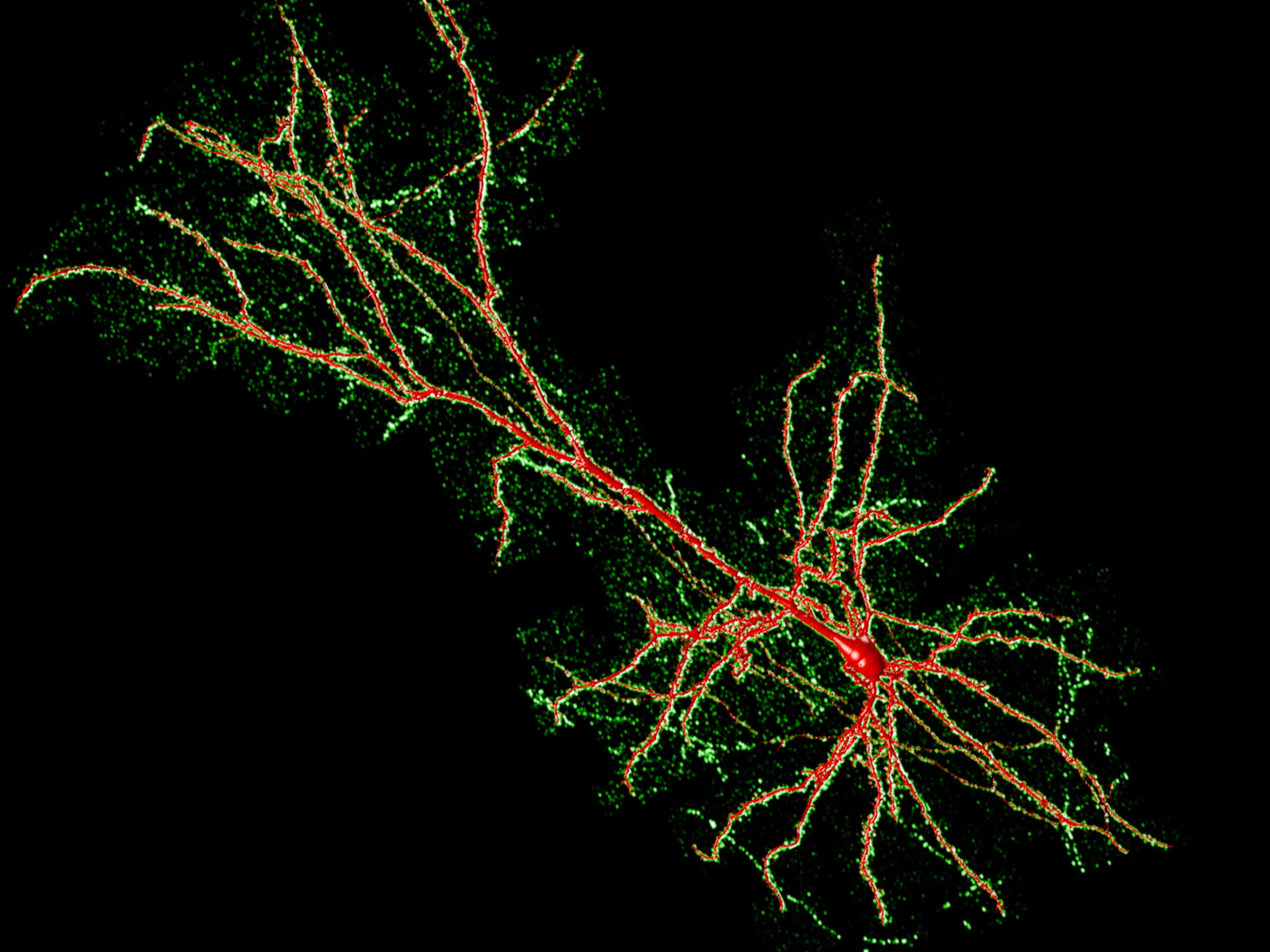
Colorful neural network visualization with branching dendrites and red soma on black background

Peng and his team designed UltraTracer to work with existing neuron tracing algorithms designed by scientists around the world, turbo-charging them to work faster and with larger datasets. In the paper, they describe applying UltraTracer to ten different base tracers and also to any other base tracers in the BigNeuron initiative (bigneuron.org), developed by different people and that used varying techniques to automatically detect the shapes of neurons in three-dimensional image stacks.

The team was able to demonstrate UltraTracer’s unique ability to supercharge existing software. Using the Allen Cell Types Database as a biological reference, the software first learned what neurons “should” look like. UltraTracer then made existing algorithms more efficient to handle bigger data sets, and combined several different algorithms in an organic way that made the most of each tracer’s strengths.

“With UltraTracer, we are giving new life to neuron tracing algorithms that already exist and making them even more powerful,” says Peng. “We can now test how well these algorithms work at very large scales, and make them work better. This will be a crucial step in addressing fundamental questions about cell types in the brain.”

Citations
No items found.

about the allen institute

The Allen Institute is an independent, 501(c)(3) nonprofit research organization founded by philanthropist and visionary, the late Paul G. Allen. The Allen Institute is dedicated to answering some of the biggest questions in bioscience and accelerating research worldwide. The Institute is a recognized leader in large-scale research with a commitment to an open science model. For more information, visit alleninstitute.org.
explore related stories

explore more stories
No articles for the category
we acceleratedevelopcatalyzeimpact

science done differently. shared with the world.

explore our accelerators

brain science

Mapping every cell, connection, and circuit in the brain—openly shared with the world.

cell science

Decoding how cells become tissues, then programming that knowledge into powerful new research tools.

neural dynamics

Revealing the brain's hidden algorithms that transform neural activity into real-world behavior.

immunology

Creating the deepest open reference for the healthy human immune system ever built.

synthetic biology

Engineering cells to record their own histories, transforming how we understand disease over time.

research

Big questions, open answers, and science built to be shared.

education

Inspiring the next generation of scientists through open science resources.

impact

Our science is empowering researchers and advancing health worldwide.
advancing science through open, collaborative research
Get the allen institute newsletter
Stay informed on the latest breakthroughs in neuroscience, bioscience, and AI-driven research.
allen institute
impactpeople & teamscareers & opportunitiesalumnihistory & founder
science resources
allencell.orgallenimmunology.orgallenneuraldynamics.orgbrain-bican.orgbrain-map.orgmicrons-explorer.org
research
brain sciencecell scienceneural dynamicsimmunologysynthetic biologypublications
education
science educationfield tripsprofessional developmenteducation resources
quick links
newseventsopen sciencepodcastscience resourceshuman brain donationvisit uscontact
follow us/

allen institute, 615 Westlake Ave North, Seattle, WA 98109 +12065487055

© 0000 allen institute. all rights reserved.
privacy policyterms of usecitation policyemployee portalpolicy & compliance