
in this article
In collaboration with scientists at the University of California, Berkeley, researchers at the Allen Institute for Brain Science have identified a specific group of neurons that control sleep. The results are published this month in the journal Nature.
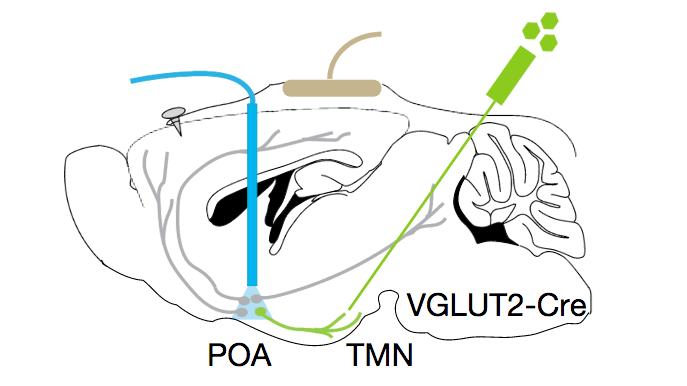
Located deep in the brain, an area of the hypothalamaus called the preoptic area (POA) has been shown to be critical for sleep, since damaging it leads to profound sleep impairment. But the composition and wiring of this part of the brain is far from straightforward. Neurons that are active during falling and staying asleep are tightly interwoven with neurons that are active during wakefulness. This makes targeting the sleep-specific neurons very challenging.
To distinguish the sleep-active neurons from the wake-active neurons, researchers employed a number of techniques including viral labeling, molecular profiling and optogenetics. They were able to trace these neurons backwards from other sleep-regulating areas of the brain and to identify a number of molecular markers that mark neurons specific only to sleep, rather than wakefulness.
“These results are exciting because they give us specific access to sleep-active neurons, rather than the POA in general, which contains intermingled cells of different functions,” says Bosiljka Tasic, Ph.D., Associate Director of Molecular Genetics and an author on the paper. “The new genes that mark these cells and new tools created based on these genes will enable us to ask many new questions about how sleep is wired in the brain, and could perhaps lead to targeted sleep therapies down the road.”
Citations
about the allen institute
The Allen Institute is an independent, 501(c)(3) nonprofit research organization founded by philanthropist and visionary, the late Paul G. Allen. The Allen Institute is dedicated to answering some of the biggest questions in bioscience and accelerating research worldwide. The Institute is a recognized leader in large-scale research with a commitment to an open science model. For more information, visit alleninstitute.org.




