in this article
The Allen Institute today announced new phases of research for its largest division, the Allen Institute for Brain Science, as well as a leader hired to direct a new neuroscience-related division of the Institute.
This change reflects a structural transition for the Allen Institute for Brain Science as it nears the end of its current 10-year scientific timeline. Established in 2003, the Allen Institute for Brain Science has grown to more than 300 researchers and staff working in two broad research programs.
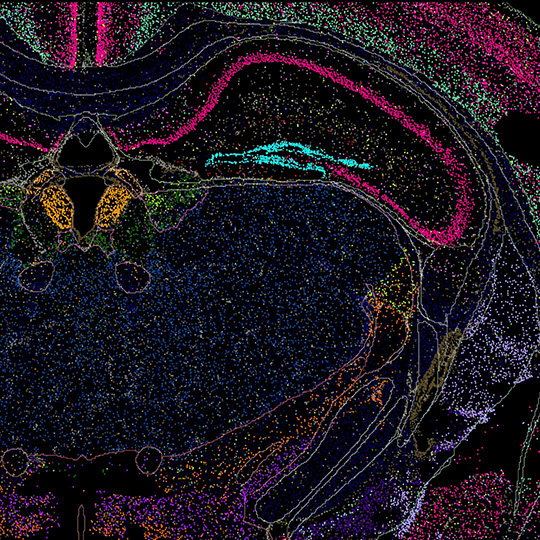
The larger of these groups, the Cell Types program, will move into a new 16-year phase that builds on the team’s success in working toward a “periodic table” of brain cell types. In this new phase, the Allen Institute for Brain Science will focus solely on brain cell types and connectivity research. The MindScope Program, which seeks to understand how the brain’s neural circuits produce the sense of vision, will also move into a new phase of discovery and will transition out of the Allen Institute for Brain Science to become a separate program of the Allen Institute.
“Through the vision and guidance of our late founder, Paul G. Allen, our model has always been to find scientific problems where our particular flavor of big, team and open science can have the greatest impact,” said Allan Jones, Ph.D., President and Chief Executive Officer of the Allen Institute. “As we shift into the next phase of our neuroscience research, I am confident that our teams will continue to push the boundaries of discovery and create invaluable resources for the community.”
Christof Koch, Ph.D., currently the President and Chief Scientist of the Allen Institute for Brain Science, will continue to lead the MindScope Program as its Chief Scientist. Hongkui Zeng, Ph.D., currently Executive Director of Structured Science, will lead the cell types and connectivity research as the Executive Vice President, Director of the Allen Institute for Brain Science.
Additionally, renowned neuroscientist Karel Svoboda, Ph.D., will join the Allen Institute in 2021 to lead a new division of the Institute, which will launch in 2022 and will focus on research related to neural computation and dynamics.
The Allen Institute for Brain Science’s next phase
The Allen Brain Observatory, established under Koch’s leadership, was built to understand how the brain stores, encodes and processes information, using the mouse visual system as a model for understanding. Koch will continue to lead Observatory projects and direct a team of researchers under the MindScope Program.
“After spending the past eight years building up the tools (such as MesoScope and Neuropixels), instrumental recording capabilities and data analysis pipelines of the Allen Brain Observatory, we are now ready over the next five years to harvest the scientific insights into how the mouse cortex, 14 million complex neurons packed into the volume of a tenth of a sugar cube, represent and evaluate incoming visual information to rapidly and robustly control the behavior and the perception of the mouse,” Koch said. “I’m looking forward to dedicating my efforts to this exciting area of research in the years ahead.”
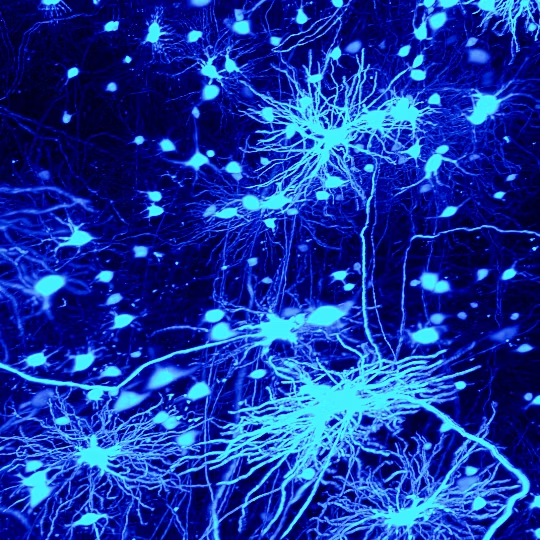
Zeng has been a neuroscientist at the Allen Institute since 2006 and leads several projects aiming to create a periodic table of cell types in the brain. Under her leadership, the Allen Institute for Brain Science will now dedicate its focus to defining comprehensive catalogs of mouse and human brain cell types, understanding how different cell types arise through development and evolution, and how they connect and function in health and in disease. The division will generate brain atlases, tools and foundational knowledge for the neuroscience community. Zeng is also the principal investigator on several large National Institutes of Health-funded research projects and programs, which she will continue to lead in her new role.
“I am honored to lead the Allen Institute for Brain Science, and I am confident our researchers will continue to lead their fields as we work together to tackle new and challenging scientific questions,” Zeng said. “Our teams have made incredible progress in the past decade in our quest to identify the ‘parts lists’ of the mouse and human brains and how these parts are connected into the ‘Google map’ of the brain. Information gained from these efforts opens up unprecedented opportunities for us to look deeper into how brain works. I’m excited to help bring our endeavor to the next level.”
A new Institute coming in 2022
The Allen Institute’s newest division is slated to launch in 2022 and will focus on neural computation and dynamics, with a more specific vision to be developed in several planning sessions this year and next. The new division, led by Svoboda, will focus on making new discoveries and solving hard problems in neural computation.
Svoboda is currently a senior group leader at The Howard Hughes Medical Institute’s Janelia Research Campus, where his lab studies synaptic plasticity and develops new technologies and tools. He was previously a professor at Cold Spring Harbor Laboratory, completed a postdoctoral fellowship at Bell Labs and earned his Ph.D. in biophysics from Harvard University. He has served as a member of the Allen Institute for Brain Science’s scientific advisory councils over the past 10 years.
“Over the years as a frequent visitor and advisor to the Allen Institute, I have grown to know and value its unique intellectual culture,” Svoboda said. “The Allen Institute has made extraordinary contributions to science and the world, and I’m so excited join this amazing community.”
Citations
about the allen institute
The Allen Institute is an independent, 501(c)(3) nonprofit research organization founded by philanthropist and visionary, the late Paul G. Allen. The Allen Institute is dedicated to answering some of the biggest questions in bioscience and accelerating research worldwide. The Institute is a recognized leader in large-scale research with a commitment to an open science model. For more information, visit alleninstitute.org.