
impact
impact
open science
subheadline
careers and opportunities
subheadline
people & teams
people & teams
subheadline
allenites
subheadline
allen institute advisors
subheadline
board of directors
subheadline
shanahan foundation fellowship
subheadline
next generation leaders
subheadline
research
overview
our approach
subheadline
publications
subheadline
open science
subheadline
accelerator
brain science
subheadline
cell science
subheadline
neural dynamics
subheadline
immunology
subheadline
synthetic biology
subheadline
education
education
science education
subheadline
education resources
subheadline
field trips
subheadline
open science
subheadline
open science quest
subheadline
news
news
stories
subheadline
podcast
subheadline
sign up for our newsletter
subheadline
events
events
all events
subheadline
conferences
subheadline
event code of conduct
subheadline
events
open science quest
subheadline
summer workshop on the dynamic brain
subheadline
open science week
subheadline
brain fest
subheadline
science resources
science resources
allencell.org
subheadline
allenimmunology.org
subheadline
allenneuraldynamics.org
subheadline
brain-bican.org
subheadline
brain-map.org
subheadline
microns-explorer.org
subheadline
impact
back to menu
impact
open science
subheading
careers and opportunities
subheading
people & teams
people & teams
subheading
allen institute advisors
subheading
board of directors
subheading
shanahan foundation fellowship
subheading
next generation leaders
subheading
research
back to menu
impact
Label
subheading
Label
subheading
people & teams
education
back to menu
research
Label
subheading
Label
subheading
Heading
news
back to menu
research
Label
subheading
Label
subheading
Heading
events
back to menu
research
Label
subheading
Label
subheading
Heading
science resources
back to menu
science resources
allencell.org
subheading
allenimmunology.org
subheading
allenneuraldynamics.org
subheading
brain-bican.org
subheading
brain-map.org
subheading
microns-explorer.org
subheading
search
stories
news

Allen Institute for Brain Science Database Release Nearly Doubles Mouse Brain Cell Data

The Allen Institute for Brain Science today announced the release of new data, tools to analyze those data and a new web-based 3D viewer to explore...

June 21, 2018
 min read
share/
The Allen Institute for Brain Science today announced the release of new data, tools to analyze those data and a new web-based 3D viewer to explore...
Thank you! Your submission has been received!
Oops! Something went wrong while submitting the form.

in this article

table of contents will display on published page only
set h2 to populate the table of contents here
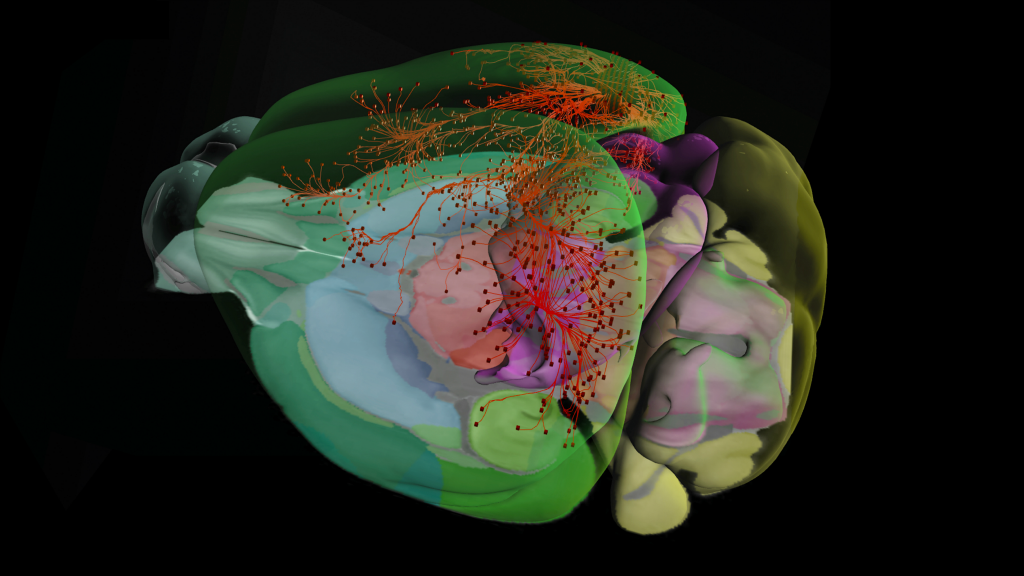
Colorful 3D brain model with green, blue, red, and yellow regions showing neural connections and pathways

SEATTLE, WASH. — June 21, 2018 — The Allen Institute for Brain Science today announced the release of new data, tools to analyze those data and a new web-based 3D viewer to explore anatomy and connections in the mouse brain, the Allen Brain Explorer. Today’s data release almost doubles the number of mouse cells in the Allen Cell Types Database – raising the number included from just over 1,000 to slightly more than 1,900 cells – as well as adding new neuronal connectivity information to the Allen Mouse Brain Connectivity Atlas and adding more single-cell transcriptomics data from mouse, human and macaque brain cells.

The growth of datasets contained in the Allen Brain Atlas allows researchers at the Allen Institute for Brain Science and in the broader neuroscience community to classify brain cells into different categories that help researchers understand more about the mammalian brain and its diversity, part of an ongoing effort to create a “periodic table” of brain cell types. As more data accumulate, those classifications provide a richer description of cellular complexity, said David Feng, Ph.D., associate director of technology at the Allen Institute for Brain Science.

“We use different aspects of the cells – their gene activity, their shape, where they send the information to, their electrical behavior – to come up with classifications that have biological meaning,” Feng said. “Understanding the properties of cells in the brain is a critical step toward understanding how the brain works.”

Because the brain is so complex, Allen Institute for Brain Science researchers need to collect large amounts of data from tens of thousands of brain cells to reliably sort the different cells into categories and begin to understand what those categories mean.

In addition to the new mouse brain cell data, today’s release includes data at the single cell level from human and macaque brains, through collaborative projects with teams at UW Medicine and the Swedish Neuroscience Institute. These precious data sets provide researchers with insight into differences between the human and animal brains, which are used to model human diseases.

“Diseases that affect the brain may start from a specific part of the brain or even a specific cell type,” said Bosiljka Tasic, Ph.D., associate director of molecular genetics at the Allen Institute for Brain Science. “To know where a disease starts – and ultimately how to treat it – we have to understand the individual building blocks of the brain.”

Today also marks the beta release of two new data analysis tools. One, the Allen Brain Explorer, is a web-based application that allows users to visualize mouse brain anatomy and connectivity in 3D. Previously, this tool had been available as a desktop application only; now, users can reach the explorer through their web browsers. The second tool, called RNA-Seq Data Navigator, allows researchers to visualize categories of brain cells based on their gene similarity patterns. These open data analysis applications join a rich toolkit for clinicians and neuroscientists around the world to use at no cost.

Citations
No items found.

about the allen institute

The Allen Institute is an independent, 501(c)(3) nonprofit research organization founded by philanthropist and visionary, the late Paul G. Allen. The Allen Institute is dedicated to answering some of the biggest questions in bioscience and accelerating research worldwide. The Institute is a recognized leader in large-scale research with a commitment to an open science model. For more information, visit alleninstitute.org.


explore related stories

explore more stories
No articles for the category
we acceleratedevelopcatalyzeimpact

science done differently. shared with the world.

explore our accelerators

brain science

Mapping every cell, connection, and circuit in the brain—openly shared with the world.

cell science

Decoding how cells become tissues, then programming that knowledge into powerful new research tools.

neural dynamics

Revealing the brain's hidden algorithms that transform neural activity into real-world behavior.

immunology

Creating the deepest open reference for the healthy human immune system ever built.

synthetic biology

Engineering cells to record their own histories, transforming how we understand disease over time.

research

Big questions, open answers, and science built to be shared.

education

Inspiring the next generation of scientists through open science resources.

impact

Our science is empowering researchers and advancing health worldwide.
advancing science through open, collaborative research
Get the allen institute newsletter
Stay informed on the latest breakthroughs in neuroscience, bioscience, and AI-driven research.
allen institute
impactpeople & teamscareers & opportunitiesalumnihistory & founder
science resources
allencell.orgallenimmunology.orgallenneuraldynamics.orgbrain-bican.orgbrain-map.orgmicrons-explorer.org
research
brain sciencecell scienceneural dynamicsimmunologysynthetic biologypublications
education
science educationfield tripsprofessional developmenteducation resources
quick links
newseventsopen sciencepodcastscience resourceshuman brain donationvisit uscontact
follow us/

allen institute, 615 Westlake Ave North, Seattle, WA 98109 +12065487055

© 0000 allen institute. all rights reserved.
privacy policyterms of usecitation policyemployee portalpolicy & compliance


