in this article
The Allen Institute for Brain Science announced today that it is undertaking three major projects designed to accelerate brain, and spinal cord research, and help scientists worldwide gain new insight into numerous diseases and disorders.
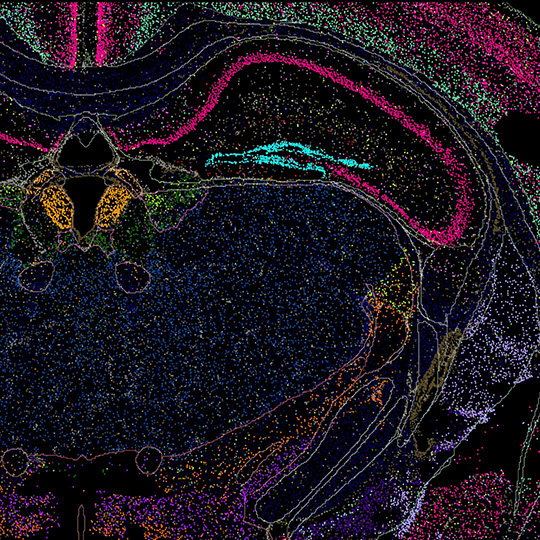
The Institute will create three new Web-based atlas resources that map gene activity in the brain and spinal cord. These include an atlas designed to provide insight into gene expression in the human brain; an atlas of the developing mouse brain designed to illustrate and enhance understanding of gene activity across multiple stages of development from birth through adulthood; and an atlas of the mouse spinal cord designed to inform research into spinal injuries due to disease, disorder or trauma.
The new atlases will be officially known as the Allen Brain Atlas (ABA)—Human Brain, ABA— Developing Mouse Brain, and ABA—Mouse Spinal Cord. Upon completion, the atlases will be made publicly available on the Internet at no charge to users to encourage widespread use and scientific collaboration.
“Building on the success of our inaugural Allen Brain Atlas project, we are inspired to take on projects at the leading edge of science—creating large-scale resources that will fuel innovation for countless discoveries in brain research,” said Allan Jones, Chief Scientific Officer at the Allen Institute. “Scientists in the research community agree that these projects will provide a transformative catalyst for advancing and promoting innovation, ultimately allowing for the most positive impact worldwide. The Institute is uniquely suited to successfully complete these projects because of its established technology platforms and multidisciplinary reach.”
Recognizing that the atlases can exponentially advance the global understanding of many diseases and disorders that afflict millions, the Allen Institute has been successful in bringing diverse groups together to fund a common project by providing centralized databases of information that an individual researcher might spend a lifetime trying to gather.
“By putting our data in the hands of scientists studying devastating diseases and disorders such as autism, obesity, epilepsy, schizophrenia and Amyotrophic Lateral Sclerosis (ALS), these new projects will enable the work of many researchers, industries and organizations,” said Elaine Jones, Chief Operating Officer at the Allen Institute. “We believe that free access to our unique resources is the best way to encourage widespread use and collaboration, which ultimately could expedite progress toward life-changing medical breakthroughs.”
Mapping the Human Brain
Building on new technology and information gained in the development of its inaugural project, the ABA—Mouse Brain, which was completed in 2006, the Institute will develop the ABA—Human Brain, the world’s first human brain atlas that overlays information about gene activity onto a three-dimensional anatomic map. For the first time and using a fresh approach to human brain mapping, the Institute will create a unique resource for understanding genes at work in the human brain and combining information about gene activity with existing anatomic and functional knowledge.
Currently, about 26 percent of American adults—close to 58 million people—suffer from a diagnosable mental disorder in a given year. This atlas will enable researchers and clinicians worldwide to advance understanding of brain diseases and disorders and speed progress toward breakthrough therapies.
“Ultimately, understanding the anatomic basis of gene expression in the normal brain will enable us to more effectively target abnormal gene expression in individual patients with brain cancer,” said Dr. Greg Foltz, a neurosurgeon at Swedish Medical Center in Seattle, Wash. “As we move into the new era of personalized medicine, understanding the variability between individuals with highly heterogeneous diseases will be fundamental to developing effective treatment strategies. The human brain atlas will provide a critical resource for any scientist or physician interested in treating diseases of the brain.”
When completed in approximately four years, the ABA—Human Brain will provide the scientific community with a comprehensive map of gene activity in the human brain. The key features include a quantitative inventory of which genes are turned on in each brain structure and a finer-resolution image database pinpointing to the cellular level where a selected list of high-value genes are turned on.
Understanding the Developing Brain
The ABA—Developing Mouse Brain will provide new insights into how a brain develops and matures. For this two-year project, the Institute will develop a highly detailed map of gene activity in the developing mouse brain. The resulting atlas will comprise an extensive image database showing where several thousand of genes are expressed, or “turned on,” in the mouse brain at multiple stages of development, from before birth through adulthood. In addition, it will show gene expression in various organs within the embryo.
“The developing brain atlas provides a molecular narrative of how the genetic map of the brain unfolds in space and time,” said Dr. David Anderson, professor of biology and Howard Hughes Medical Institute investigator at the California Institute of Technology. “The atlas will be invaluable in gaining insight into the origins of certain behavioral disorders, such as schizophrenia and autism, which are increasingly thought to result from abnormalities of brain development.”
This new atlas holds promise for furthering understanding of human developmental disorders such as autism and other age-associated conditions including schizophrenia and Alzheimer’s disease. In addition, it is likely to uncover new opportunities for therapeutic intervention, as genes that are important for healthy brain development and maintenance may be helpful in slowing progress of degenerative diseases, preventing life-changing secondary brain damage from stroke or other brain injuries and repairing brain tissue already damaged by injury or disease.
Analyzing the Spinal Cord
In response to specific requests from the spinal cord research community and advocacy groups, and with support from a diverse consortium of funders, the Institute is following its successful ABA—Mouse Brain project with an atlas mapping gene expression in the mouse spinal cord. Expected to be complete in a one-year timeframe, the ABA—Spinal Cord will be a comprehensive genome-wide survey of gene expression that pinpoints where each gene is expressed—or “turned on”—in both juvenile and adult mouse spinal cord.
“The spinal cord is relatively small, compared to the brain, but it is a crucial highway for transmitting signals between the brain and the rest of the body in order to make everything work the way we need it to,” said Dr. Jane Roskams, associate professor at the Brain Research Center and iCord at the University of British Columbia. “It may be small, but can be catastrophic when it becomes broken. The problem is that we know very little about the genes that control different functions in the spinal cord. This mouse spinal cord atlas will absolutely help researchers advance their work in this area in quantum leaps, and maybe it will help us discover how to make spinal cord patients take leaps of their own.”
The Institute hopes this unique database will support the entire spinal cord research community, offering an essential baseline of the normal mouse spinal cord for comparison with models of injuries or diseases found in humans. The atlas holds great promise for furthering understanding of diseases and disorders affecting the spinal cord—including ALS, multiple sclerosis, Spinal Muscular Atrophy and spinal cord injuries—and pointing the way for effective treatments.
The ABA—Spinal Cord is funded by a group of disease organizations, foundations, and corporate and private donors. The Institute will continue seeking support from individuals and organizations for the spinal cord atlas project.
“We are excited to see such a diverse array of funders come forward with the shared goal of supporting this project to advance spinal cord research,” said Elaine Jones. “This is an example of individuals and organizations coming together to fund an important project that will empower scientists and have farreaching impacts on spinal cord research in the future. We look forward to building similar funding groups for our human brain atlas, developing brain atlas and other projects moving forward.”
Citations
about the allen institute
The Allen Institute is an independent, 501(c)(3) nonprofit research organization founded by philanthropist and visionary, the late Paul G. Allen. The Allen Institute is dedicated to answering some of the biggest questions in bioscience and accelerating research worldwide. The Institute is a recognized leader in large-scale research with a commitment to an open science model. For more information, visit alleninstitute.org.