impact
impact
open science
subheadline
careers and opportunities
subheadline
people & teams
people & teams
subheadline
allenites
subheadline
allen institute advisors
subheadline
board of directors
subheadline
shanahan foundation fellowship
subheadline
next generation leaders
subheadline
research
overview
our approach
subheadline
publications
subheadline
open science
subheadline
accelerator
brain science
subheadline
cell science
subheadline
neural dynamics
subheadline
immunology
subheadline
synthetic biology
subheadline
education
education
science education
subheadline
education resources
subheadline
field trips
subheadline
open science
subheadline
open science quest
subheadline
news
news
stories
subheadline
podcast
subheadline
sign up for our newsletter
subheadline
events
events
all events
subheadline
conferences
subheadline
event code of conduct
subheadline
events
open science quest
subheadline
summer workshop on the dynamic brain
subheadline
open science week
subheadline
brain fest
subheadline
science resources
science resources
allencell.org
subheadline
allenimmunology.org
subheadline
allenneuraldynamics.org
subheadline
brain-bican.org
subheadline
brain-map.org
subheadline
microns-explorer.org
subheadline
impact
back to menu
impact
open science
subheading
careers and opportunities
subheading
people & teams
people & teams
subheading
allen institute advisors
subheading
board of directors
subheading
shanahan foundation fellowship
subheading
next generation leaders
subheading
research
back to menu
impact
Label
subheading
Label
subheading
people & teams
education
back to menu
research
Label
subheading
Label
subheading
Heading
news
back to menu
research
Label
subheading
Label
subheading
Heading
events
back to menu
research
Label
subheading
Label
subheading
Heading
science resources
back to menu
science resources
allencell.org
subheading
allenimmunology.org
subheading
allenneuraldynamics.org
subheading
brain-bican.org
subheading
brain-map.org
subheading
microns-explorer.org
subheading
search
stories
news

Allen Institute partners to bring open science to Africa

Computational neuroscience course, built on Allen Institute tools and data, aimed to empower next-gen researchers in Africa.

August 2, 2024
 min read
share/
Computational neuroscience course, built on Allen Institute tools and data, aimed to empower next-gen researchers in Africa.
Thank you! Your submission has been received!
Oops! Something went wrong while submitting the form.

in this article

table of contents will display on published page only
set h2 to populate the table of contents here

In a sunlit classroom in Kigali, Rwanda, Vincent Ogwal fixates on his computer screen, lines of code cascading before him. The young graduate student from Uganda grapples with questions that have long fascinated him, questions at the intersection of technology and neuroscience: How can we decode the brain’s intricate signals? What secrets of human cognition might computational models unveil?

Ogwal was one of 20 undergraduate and graduate students from across Africa selected to explore how computational neuroscience and machine learning might help us understand the brain’s deepest mysteries. In mid-July, they gathered at the Carnegie Mellon University (CMU)-Africa campus in a highly competitive summer course organized by TReND in Africa (Teaching and Research in Natural Sciences for Development in Africa), a volunteer-run charity supporting scientific advancement across the continent.
Three people collaborating at a table with laptops and a keyboard during a team training session.
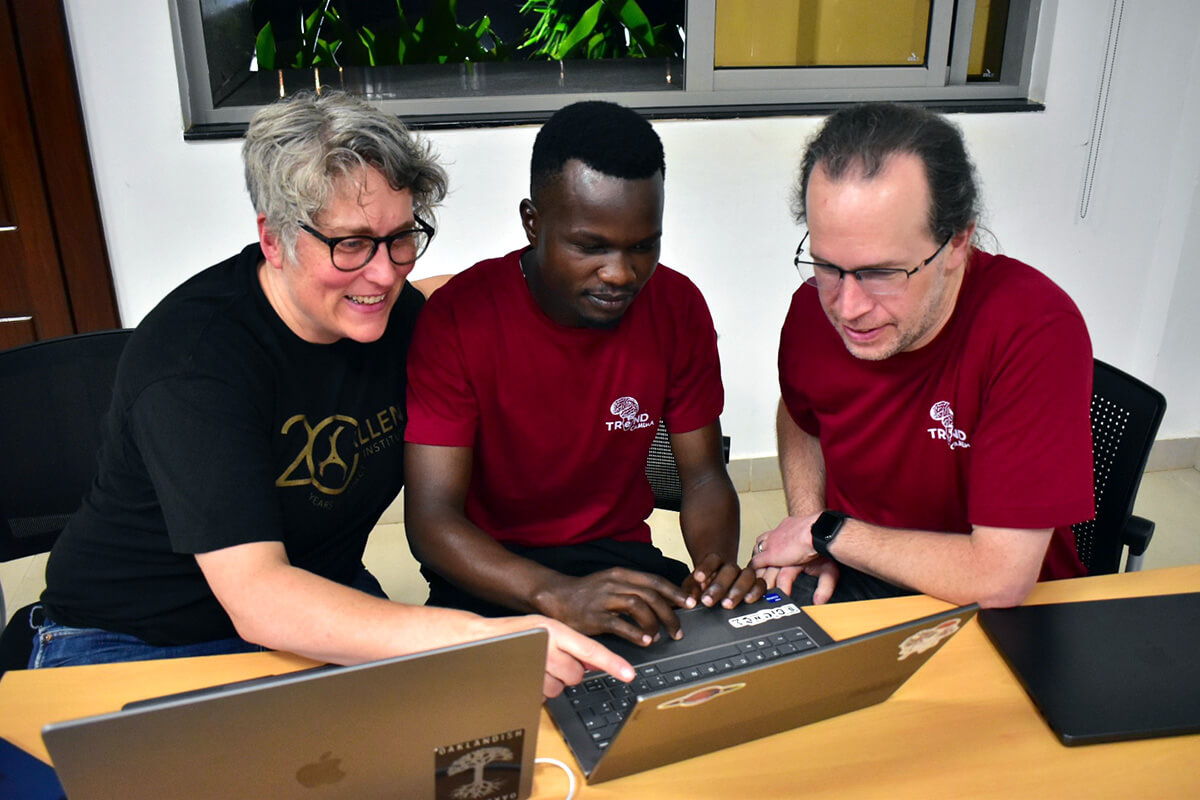
Allen Institute researchers Saskia De Vries, Ph.D. (left) and Michael, Buice, Ph.D. (right) work with student Vincent Ogwal.

This year, the charity partnered with the Allen Institute to further develop the TReND-CaMinA (Computational Neuroscience and Machine learning in Africa) course, utilizing the Institute’s free tools and datasets.

“Based on their experience last year, the organizers were eager for students to be able to conduct projects using real data,” said Saskia de Vries, Ph.D., associate director of Data and Outreach at the Allen Institute. “That’s where we came in.”

Several Allen Institute scientists, including de Vries and Michael Buice, Ph.D., associate investigator, traveled to Kigali to provide hands-on tutorials on resources like the Allen Brain Observatory.

“The students were very engaged and eager to dive into the course,” Buice said. “We received multiple accounts from the students that the initial day was extremely overwhelming, but that after some time for review and through the second day things started to coalesce.” 
Large group of people standing together in front of colorful modern sign
2024’s TReND-CaMinA students and staff in front of CMU Africa’s campus

For students like Ogwal, the course was a transformative experience.

“Working with the Allen Institute’s data sets provided an invaluable opportunity to apply advanced data analysis techniques to real-world neuroscience problems, leading to meaningful discoveries about brain function and organization,” he said. “The insights gained from this analysis contribute to the broader field of neuroscience and highlight the potential of large-scale data in advancing our understanding of the brain.”

His sentiment embodied the spirit of the program.

The TReND-CAMinA course aims to establish the fields of computational neuroscience and machine learning in Africa, nurture a new generation of researchers addressing challenges unique to the continent, and create a network that fosters sustainable development and contributes to global knowledge.
Group of people in burgundy shirts assembled circuit boards and wires on wooden table together.
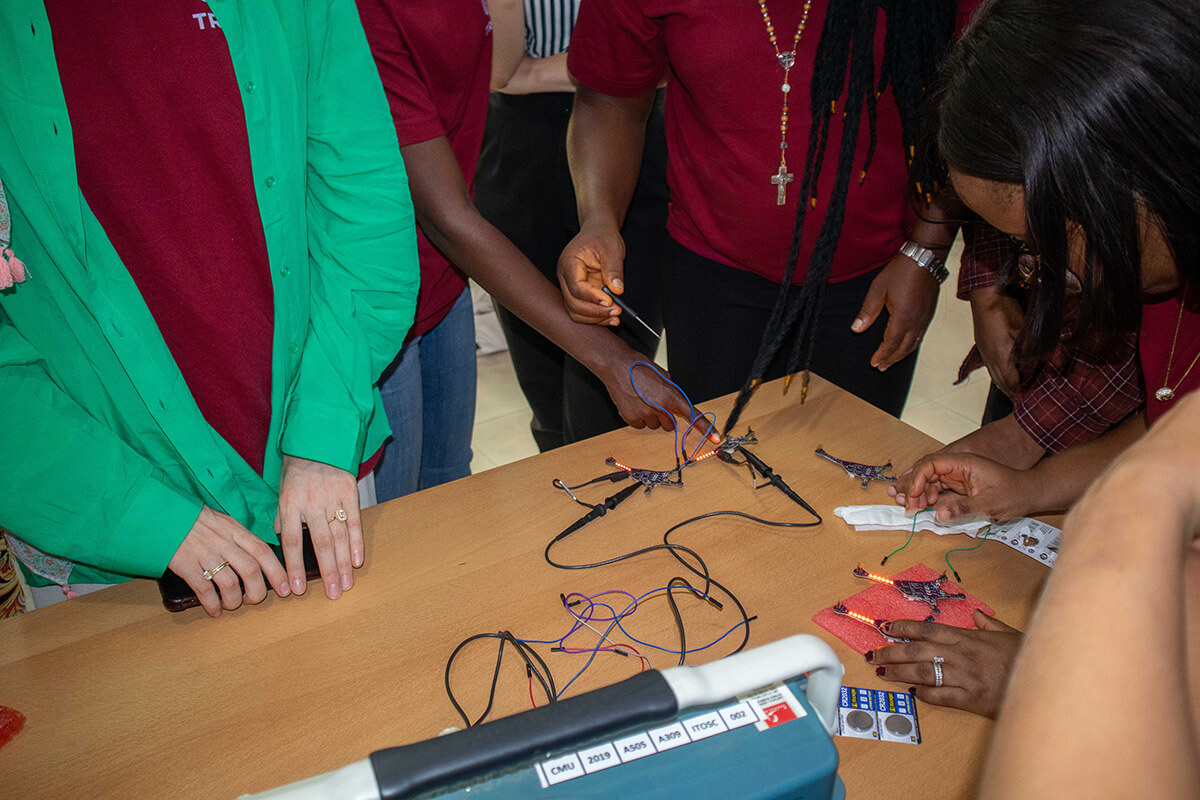
Students work with a printed circuit board device that simulates the dynamics of real neurons.

“African researchers primarily focus on applied and translation research. Opportunities for fundamental research are scarce, making it difficult to see the relevance of basic scientific questions,” said Artemis Koumoundourou, Ph.D., executive director of TReND. “Exposing our students to the Allen Institute’s work conveyed the necessity of fundamental research. Not only that, the participants felt motivated and inspired by the data and the magnitude of the effort put into it.”

Kigali, Rwanda

Your browser does not support HTML5 video.

The students’ drive was impressive, de Vries said.

“Given the limited opportunities to study neuroscience in Africa, these students have already shown remarkable initiative,” she said. “They were very curious, highly motivated, and determined to make sure they understood the material as we were teaching.”

The experience also highlighted the importance of cross-cultural understanding in scientific endeavors, de Vries added.
A blank white image with no visible content or objects

The Student Experience

Simangele Shabalala discusses why she applied for the TReND-CAMiNA course.

“One of my big takeaways was how different the academic training environment is in Africa,” she said. “Better understanding their education system will enable us to better evaluate African candidates for our programs and job openings, and ultimately engage and collaborate more effectively with African scientists.”
Group of five people wearing matching red Africa-themed t-shirts walking up building steps
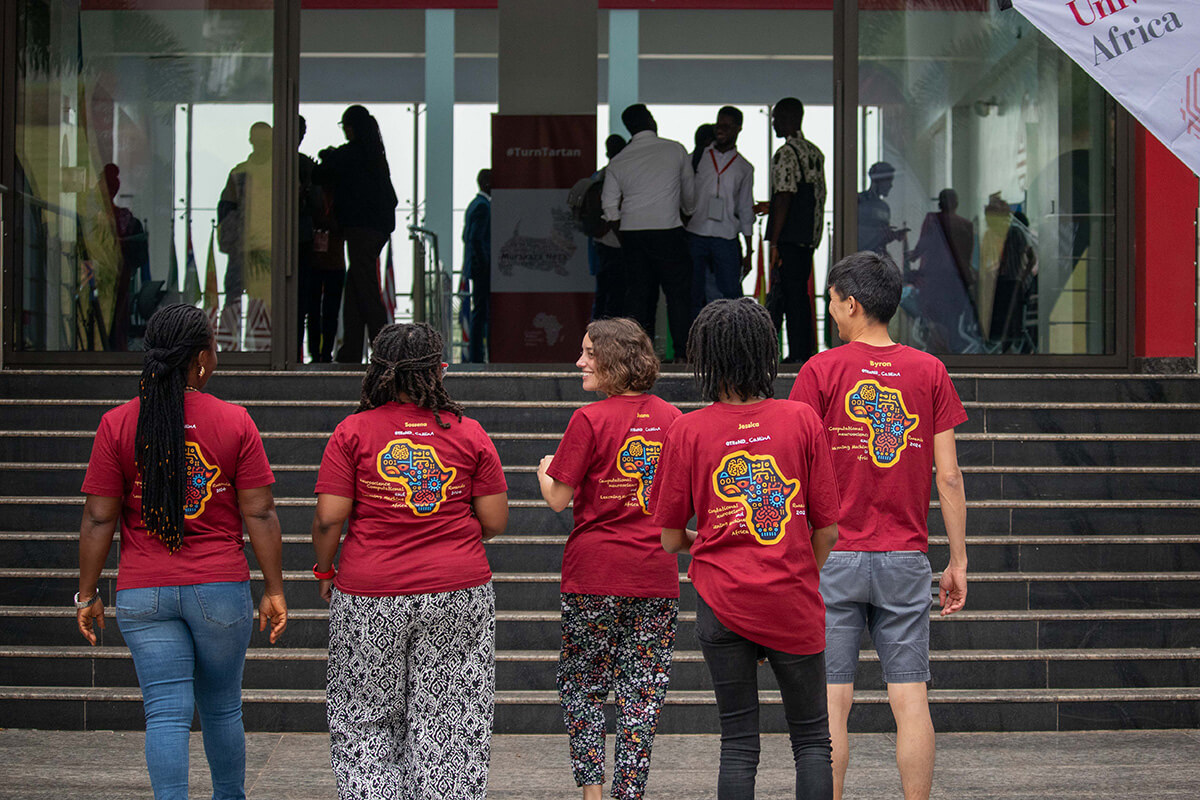
A group of students is seen entering a building on CMU Africa’s campus

The TReND team is eager to deepen the partnership, she added. “Working with the Allen team enriches our course and has a positive impact on our student’s careers and on the dissemination of computational neuroscience and machine learning skills across Africa,” Koumoundourou said.

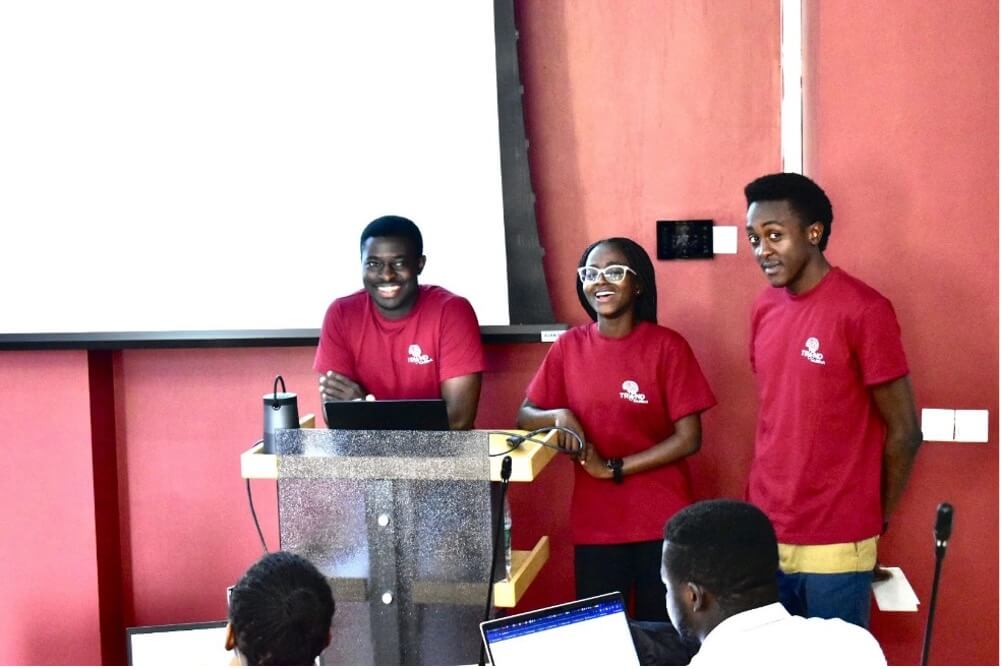
The course culminated in small research projects and presentations, where students applied their newly acquired knowledge of Allen Institute data and tools.
Three smiling young people in red t-shirts present at podium against pink wall background.
Musirikare Ben Nyirihirwe (left), Ruby Etornam Adikah, and Angelo Karugo share their research into how neurons respond to repeated stimulus exposure.

“Learning from people with different areas of expertise and backgrounds has been incredibly rewarding,” said Ruby Etornam Adikah, who is studying to be an optometrist at Kwame Nkrumah University of Science and Technology. “Over just two and a half weeks, we built lifelong connections, networks, and friendships, becoming more than just colleagues—we became family.”

All photos courtesy of the students, faculty, and staff of TReND-CaMinA.

Citations
No items found.

about the allen institute

The Allen Institute is an independent, 501(c)(3) nonprofit research organization founded by philanthropist and visionary, the late Paul G. Allen. The Allen Institute is dedicated to answering some of the biggest questions in bioscience and accelerating research worldwide. The Institute is a recognized leader in large-scale research with a commitment to an open science model. For more information, visit alleninstitute.org.


explore related stories

explore more stories
No articles for the category
we acceleratedevelopcatalyzeimpact

science done differently. shared with the world.

explore our accelerators

brain science

Mapping every cell, connection, and circuit in the brain—openly shared with the world.

cell science

Decoding how cells become tissues, then programming that knowledge into powerful new research tools.

neural dynamics

Revealing the brain's hidden algorithms that transform neural activity into real-world behavior.

immunology

Creating the deepest open reference for the healthy human immune system ever built.

synthetic biology

Engineering cells to record their own histories, transforming how we understand disease over time.

research

Big questions, open answers, and science built to be shared.

education

Inspiring the next generation of scientists through open science resources.

impact

Our science is empowering researchers and advancing health worldwide.
advancing science through open, collaborative research
Get the allen institute newsletter
Stay informed on the latest breakthroughs in neuroscience, bioscience, and AI-driven research.
allen institute
impactpeople & teamscareers & opportunitiesalumnihistory & founder
science resources
allencell.orgallenimmunology.orgallenneuraldynamics.orgbrain-bican.orgbrain-map.orgmicrons-explorer.org
research
brain sciencecell scienceneural dynamicsimmunologysynthetic biologypublications
education
science educationfield tripsprofessional developmenteducation resources
quick links
newseventsopen sciencepodcastscience resourceshuman brain donationvisit uscontact
follow us/

allen institute, 615 Westlake Ave North, Seattle, WA 98109 +12065487055

© 0000 allen institute. all rights reserved.
privacy policyterms of usecitation policyemployee portalpolicy & compliance


