impact
impact
open science
subheadline
careers and opportunities
subheadline
people & teams
people & teams
subheadline
allenites
subheadline
allen institute advisors
subheadline
board of directors
subheadline
shanahan foundation fellowship
subheadline
next generation leaders
subheadline
research
overview
our approach
subheadline
publications
subheadline
open science
subheadline
accelerator
brain science
subheadline
cell science
subheadline
neural dynamics
subheadline
immunology
subheadline
synthetic biology
subheadline
education
education
science education
subheadline
education resources
subheadline
field trips
subheadline
open science
subheadline
open science quest
subheadline
news
news
stories
subheadline
podcast
subheadline
sign up for our newsletter
subheadline
events
events
all events
subheadline
conferences
subheadline
event code of conduct
subheadline
events
open science quest
subheadline
summer workshop on the dynamic brain
subheadline
open science week
subheadline
brain fest
subheadline
science resources
science resources
allencell.org
subheadline
allenimmunology.org
subheadline
allenneuraldynamics.org
subheadline
brain-bican.org
subheadline
brain-map.org
subheadline
microns-explorer.org
subheadline
impact
back to menu
impact
open science
subheading
careers and opportunities
subheading
people & teams
people & teams
subheading
allen institute advisors
subheading
board of directors
subheading
shanahan foundation fellowship
subheading
next generation leaders
subheading
research
back to menu
impact
Label
subheading
Label
subheading
people & teams
education
back to menu
research
Label
subheading
Label
subheading
Heading
news
back to menu
research
Label
subheading
Label
subheading
Heading
events
back to menu
research
Label
subheading
Label
subheading
Heading
science resources
back to menu
science resources
allencell.org
subheading
allenimmunology.org
subheading
allenneuraldynamics.org
subheading
brain-bican.org
subheading
brain-map.org
subheading
microns-explorer.org
subheading
search
stories
news

Breakthrough Dravet Syndrome gene therapy in mice brings new hope to families

In a groundbreaking advancement scientists have developed a new gene replacement therapy in mice that could lead to more effective treatments in...

March 19, 2025
 min read
share/
In a groundbreaking advancement scientists have developed a new gene replacement therapy in mice that could lead to more effective treatments in humans.
Thank you! Your submission has been received!
Oops! Something went wrong while submitting the form.

in this article

table of contents will display on published page only
set h2 to populate the table of contents here

Breakthrough Dravet Syndrome gene therapy in mice brings new hope to families

Scientists successfully replace defective gene to alleviate symptoms without side effects.

By Liz Dueweke

In a groundbreaking advancement for families grappling with the challenges of Dravet syndrome, a rare and life-altering form of epilepsy, scientists have developed a new gene replacement therapy in mice that could lead to more effective treatments in humans. The new therapy, a collaboration between researchers at the Allen Institute and Seattle Children’s Research Institute, alleviated symptoms and led to long-term recovery without toxicity, side effects, and death.

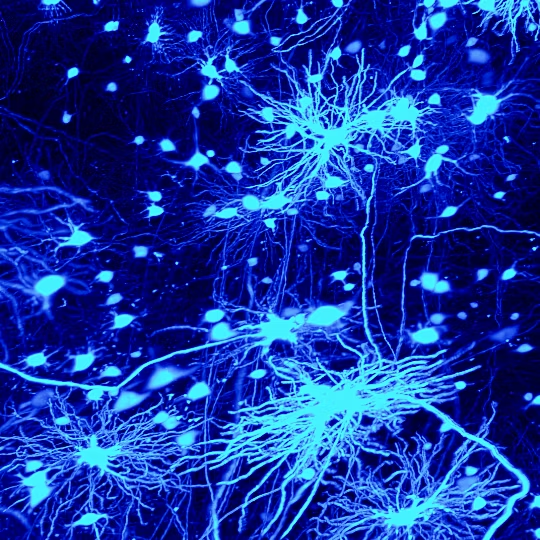
(This movie shows SCN1A genes illuminated in neurons of a mouse with Dravet syndrome.)

“People who take drugs for epilepsy often complain that the drugs are very impactful, they can slow down the seizures but it changes a lot about their brain,” said Boaz Levi, Ph.D., associate investigator at the Allen Institute, who co-led the study with Franck Kalume,Ph.D., an associate professor at the University of Washington and principal investigator at Seattle Children’s Research Institute.

Dravet syndrome affects around 1 in 15,700 children, and most cases are caused by mutations in the SCN1A gene. This gene plays a crucial role in the brain’s ability to regulate activity through fast-spiking interneurons. With severe seizures and developmental delays, this disease has long left families and researchers desperate for more effective treatments.

These two Electroencephalogram (EEG) recordings, at 25% speed, show neural activity in mouse brains. The top recording is from a Dravet Syndrome (DS) model mouse that was treated with the SCN1A AAVs while the bottom recording is from a DS model mouse that was not treated. The untreated mouse experiences a seizure during this recording (large amplitude spikes halfway through the recording), while no seizures are observed in the treated mouse during the recorded interval.

This new therapy involves an innovative two-step strategy:

1. Precision gene delivery: Using specialized enhancers (short stretches of DNA that act like switches to control when and where a specific gene is turned on) scientists were able to target specific cells that are defective in patients with Dravet syndrome.

2. Solving the puzzle of gene size limits: Gene therapy is done through AAV vectors. These are harmless viruses that can carry genes into cells. But the SCN1A gene is too large to fit into conventional AAV vectors, so scientists overcame this hurdle by using a protein fusion mechanism which splits the gene into two parts so that it can be carried into the cell and reassembled. Each half is delivered to the same cell by a separate virus where the fuse together to make the final gene. This is like delivering a large piece of furniture into your home in two parts because it can’t fit through the front door and then reassembling it once the pieces are inside.

Treated mice in this study showed remarkable improvement: Seizures were alleviated, recovery was long-lasting, and no adverse effects were observed.

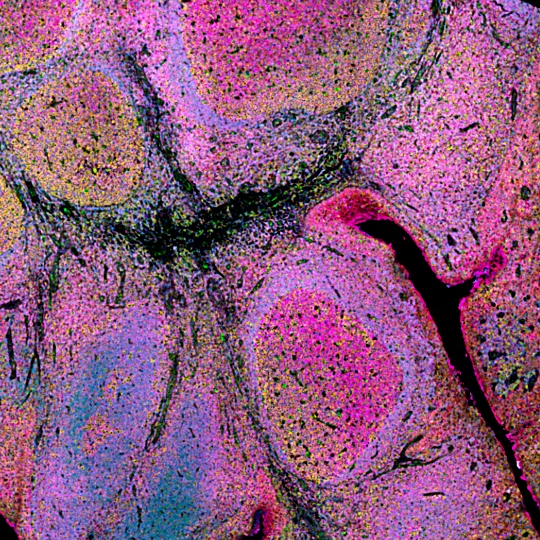
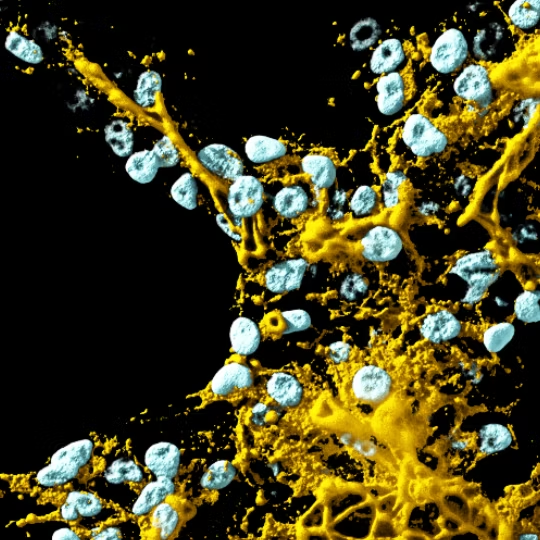
(This image shows neurons illuminated in yellow in the brain of a mouse that received neuron-specific SCN1A AAVs which work to produce safe correction of Dravet Syndrome symptoms.)

What’s next? A promising path forward

These results not only support the potential of AAV-mediated SCN1A gene replacement, but also spotlight the critical role of cell-specific therapies in combating genetic disorders like Dravet syndrome. “These are people who are going to have a severely impacted standard of living,” said Levi. “We are hopeful this sort of a therapy could have a huge impact for families, and that’s what’s exciting to me.”

Related News

“Computational crystal ball” helps predict cell behavior

Mar 31, 2026

Mind trip: How psilocybin changes the brain

Mar 12, 2026

Computer model predicts aspects of cognitive performance

Jan 28, 2026

Citations
No items found.

about the allen institute

The Allen Institute is an independent, 501(c)(3) nonprofit research organization founded by philanthropist and visionary, the late Paul G. Allen. The Allen Institute is dedicated to answering some of the biggest questions in bioscience and accelerating research worldwide. The Institute is a recognized leader in large-scale research with a commitment to an open science model. For more information, visit alleninstitute.org.
explore related stories

explore more stories
No articles for the category
we acceleratedevelopcatalyzeimpact

science done differently. shared with the world.

explore our accelerators

brain science

Mapping every cell, connection, and circuit in the brain—openly shared with the world.

cell science

Decoding how cells become tissues, then programming that knowledge into powerful new research tools.

neural dynamics

Revealing the brain's hidden algorithms that transform neural activity into real-world behavior.

immunology

Creating the deepest open reference for the healthy human immune system ever built.

synthetic biology

Engineering cells to record their own histories, transforming how we understand disease over time.

research

Big questions, open answers, and science built to be shared.

education

Inspiring the next generation of scientists through open science resources.

impact

Our science is empowering researchers and advancing health worldwide.
advancing science through open, collaborative research
Get the allen institute newsletter
Stay informed on the latest breakthroughs in neuroscience, bioscience, and AI-driven research.
allen institute
impactpeople & teamscareers & opportunitiesalumnihistory & founder
science resources
allencell.orgallenimmunology.orgallenneuraldynamics.orgbrain-bican.orgbrain-map.orgmicrons-explorer.org
research
brain sciencecell scienceneural dynamicsimmunologysynthetic biologypublications
education
science educationfield tripsprofessional developmenteducation resources
quick links
newseventsopen sciencepodcastscience resourceshuman brain donationvisit uscontact
follow us/

allen institute, 615 Westlake Ave North, Seattle, WA 98109 +12065487055

© 0000 allen institute. all rights reserved.
privacy policyterms of usecitation policyemployee portalpolicy & compliance