in this article

Emily Sylwestrak, Ph.D., has a hard time putting her finger on the exact moment her interest in science began. It’s always been there, for as long as she can remember.
But she can trace her love affair with neuroscience back to a very precise point. She was in college at the University of Illinois and had just started a job in a lab where the researchers use a technique known as electrophysiology to read out neurons’ activity in real time.
To Sylwestrak, that first experiment was like having a conversation with the cells in the petri dish in front of her.
“I just thought that was the coolest thing,” she said. “This brain tissue is alive in a dish and I can talk to each neuron to see what it’s saying.” Sylwestrak was hooked.
Fast forward 15 years from that first experiment, and Sylwestrak is now getting ready to launch her own brand-new lab at the University of Oregon. Throughout her neuroscience research career, she’s relied heavily on Allen Institute for Brain Science resources: first as a doctoral student studying how neurons find their partners when they make synapses, and then as a postdoctoral fellow studying an ancient, molecularly diverse brain structure known as the habenula that plays a role in addiction, depression, pain and sleep.
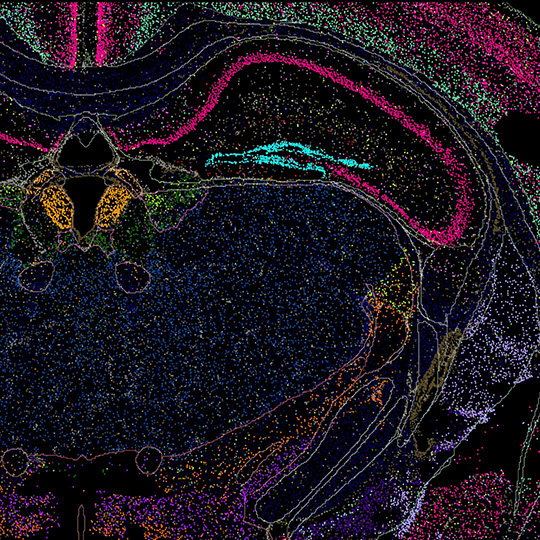
Both her doctoral work and her most recent project working in the Deisseroth Lab at Stanford University came about in part because of observations she made in the Allen Mouse Brain Atlas, a publicly available database produced by the Allen Institute for Brain Science that charts where all genes are turned on and off throughout the entire mouse brain.
“The tools of the Allen Institute have been critical at several points in my career,” she said.
Sylwestrak has long been interested in diversity in the brain, or more specifically, how neurons that are all different in shape and activity work together to drive behavior. And the habenula is one of the most diverse parts of the brain, cellularly speaking.
A tiny brain structure that stands out
Sylwestrak first came to this area of research almost by chance. The habenula was right next to the mouse neurons she was studying in her doctoral research on a completely different topic. When she was looking at the Allen Mouse Brain Atlas, which uses different colors of fluorescent labels to show where more than 20,000 different genes are turned on or off in the mouse brain, she noticed some particularly bright variance in this tiny structure.
“From a visual perspective, it really stands out,” she said.
And she saw that there were some genes that seemed specialized to the habenula, for example, one gene that’s involved in response to nicotine lights up there and nowhere else in the brain.
Other research groups have seen in humans and in rodents that brain activity in the habenula is altered in people with depression or addiction, but those studies didn’t pinpoint specific cell types in those roles. Understanding the individual cell types behind brain function and dysfunction is important, Sylwestrak said, if you want to develop better treatments.
Take human response to reward and reward-seeking behavior, for example. Reward drives so much of what we do — think cracking open a beer at the end of a long day, or promising yourself five minutes of surfing the internet if you get to the end of a lengthy work task. But the same circuits that drive this rather innocuous reward-seeking can be hijacked by drugs of abuse.
“If you want to treat something like addiction, you might have a lot of options of what to target, because there are so many areas of the brain involved in reward,” Sylwestrak said. “But each of those treatments might also have off-target effects.”
Picking apart cell types in the habenula
Because of the specialized patterns of gene expression Sylwestrak saw in the habenula, she thought this structure might be different. But before researchers can start developing drugs to target this structure, they need to understand what its cells do.
“To understand something, it helps to know its component parts,” Sylwestrak said.
To dig deeper into the habenula, Sylwestrak focused on four cell types in that region, as defined by four different genes that light up in different ways in the Allen Mouse Brain Atlas. She trained mice to perform a task in exchange for a reward and studied how the activity of each type of neuron changed when the animals were seeking out or receiving their reward. What were the cells saying to her, and what did that mean about their role in reward?
As Sylwestrak suspected and as the Allen Institute gene expression data had hinted, the different cells in the habenula have different roles to play. One of the cell types was active when the mouse was receiving its reward. One type was active when an animal was expecting a reward. And one was especially active when an animal expected a reward based on its training, but the reward was withheld.
How these cell types work together in the habenula — and whether maladaptation in their human counterparts is involved in drug-seeking, addiction, or depression — is yet to be worked out. That’s part of what Sylwestrak hopes to tackle in her new lab.
Sharing science openly
Last December, more than a decade after she’d first started sifting through the Allen Mouse Brain Atlas, Sylwestrak presented her research at the Allen Institute’s 2018 Showcase Symposium. She was recently appointed to the Next Generation Leaders council, an Allen Institute for Brain Science advisory council by and for early-career researchers; members of that council are invited to participate in and present at the Showcase.
It was Sylwestrak’s first visit to the Institute in person. Being named to the council and getting to present was “an absolute honor,” she said. “It was great to see how it all works. The possibilities of this place are really palpable when you visit.”
When thinking about what she wanted to talk about at the symposium, she was excited to share her most recent results, especially knowing the project had its genesis in Allen Institute data. But the habenula work is not yet published, and it’s the largest part of her postdoctoral research. So Sylwestrak had a moment of pause when she was putting together her slides —scientists are sometimes wary of sharing unpublished work publicly — but that doubt was only temporary.
“I shared this in part because it’s one of the goals of open science, to propel people to share their findings earlier, so that we can learn from each other. I’m excited that the Allen Institute is really pushing on that,” she said. “I thought, I don’t want to do science in an atmosphere where I have to worry about sharing my results openly. If I can’t succeed in this way, I’m not sure if I want to.”
Watch Emily Sylwestrak’s full presentation from the 2018 Showcase Symposium:
Emily Sylwestrak | Showcase 2018
Citations
about the allen institute
The Allen Institute is an independent, 501(c)(3) nonprofit research organization founded by philanthropist and visionary, the late Paul G. Allen. The Allen Institute is dedicated to answering some of the biggest questions in bioscience and accelerating research worldwide. The Institute is a recognized leader in large-scale research with a commitment to an open science model. For more information, visit alleninstitute.org.