
Did you ever wish you could unsee something? It turns out your brain is capable of that — no bleach required.
Unfortunately, it’s a limited superpower: In a phenomenon known as “visual masking,” we don’t consciously perceive an image if another image is shown in quick succession. But the timing of those images matters. The first image needs to flash on and off fairly quickly, and the second image needs to follow rapidly (on the order of 50 milliseconds), for the masking to work.

To be clear, while the first image doesn’t last in your field of vision for very long, it’s definitely long enough that you would be aware of it without the second image, or mask.

What are the steps between the rain of photons on your retina and actual conscious perception of what you are seeing?
Christof Koch, Ph.D.
meritorious investigator at the Allen Institute
Scientists discovered this strange phenomenon in the 19th century, but why — and how — the human brain does this remains a mystery.
“This is an interesting observation, where what is present in the world is not accurately reflected in your perception,” said Shawn Olsen, Ph.D., an investigator at the Allen Institute. “Like other visual illusions, we think that it tells us something about the way the visual system works and ultimately about the neural circuits that underlie visual awareness.”
In a new study published today in the journal Nature Neuroscience, Olsen and his colleagues delved into the science behind this odd optical illusion — and showed for the first time that it happens in mice too. After training mice to report on what they saw, the team was also able to pinpoint a certain region of the brain that’s necessary for the visual masking illusion to work.
The study narrows down the parts of the brain responsible for awareness of the world around us, said Christof Koch, Ph.D., a meritorious investigator at the Allen Institute, who led the study along with Olsen and Sam Gale, Ph.D., a scientist at the Allen Institute. “What are the steps between the rain of photons on your retina and actual conscious perception of what you are seeing?” he asked.
How do we perceive?
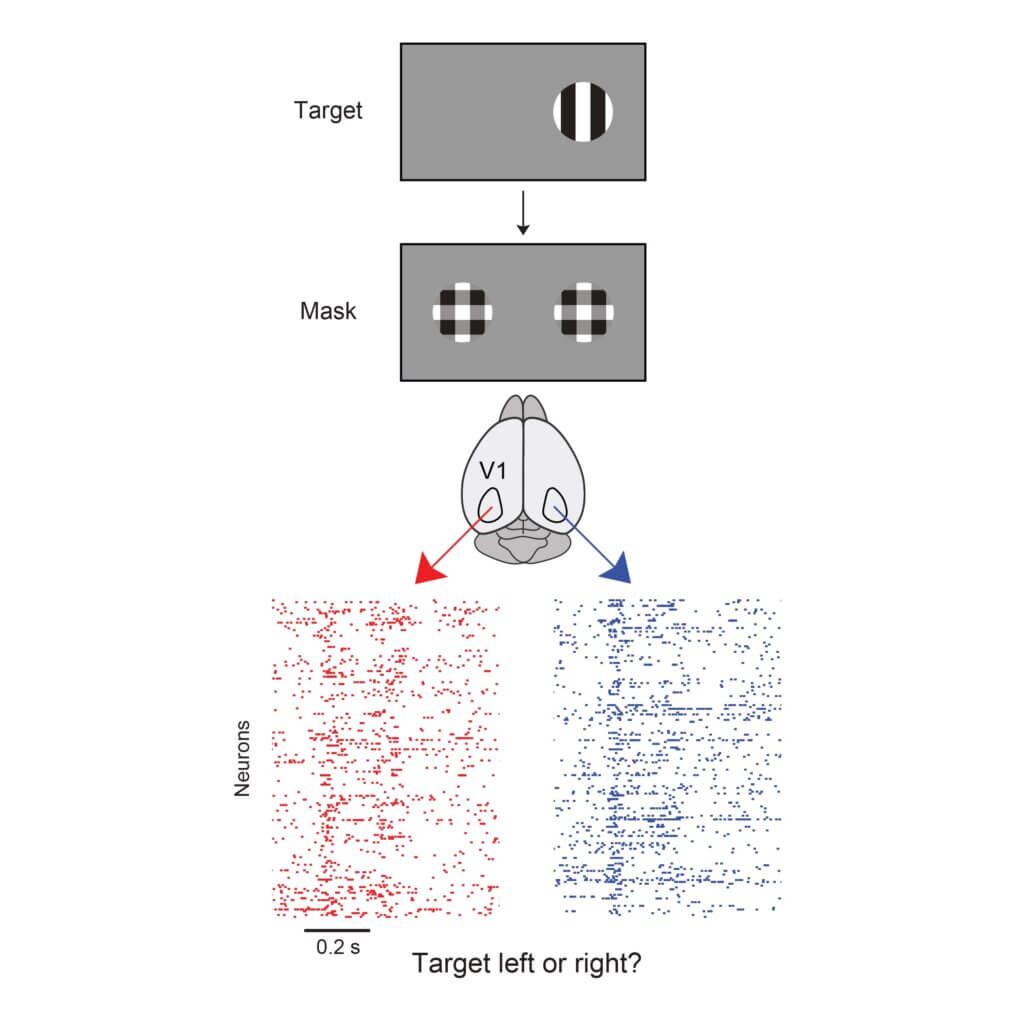
When the rain of photons impinges on our retinas, the information takes a prescribed path from our eyeballs through several different regions of the brain, ending in higher processing areas of the cortex, the wrinkled outermost shell of the brain. From previous studies of visual masking, scientists know that neurons in the retina and parts of the brain early in that pathway are activated even when a person is not aware that they’re seeing an image. In other words, your brain is seeing things without your knowledge.
To explore where unconscious sensation turns into conscious perception and action, the scientists first trained 16 mice to turn a tiny LEGO wheel toward the direction of a quickly flashed image in exchange for a treat if they chose the correct direction. The scientists then added a different masking image on both sides of the screen, directly following the target image. With the addition of the mask, the animals could no longer do the task correctly — implying they were no longer aware of the original, target image.
Because visual masking had never been tested in mice before, the research team had to create the task for them, meaning the images and how they were shown differed from those used in previous human studies. To confirm that the optical illusion they showed the rodents is relevant to us, the team also tested it in 16 people (the wheel replaced by keystroke; no treats required). Human perception (or lack thereof) and mouse perception of this specific visual masking illusion turned out to be very similar.
The scientists then used a special technique known as optogenetics that can quickly suppress the activity of cells or entire regions of the brain with a flash of light. They aimed this suppression at the mouse primary visual cortex, known to be the first part of the cortex where visual information from the eyes enters the higher cortical areas of the brain. By turning off the primary visual cortex at the instant the masking image was shown, but after the target image, the research team was able to block visual masking entirely — the mice went back to correctly pinpointing the location of the first image even though a masking image was present.
That result means that conscious perception is happening either in the visual cortex or in higher areas of the cortex downstream of it. That fits with the general sentiment in the field that the cortex is the seat of conscious perception in mammals, including us, Koch said.
Although their study narrowed down the region responsible for conscious perception to the cortex, there are still many areas of the cortex that could be involved. Further studies would need to silence these other regions to test their effect on the visual masking task.
“We’re starting to put some bounds on where masking is occurring,” Olsen said. “We think this is a good paradigm to follow up on to track down the other regions that are listening to the primary visual cortex and essentially fusing the streams of target and mask information in the brain.”
Citations
about the allen institute
The Allen Institute is an independent, 501(c)(3) nonprofit research organization founded by philanthropist and visionary, the late Paul G. Allen. The Allen Institute is dedicated to answering some of the biggest questions in bioscience and accelerating research worldwide. The Institute is a recognized leader in large-scale research with a commitment to an open science model. For more information, visit alleninstitute.org.