in this article
The DNA encoded a message, if you knew how to look for it: WA HATH GOD WRUOGT?
The scientists who read the jumbled letters were pleased. It wasn’t that far off from the message they’d asked the cells to carry embedded in their chromosomes, transmitting the message in a secret code of DNA as the cells went about their normal business of growing and dividing.
The original phrase they’d put into the cells’ DNA, “What hath God wrought?”, is a Bible verse that was also the first message ever sent by Morse code. They also ran experiments with the phrases “Mr. Watson, come here!” (what Alexander Graham Bell said in the world’s first telephone call) and “bound forever, DNA” (a lyric from the song DNA by the K-pop band BTS), which, when passed through the cells, came out as “Mr. Watson, com! hee!” and “bound foreve,r DNA.”
Not too shabby, for a bunch of mindless cells in a petri dish.
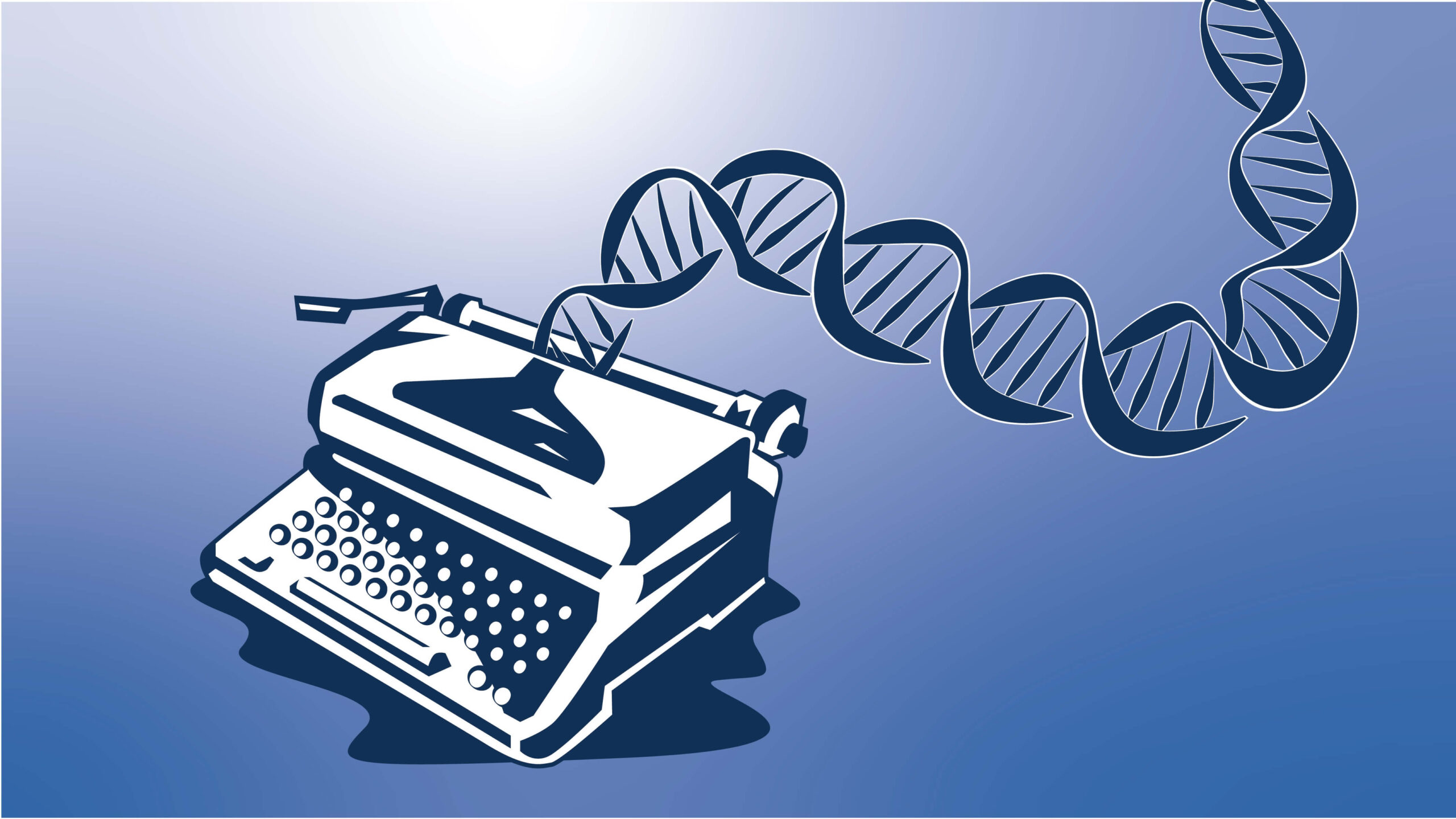
The message-encoding device is a new method the scientists developed to “write” information into cells’ DNA. Just as 1s and 0s encode the letters you’re reading on your computer or phone screen, DNA’s building blocks, ACT and G, can be used as the basis for any multitude of coded messages. The team of biologists at the University of Washington and Allen Discovery Center for Cell Lineage Tracing dubbed the new technique DNA Typewriter and described it in an article published in Nature earlier this month, led by UW researchers Junhong Choi, Ph.D., and Jay Shendure, M.D., Ph.D.
While queueing cells to spit out K-pop lyrics and Bible verses might be hilarious, it’s not the ultimate goal of the technology. The scientists wanted a method to trace cells in a growing animal. Understanding how we and other animals grow from one cell to many different, interconnected cells is key to understanding our own biology — as well as understanding what goes wrong in developmental diseases where some cells don’t grow or form as they should.
DNA Typewriter could be used to trace every single cell in a developing animal thanks to two key features of the technique: its ability to encode more than 4,000 unique barcodes in various combinations into individual cells, and its ability to leave a timestamp of sorts on each message it encodes. Together, these features will give the scientists a readout of each cell’s complete family history through development.
“This method is analogous to a conventional writing system in that we can write a large number of symbols in a certain order,” Shendure said. “It really opens up the imagination of what might be possible, with additional kinds of genome engineering layered on top of the DNA typewriter.”
DNA that records its own history
Despite decades of developmental biology, the field of biology that seeks to understand how animals grow from one cell to many, there’s only one kind of animal whose complete cellular development is known: The microscopic, transparent worm called C. elegans’s development was painstakingly traced by eye nearly 40 years ago. One intrepid biologist spent many, many hours hunched over a microscope watching the worm grow. That feat was possible because the worm at its adult size is just 1000 cells large, and because it’s entirely see-through. Compare that to the frustratingly opaque mouse with its billions of cells.
Junhong and his colleagues built DNA Typewriter on the backbone of a DNA-editing technology known as CRISPR, which acts as a kind of molecular scissors to cut and replace regions of DNA very precisely. The UW biologists had the idea to make a sequential version of CRISPR, building a “DNA tape,” where the editing of a stretch of DNA in the tape triggers an edit in the next stretch, and so on. The edited “tape” thus moves through the genome-writing machinery like a carbon ribbon through a typewriter.
Junhong wasn’t sure this approach was going to pan out. In theory, the CRISPR-based genome editor should only move on to the next section of DNA tape once the previous piece had been edited, but he was worried that with enough editing molecules floating around in the cell, the tape might just get edited all over the place.
“In the beginning, I thought this strategy wouldn’t work,” he said. “But then the first experiment that we did, we demonstrated that the edits happened sequentially, not all at once. And that was quite striking.”
The researchers also introduced specific messages in each edit, using a unique DNA sequence to mark each edit in turn. In the case of the text messages, they coded English letters and punctuation into individual DNA sequences, but in the case of tracking a cell lineage, they’ve developed more than 4,000 unique DNA barcodes that can be used to trace development.
Imagine looking at two cells in a developed animal using this technique: One’s DNA tape reads ABCXYZ, while the other reads ABCDEF. You’d know that these two cells came from the same cell because their first few edits are the same. If you had enough of those different strings of barcodes (which would be much longer in a real lineage experiment), you could piece together exactly how the entire animal grew, every step of its cellular history. The scientists tried their technique with cells in a dish and were able to trace the growth of one cell to more than one million cells.
Borrowing from evolution
So far, they’ve only tested the typewriter in cells growing in a petri dish, not in real growing animals. But in theory, if you engineer a mouse embryo to carry the correct DNA tape and editing machinery, there’s no reason it shouldn’t work to write a record of the animal’s entire development.
It’s the same kind of technique evolutionary biologists use to construct evolutionary trees showing how closely different species are related to each other – these biologists use differences in DNA to understand the relationships between different kinds of creatures. The fewer DNA changes between them, the more closely related two species are. DNA Typewriter will force a growing animal to record its own evolutionary tree in its cells. If two cells have the same edits after the animal finishes developing, the scientists will know those cells are more closely related in the developmental lineage than cells with different sets of edits.
Ultimately, the biologists also hope to combine DNA Typewriter with another method they’ve developed to not only track cell lineages, but also more complicated processes inside cells. This double-recording device could theoretically record things like how cells choose their developmental fate (i.e., how a stem cell chooses to become a heart cell or a brain cell), or even what happens in childhood diseases when something goes wrong during development.
Citations
about the allen institute
The Allen Institute is an independent, 501(c)(3) nonprofit research organization founded by philanthropist and visionary, the late Paul G. Allen. The Allen Institute is dedicated to answering some of the biggest questions in bioscience and accelerating research worldwide. The Institute is a recognized leader in large-scale research with a commitment to an open science model. For more information, visit alleninstitute.org.