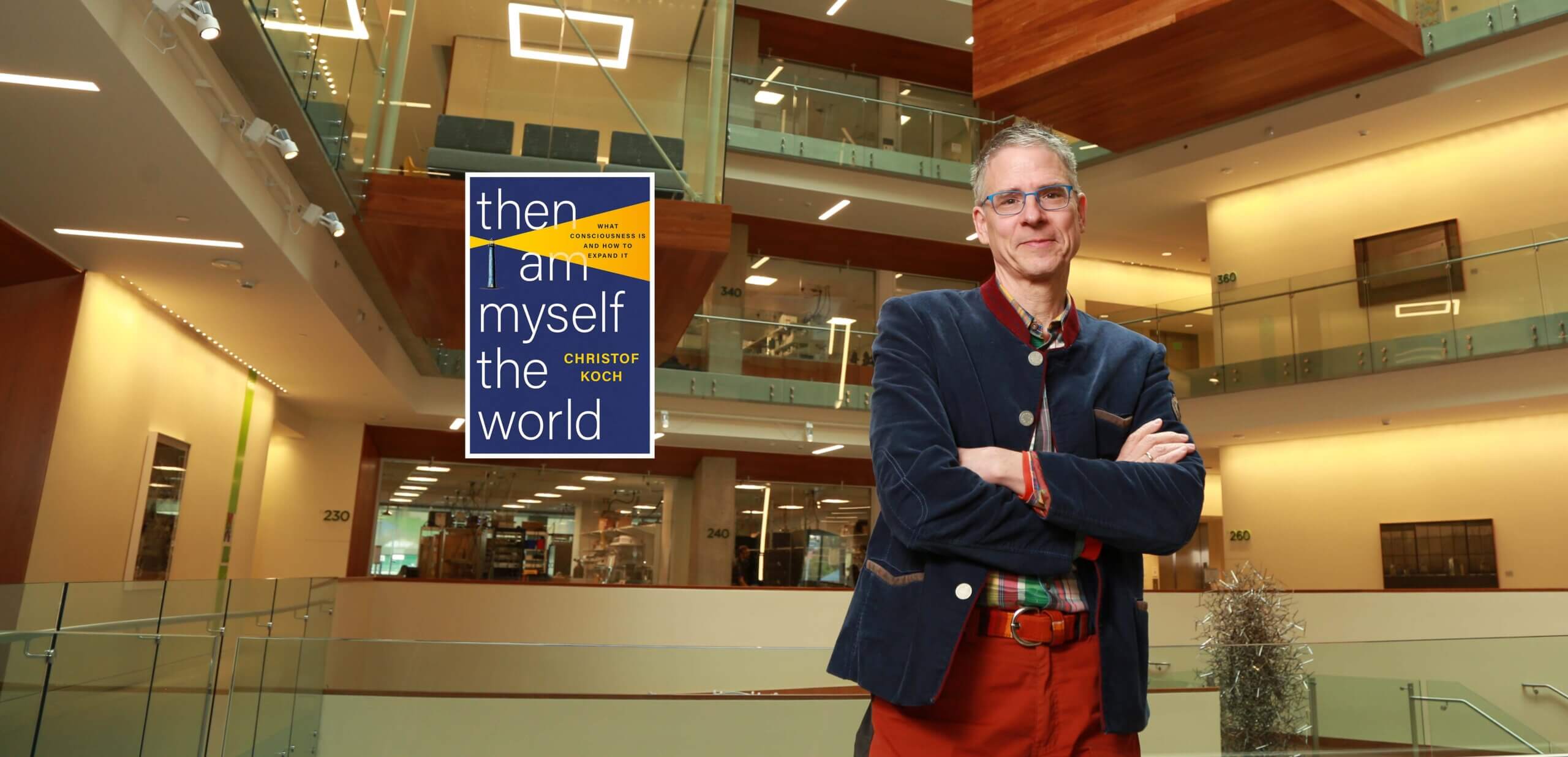

It turns out defining consciousness may be simpler than we think.
This age-old question, debated and puzzled over for millennia, has a straightforward answer according to famed neuroscientist Christof Koch.
“Consciousness is experience,” said Koch, Ph.D., meritorious investigator at the Allen Institute. “Pain, pleasure, being in love, being angry, being bored, having a psychedelic experience or a mystical experience or a near-death experience—those are all different forms of consciousness. Without consciousness, I am no one and nothing to myself.”
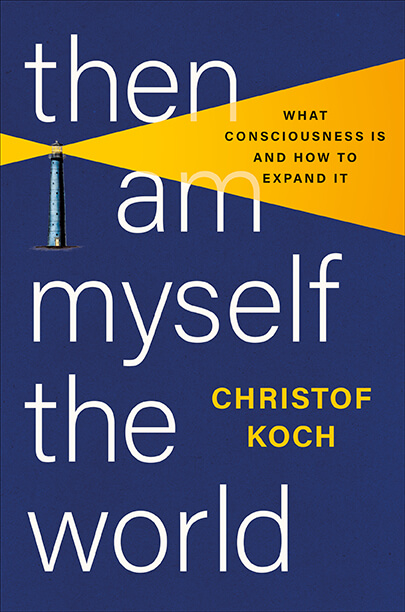
But if it’s easy to define, the central aspect of our lives is far from easily understood. Koch has spent decades trying to unravel the mysteries of consciousness, a journey he details in his latest book, “Then I Am Myself the World: What Consciousness Is and How to Expand It.”
We sat down with Koch to discuss the book, his near-death experience, why he’s worried about AI, and the importance of loving your fate (or at least the Seattle rain).
Q: You’ve been chasing the footprints of consciousness for decades. Are we making progress, or is the conscious mind as big a mystery as when you began?
When I started 35 years ago, I was told by a well-meaning colleague, “Christof, you should wait to think about consciousness until you’ve obtained the holy state of tenure.”
But I felt that was self-defeating since if science is supposed to describe everything in the universe, it must describe the central aspect of all of our existence. Not even trying to do so would be to admit failure.
Around that time, Francis Crick and I articulated an empirical operational pragmatic program for studying consciousness in the brain using fMRI, EEG, microelectrodes and all the other tools that neuroscientists, psychologists and clinicians invented over the last 100 years. And today, “the science of consciousness” is a field and there are plenty of conferences where people talk about the neural correlates of consciousness.
And this isn’t just an abstruse academic subject. One of the hardest calls we may have to make is when a loved one is on life-support following a cardiac arrest, stroke, or traumatic brain injury and is behaviorally unresponsive in the ICU. If this lasts for more than a few days, the medical team together with the family (that’s you) will decide to discontinue life support.
Yet we now know that up to 20% of such patients are conscious but are unable to signal this given their brain damage. The field has now developed a simple tool that measures the complexity of the brain’s electrical response to a brief pulse; this method, that has to be translated from a clunky research prototype to a tool that can be quickly and easily used in the ICU, could reliably detect consciousness. And that’s progress in the ancient mind-body problem.
Q: In your book you describe ‘transformational experiences’ – psychedelic, religious, mystic, and near-death experiences that can change our lives and our perceptions. How?
I had a near-death experience during the opening days of Covid. It was utterly remarkable – I saw a singularity of overwhelming brightness and felt terror and ecstasy. Nothing else – no body, no Christof, no self, no identity what-so-ever, but also no world and no passage of time. Nothing except for the icy blue light, and the awfulness of naked existence.
The title of the book comes from another extraordinary experience, a so-called mystical one, where my personal identity had been stripped away and one becomes aware of all of existence simultaneously, what Aldous Huxley in The Doors of Perception called Mind-at-large, hovering no-where, surrounded by stars and galaxies. Absolutely astounding and notoriously ineffable to put into words. The mind accesses some fundamental aspect of reality that is more real than real.
And so, the question is: is that just your brain on drugs or does it reveal something fundamental about the world at large? Does this call for a fundamental revision in one’s metaphysics, of one’s view of what exists?
Q: So, what’s the answer?
Well, that depends on what you believe about the world. Are you a so-called physicalist, where everything is just rooted in the physical? Or do you believe that ultimately everything is a manifestation of something mental, a broad school of thought called idealism? Or are you a classical dualist, where you believe there’s both a mental and physical domain, or a panpsychist where everything has both mental and physical aspects? These are different metaphysical assumptions and science in general, and neuroscience in particular, can’t directly verify or falsify these.
People really do have these transformative experiences, where they can change their life fundamentally. It’s remarkable that a single experience that typically lasts under an hour by the clock can have such a transformative effect on us. But that seems to be the case.
Q: The new book opens with your own transformative experience, which results in, among other things, the loss of a fear of death. Any advice for the rest of us mortals?
As you get older, you have more difficulty sleeping – so you lie in bed and think about what happens once you’re dead. Not just dead for a long time, but forever and ever. It’s like staring into a bottomless abyss; you recoil with existential vertigo.
But since my experience four years ago (that I hope I will never again have to undergo as it is utterly terrifying) that fear has totally vanished. Gone. My loss of death anxiety is not uncommon in people who have undergone a near-death experience, an unexpected and unexplained (so far), lasting benefit. I don’t want to die, but I accept that everything that has a beginning must have an end. Including my personal existence.
Q: You write that we are the agents in charge of our own narrative, and that our attitudes towards events beyond our control can have profound consequences for our well-being. Could you elaborate on this concept and perhaps provide some examples of how this agency can manifest in our daily lives?
Many wisdom traditions have emphasized for thousands of years that you are the agent in charge of your own life.
You can be born unlucky—during a war or a pandemic, say. But you must deal with these facts, and the question is how. Do you think of yourself as being the hopeless victim of forces beyond your control, and all you can do in response is being highly anxious and look for warning signs and triggers everywhere? Or do you actively develop a different narrative where you take control of your attitude to events that are beyond your control, remain curious and open to the world and embrace your fate?
Let me give you a trivial but real example. After living for more than a quarter of a century in SoCal, when I was getting ready to move to the rainy Pacific Northwest, my friends questioned the wisdom of leaving sunny Pasadena to move to gloomy Seattle. I promised myself that I would never, ever complain about the weather. Never. Period. There is no bad weather, only bad clothing or a bad attitude. This stance really makes a dramatic difference. Now I love the glorious rain that makes everything verdant and lush. It’s life-affirming, right?
Q: Should we be worried about artificial intelligence over the next 5-10 years?
We do need to worry about AI.
We’re the dominant species on the planet, not because we’re the wisest but because we’re the most aggressive and the most intelligent. Designing creatures that potentially will be smarter than us and, sooner or later, will be applied to warfare, should give us pause.
Whether or not these creatures will be sentient, will be conscious, is less relevant. It’s intelligence we should worry about as well as the intention of the people behind setting that intelligence loose.
In fact, I almost feel once we do have super intelligent AI, that if they would be conscious, they might experience empathy when they consider us. So at the end of the day this might save homo sapiens as a species (but probably not eight billion of us). In this debate it is critical to distinguish artificial intelligence from artificial consciousness. The potential promise, and the potential danger, of AI comes from them being intelligent or super intelligent.
Q: Do you think chatbots or large language models are, or might become, conscious?
No, these algorithms, running on conventional von Neumann computers in the cloud, will never be conscious. In fact, this is a specific prediction of integrated information theory. They can do eventually and probably very soon do everything we can do, but they will never be what we are, which is conscious.
Yes, you can simulate consciousness – ask Claude whether it’s conscious. But it’s all a deep fake. Just like you can simulate a rainstorm without the inside of a computer getting wet or simulate the effect of the mass at the center of our galaxy on the surrounding fabric of space-time, but you will not be sucked into the computer-simulated black hole. You must build something like a human brain, neuromorphic engineering, to create consciousness. Maybe future machines like quantum computers could be conscious, but conventionally built digital machines will never be conscious.
Q: What do you hope readers walk away with?
With the sheer wonder and miracle of existence and that we are conscious at all. We could live in a universe where we’re all zombies! Nothing in the laws of physics, chemistry or biology as presently conceived predicts consciousness, explains feelings. Yet here we are, seeing, hearing, feeling! Isn’t it fantastic that we live in a universe that enables us to appreciate the beauty and terror of existence? We’re here for a limited time, so let’s enjoy it.
Citations
about the allen institute
The Allen Institute is an independent, 501(c)(3) nonprofit research organization founded by philanthropist and visionary, the late Paul G. Allen. The Allen Institute is dedicated to answering some of the biggest questions in bioscience and accelerating research worldwide. The Institute is a recognized leader in large-scale research with a commitment to an open science model. For more information, visit alleninstitute.org.




