impact
impact
open science
subheadline
careers and opportunities
subheadline
people & teams
people & teams
subheadline
allenites
subheadline
allen institute advisors
subheadline
board of directors
subheadline
shanahan foundation fellowship
subheadline
next generation leaders
subheadline
research
overview
our approach
subheadline
publications
subheadline
open science
subheadline
accelerator
brain science
subheadline
cell science
subheadline
neural dynamics
subheadline
immunology
subheadline
synthetic biology
subheadline
education
education
science education
subheadline
education resources
subheadline
field trips
subheadline
open science
subheadline
open science quest
subheadline
news
news
stories
subheadline
podcast
subheadline
sign up for our newsletter
subheadline
events
events
all events
subheadline
conferences
subheadline
event code of conduct
subheadline
events
open science quest
subheadline
summer workshop on the dynamic brain
subheadline
open science week
subheadline
brain fest
subheadline
science resources
science resources
allencell.org
subheadline
allenimmunology.org
subheadline
allenneuraldynamics.org
subheadline
brain-bican.org
subheadline
brain-map.org
subheadline
microns-explorer.org
subheadline
impact
back to menu
impact
open science
subheading
careers and opportunities
subheading
people & teams
people & teams
subheading
allen institute advisors
subheading
board of directors
subheading
shanahan foundation fellowship
subheading
next generation leaders
subheading
research
back to menu
impact
Label
subheading
Label
subheading
people & teams
education
back to menu
research
Label
subheading
Label
subheading
Heading
news
back to menu
research
Label
subheading
Label
subheading
Heading
events
back to menu
research
Label
subheading
Label
subheading
Heading
science resources
back to menu
science resources
allencell.org
subheading
allenimmunology.org
subheading
allenneuraldynamics.org
subheading
brain-bican.org
subheading
brain-map.org
subheading
microns-explorer.org
subheading
search
stories
news

Getting deep into the brain

As we try to uncover how many cell types are in the brain, researchers are recognizing the importance of characterizing neurons by several features:...

June 29, 2017
 min read
share/
Allen Institute researchers are pushing the boundaries of what's possible in neuroscience, developing new tools and methods to access and study the deepest regions of the brain.
Thank you! Your submission has been received!
Oops! Something went wrong while submitting the form.

in this article

table of contents will display on published page only
set h2 to populate the table of contents here

For neurons on the surface of the brain, there are powerful new tools to collect this information from just one cell at a time. But what happens when we need to learn about cells deeper in the brain—ones we cannot see right on the surface?
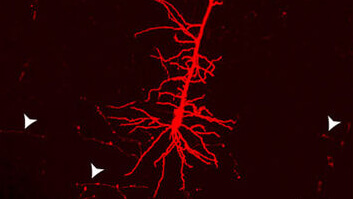
Bright red branching neural network or blood vessel structure on dark background

“Probing neurons past the surface of the brain is challenging even for well-trained humans who need to collect data from only a single cell and not damage cells around the target cell,” says Lu Li, Ph.D., Senior Scientist at the Allen Institute for Brain Science. “This makes large-scale collection of this data incredibly hard. Our goal was to create a robot that could do the work just as well or better than a human.”

One challenge the robot faced was how to find target cells and avoid tissue damage without an operator being able to see neighboring cells on the surface of the brain. Li and his team first developed a method to enable the robot’s probe to passively detect whether cells were firing nearby, and then to actively probe the space for hidden cells.

Once the probe reached its target site, researchers demonstrated that the probe could effectively deliver a molecule that distributed to the far ends of just a single neuron, making tagging the neuron possible for future experiments.

The robot, called the Automatic single-Cell Experimenter (ACE), is described this month in the journal Nature Communications.

“ACE has several distinct advantages over typical optical approaches,” says Li. “First, it can label individual cells deeper in the brain, not just the cortex, and the particular molecule we use to label the neuron’s shape only requires a small amount to visualize the entire cell.”

Since the ultimate goal of the work is to decipher cell types in the brain, this kind of highly specific labeling is the key first step in order to correlate data on how a neuron is shaped with functional data, including how it sends and receives signals in circuits.

“We hope that by creating this technology, we can automate and thereby increase the number of experiments done to isolate single cells, and to make the question of how many cell types are in the brain that much more accessible,” says Li.

Citations
No items found.

about the allen institute

The Allen Institute is an independent, 501(c)(3) nonprofit research organization founded by philanthropist and visionary, the late Paul G. Allen. The Allen Institute is dedicated to answering some of the biggest questions in bioscience and accelerating research worldwide. The Institute is a recognized leader in large-scale research with a commitment to an open science model. For more information, visit alleninstitute.org.
explore related stories

explore more stories
No articles for the category
we acceleratedevelopcatalyzeimpact

science done differently. shared with the world.

explore our accelerators

brain science

Mapping every cell, connection, and circuit in the brain—openly shared with the world.

cell science

Decoding how cells become tissues, then programming that knowledge into powerful new research tools.

neural dynamics

Revealing the brain's hidden algorithms that transform neural activity into real-world behavior.

immunology

Creating the deepest open reference for the healthy human immune system ever built.

synthetic biology

Engineering cells to record their own histories, transforming how we understand disease over time.

research

Big questions, open answers, and science built to be shared.

education

Inspiring the next generation of scientists through open science resources.

impact

Our science is empowering researchers and advancing health worldwide.
advancing science through open, collaborative research
Get the allen institute newsletter
Stay informed on the latest breakthroughs in neuroscience, bioscience, and AI-driven research.
allen institute
impactpeople & teamscareers & opportunitiesalumnihistory & founder
science resources
allencell.orgallenimmunology.orgallenneuraldynamics.orgbrain-bican.orgbrain-map.orgmicrons-explorer.org
research
brain sciencecell scienceneural dynamicsimmunologysynthetic biologypublications
education
science educationfield tripsprofessional developmenteducation resources
quick links
newseventsopen sciencepodcastscience resourceshuman brain donationvisit uscontact
follow us/

allen institute, 615 Westlake Ave North, Seattle, WA 98109 +12065487055

© 0000 allen institute. all rights reserved.
privacy policyterms of usecitation policyemployee portalpolicy & compliance