
in this article
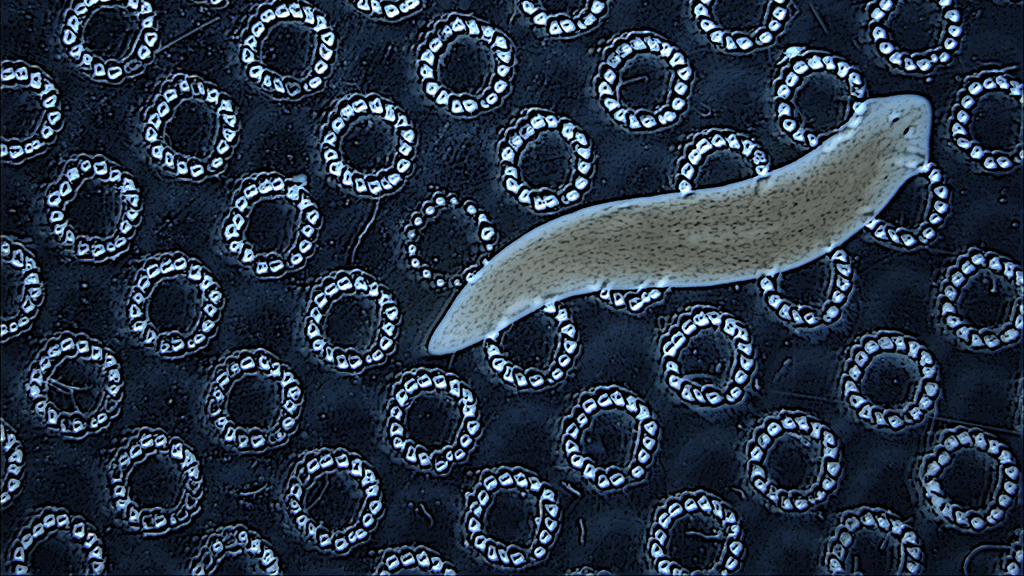
How does that happen? What are the biological rules that underwrite life’s intricate and beautifully varied forms? How do single cells and multicellular organisms adjust to changing circumstances, in some cases regenerating structures after significant damage?
Last week, an international group of researchers gathered at the Allen Institute to present and discuss their attempts to answer those questions. The symposium, titled “Exploring Frontiers: Nature’s Blueprint,” brought together scientists who study plants, animals, bacteria, and even synthetic life under the umbrella of morphogenesis, the often-mysterious biological processes that allow biological structures to create and maintain complex shape.
In a broad sense, some think of DNA as the blueprint of life, but that might not be the full picture, said biologist Wallace Marshall, Ph.D., one of the symposium speakers whose University of California, San Francisco, laboratory team studies the trumpet-shaped microscopic organism known as Stentor.
A blueprint tells its users exactly where to put all the parts and what the finished product should look like. “DNA is more like a recipe book with a list of ingredients but no pictures,” Marshall said. “That’s fine if you’re making soup, but what if you’re making beef wellington?”
Creatures obviously know how to build themselves from their starting materials. But scientists still don’t understand that process fully. In other words, there’s a deep chasm in human knowledge between genetics and a creature’s finished anatomy.
“There are so many fundamental things we don’t know about how anatomy is formed, and that’s more than evident in health and disease,” said Kathryn Richmond, Ph.D., Director of The Paul G. Allen Frontiers Group, a division of the Allen Institute and host of last week’s event. “With new tools and new modeling and visualization approaches, it’s really a perfect time to be asking these questions and revealing some of that dark matter of why things work the way they do.”
Animals that never finish growing
Two of the symposium’s speakers covered the topic of regenerative biology. Several animals – some amphibians, worms and fish – can regrow amputated body parts. Some, like frogs, lose the ability as they get older, but some, like the cheery-looking axolotl, can regenerate limbs through adulthood.
“We have to know how that happens to harness these kinds of clues for regenerative medicine in the future,” said Jessica Whited, Ph.D., a biologist who studies axolotl regeneration at Harvard University and the Allen Discovery Center at Tufts University.
You could look at an animal’s regrowth of a limb like the construction of an Ikea bookcase, Whited said: You need a set of tools, the building blocks, an instruction manual, and the right environment. All of that is built into the axolotl’s body, we just haven’t tapped into most of it.
Whited studies the blastema, a special fast-growing structure that forms at the site of a missing limb and which seems to hold all those construction parts in itself. Researchers have found that a blastema transplanted to another location or another animal can regrow a limb just as easily as in its native location. Whited and her team have identified some of the genes responsible for this structure’s fantastical regrowth abilities and found that immune cells seem to play an important role as well.
Michael Levin, Ph.D., director of the Allen Discovery Center at Tufts University and organizer of the symposium, also studies regeneration and body form, with a slightly different twist, focusing on how evolution exploits the laws of physics and of computation to enable cells to know what to build and when to stop remodeling. In both the flatworm known as Planaria and in tadpoles and baby frogs, Levin and his laboratory team have found that the body’s electrical patterns are incredibly important.
We tend to think of bioelectricity in the context of neurons and electrical synapses, but it turns out that electrical currents may be even more interwoven and ancient to life itself. A specific pattern of electrical charges in very early embryos seems to direct tadpole brain formation, Levin’s team found. With the help of computational modeling, they were able to manipulate that bioelectric pattern to repair severe birth defects of the brain and face caused by mutations or exposure to defect-triggering chemicals. They have also engineered worms to grow double heads or tadpoles to grow eyes on their guts just by manipulating the animals’ normal bioelectric patterns.
“There’s this remarkable anatomic plasticity at multiple levels of organization, which enables tissues to store information about the anatomy they should have,” Levin said. “Bioelectric signaling is key to reading out these pattern memories and rewriting them, allowing cells to build to a different spec.”
The shape of tiny things
Will Ratcliff, Ph.D., an evolutionary biologist at the Georgia Institute of Technology, wants to understand the evolution of multicellularity. How did we go from our single-celled ancestors to large assemblies of multiple specialized cells? Multicellular life has evolved at least 25 different time’s in our planet’s history.
Ratcliff and his team forced that evolution to happen in the lab by looking for mutations that cause the single-celled baker’s yeast to become a multicellular creature. They found such a mutation that causes the yeast to grow in a “snowflake”-like conglomerate, the cells sticking together when they divide rather than completely separating. The researchers don’t know if a similar sticky mutation is what gave rise to our own multicellularity, but they did find that once the snowflake yeast arose, they quickly started gaining new mutations that supported their new larger size.
Arthur Prindle, Ph.D., a biologist at Northwestern University, described research on naturally occurring sticky single cells: bacterial biofilms. Prindle and his colleagues have found that, like planaria and tadpoles, bacterial biofilms rely on electrical signals to communicate and set their shape. The single-celled animals send electrical pulses from one part of the film to another to signal when food levels are high or low, which changes the community’s growth patterns.
Modeling life’s form
Many of the symposium’s speakers turn to math to try to capture the rules of life’s shape. Dagmar Iber, Ph.D., a computational biologist at ETH Zurich, uses mathematical models to study such varied life forms as fruit fly wings, mammalian lungs and kidneys, and epithelia, the thin tissue linings of many of our organs. She found that the branching patterns of mammalian lungs and kidneys as they grow follow the same general principles as leopard’s spots, a mathematical principle known as a Turing mechanism.
“It’s reassuring to see when nature abides by mathematics,” Iber said.
Citations
about the allen institute
The Allen Institute is an independent, 501(c)(3) nonprofit research organization founded by philanthropist and visionary, the late Paul G. Allen. The Allen Institute is dedicated to answering some of the biggest questions in bioscience and accelerating research worldwide. The Institute is a recognized leader in large-scale research with a commitment to an open science model. For more information, visit alleninstitute.org.




