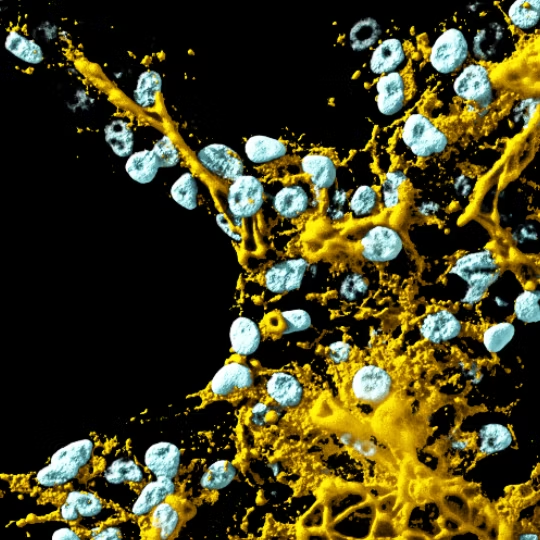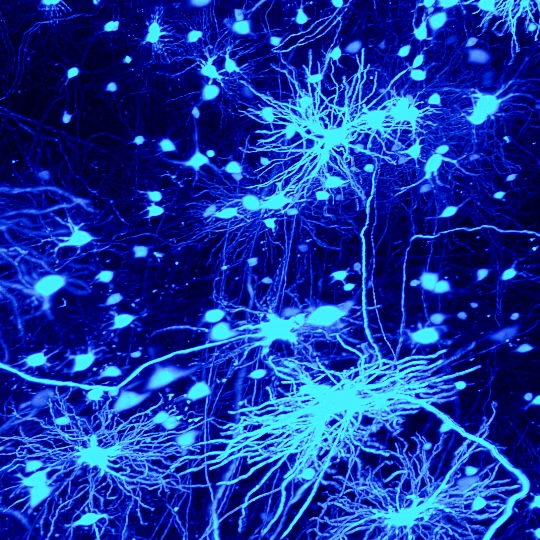

For many outsiders to neuroscience, the study of the brain has a certain exotic allure. Delicate, spindly neurons send communiques in a mysterious electrical language at split-second speed. Many neuron names match that romantic allure: Chandelier cells. Spindle neurons. The rosehip neuron.
There are likely at least hundreds of different types of neurons in our brains. Many of these specialized cells got their names based on what scientists thought they looked like — a chandelier, a basket, a rosehip — or simply adopted the name of their discoverers, in the case of the Betz cell or the Von Economo neuron.
But the more scientists study the brain, and the more techniques they develop to sort through neurons, the more complicated the picture gets. At some point in the not-too-distant past, scientists realized they would be better served by a comprehensive naming strategy than one-off names based on subjective measures of cell shape. In other words, they needed a lexicon that was more systematic than romantic.
“I think everyone wants to get to that part of naming a neuron where you’ve found a cell type, you’ve learned all of its features, and now it’s time to give it a name,” said Jeremy Miller, Ph.D., Senior Scientist at the Allen Institute for Brain Science, a division of the Allen Institute. “But the problem is, we can’t even really agree on how to define cell types or assign cells to them. We have a problem tracking information to know if different neuroscientists are talking about the same kind of cell or not.”
Miller and his colleagues set out to build a systematic naming structure for neurons, but in the end, the information-tracking turned out to be just as important as the naming strategy, he said. They published a study late last year in the journal eLife describing that tracking and naming strategy, which they dubbed the common cell type nomenclature, or CCN.
The name of the framework itself evolved in a meta way, taking into account response to input from scientists, according to Amy Bernard, Ph.D., Director of Science and Technology Strategy at the Allen Institute, who led the CCN development along with Miller.
“We worked with the scientific community to understand their needs as we developed this naming framework. Our first version of this nomenclature scheme had a very long name to capture the complexity of our system,” Bernard said. When she talked to colleagues about the concept with that longer name, many were skeptical. But when the team used a simpler, shorter name, researchers were more interested. “The idea of a common cell type nomenclature was an easier handle for people to grab onto. It goes to show that there’s something about anchoring information in a simple, shared way that will make it more useful to people,” she said. Which is what the CCN itself is trying to do for the field.
Managing big neuroscience data
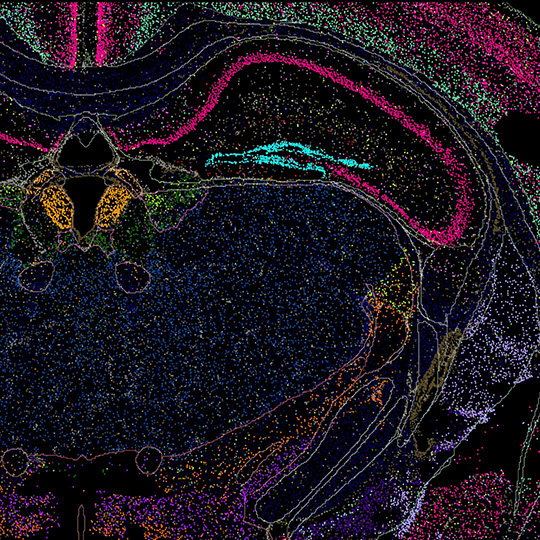
The field needs a brain cell-naming system in part because new high-throughput technologies are enabling scientists to discover ever more kinds of neurons and other brain cell types (neurons are just one of several general classes of brain cells), but also because scientists are sifting through brain cells using many different methods, some of which capture data from hundreds of thousands of cells at once. Neuroscientists who study cell shape and those who study brain cells’ gene activity need a consistent way to tell if they are studying the same cell type or not.
The nomenclature within the CCN is more of a serial number than a true name, but existing or colloquial names like “chandelier cells” can easily be appended to that string of letters and numbers. The information-tracking part of the CCN is designed to work with data derived from single-cell transcriptomics, which reads out the suite of unique genes a given cell switches on. Miller and his colleagues built a simple, open-access program where scientists input files and annotations from a standard cell typing study and their program spits out formatted files that are compatible with large, standardized databases like those at the Allen Institute where researchers can compare datasets from different labs.
Not just a brain problem
Neuroscientists aren’t the only ones struggling with naming systems. It’s an issue across human biology for many studying individual cells and cell types. And while there are certain characteristics unique to neurons — electrical signaling, for example — all cell types in all organs have genes that they switch on and off. Single-cell transcriptomics is a method that allows researchers to inventory all ‘active’ genes in a single cell and is used across the field of human cell biology in individual university labs, large organizations like the Allen Institute, and in huge multi-lab collaborative efforts like the Human Cell Atlas and the National Institutes of Health’s Human Biomolecular Atlas and BRAIN Initiative Cell Census Network.
Sanjay Jain, M.D., Ph.D., studies the human kidney and urinary tract at Washington University School of Medicine in St. Louis and is also involved with the Kidney Medicine Precision Project. That project’s research goal is to map cell types in the kidney and urinary tract – in people with or without diseases that affect the kidney. They are starting with the non-diseased, reference cells so that they can eventually understand what changes in cells and cell types in disease. They are grappling with similar language problems as the neuroscience field, Jain said.
“Once we have made this atlas, then we want to make atlases of disease states to see how cells shift from healthy to diseased states and what are the genetic drivers for that,” Jain said. “But in order to do that, it’s very important to have some sort of common or standardized language about kidney segments, structure and cells so one lab can understand what another lab is talking about.” — written by Rachel Tompa, Ph.D.
Citations
about the allen institute
The Allen Institute is an independent, 501(c)(3) nonprofit research organization founded by philanthropist and visionary, the late Paul G. Allen. The Allen Institute is dedicated to answering some of the biggest questions in bioscience and accelerating research worldwide. The Institute is a recognized leader in large-scale research with a commitment to an open science model. For more information, visit alleninstitute.org.