impact
impact
open science
subheadline
careers and opportunities
subheadline
people & teams
people & teams
subheadline
allenites
subheadline
allen institute advisors
subheadline
board of directors
subheadline
shanahan foundation fellowship
subheadline
next generation leaders
subheadline
research
overview
our approach
subheadline
publications
subheadline
open science
subheadline
accelerator
brain science
subheadline
cell science
subheadline
neural dynamics
subheadline
immunology
subheadline
synthetic biology
subheadline
education
education
science education
subheadline
education resources
subheadline
field trips
subheadline
open science
subheadline
open science quest
subheadline
news
news
stories
subheadline
podcast
subheadline
sign up for our newsletter
subheadline
events
events
all events
subheadline
conferences
subheadline
event code of conduct
subheadline
events
open science quest
subheadline
summer workshop on the dynamic brain
subheadline
open science week
subheadline
brain fest
subheadline
science resources
science resources
allencell.org
subheadline
allenimmunology.org
subheadline
allenneuraldynamics.org
subheadline
brain-bican.org
subheadline
brain-map.org
subheadline
microns-explorer.org
subheadline
impact
back to menu
impact
open science
subheading
careers and opportunities
subheading
people & teams
people & teams
subheading
allen institute advisors
subheading
board of directors
subheading
shanahan foundation fellowship
subheading
next generation leaders
subheading
research
back to menu
impact
Label
subheading
Label
subheading
people & teams
education
back to menu
research
Label
subheading
Label
subheading
Heading
news
back to menu
research
Label
subheading
Label
subheading
Heading
events
back to menu
research
Label
subheading
Label
subheading
Heading
science resources
back to menu
science resources
allencell.org
subheading
allenimmunology.org
subheading
allenneuraldynamics.org
subheading
brain-bican.org
subheading
brain-map.org
subheading
microns-explorer.org
subheading
search
stories
news

How Hollywood’s latest animation technique is shedding new light on cell biology

A method developed to make more realistic computer graphics now forms the backbone of new 3D cell visualization tool

October 28, 2019
 min read
share/
A method developed to make more realistic computer graphics now forms the backbone of new 3D cell visualization tool
Thank you! Your submission has been received!
Oops! Something went wrong while submitting the form.

in this article

table of contents will display on published page only
set h2 to populate the table of contents here

Dan Toloudis has spent his career designing graphics tools for computer animators. In previous graphics engineering jobs, he wrote programs that enabled artists to create lifelike dragons at DreamWorks Animation or spinning cars for a digital Ford commercial.

Now he spends his days thinking about human cells.

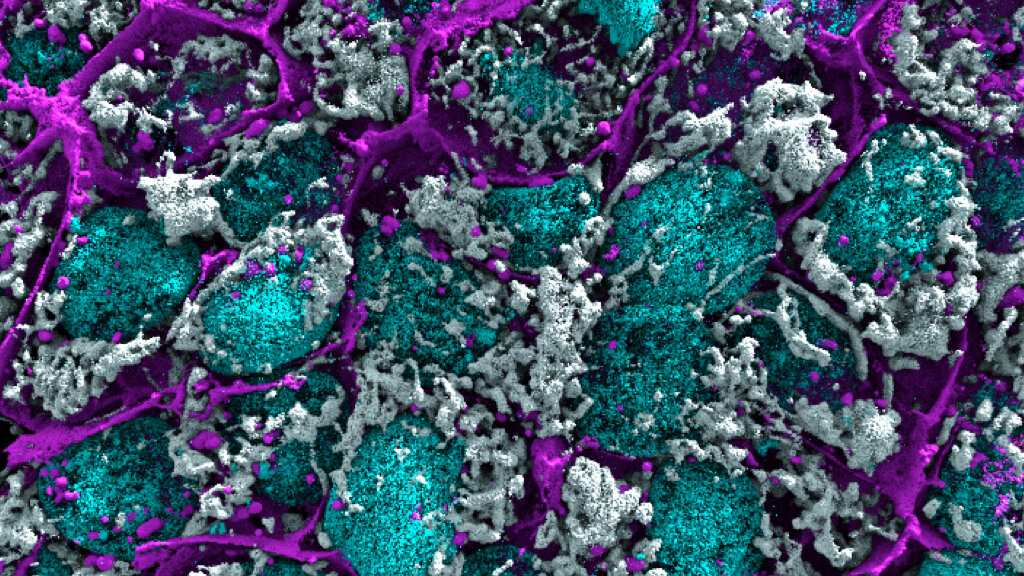
Toloudis is one of the engineers behind AGAVE, a new graphics tool developed at the Allen Institute for Cell Science to help researchers visualize the delicate and dynamic inner workings of human stem cells.

AGAVE uses path trace rendering, a graphics technique straight from Hollywood’s animation studios that is shedding new light — literally — on the microscopic structures inside our bodies.

Path tracing is responsible for the realism of the dancing, crashing waves in Disney’s Moana, or the rich shadows in caves and hallways in the recently announced release of Minecraft. The technique is all about light and dark, using sophisticated graphics techniques to create a 2D image on a movie or computer screen that matches what we expect from the 3D world around us.

Light and shadow for scientific discovery

“Think of the way light reflects and refracts inside a volume. With something like water, there are a lot of subtle secondary effects from how light bounces around,” Toloudis said. “It’s all about understanding the physics of that effect.”

As visual creatures, we instinctively rely on those subtle effects to understand and navigate our 3D worlds. Path tracing, also known as ray tracing, is a method that captures rays of light in a scene as they bounce from a light source off of different surfaces in the field of view, finally making their way to the camera. Pictures or animated movies that recreate realistic light and shadow look more natural to us, more understandable, because of these complex layers of reflections and shadows.

The same is true for scientific images of cells. Researchers can better interpret images of cells if the light and shadows on the data representations of cellular structures match what our brains expect from natural light. This visualization method can thus help scientists understand the spatial relationships between different parts of the cell, relationships that may be crucial to understanding how our cells work.

“This technique is letting us interpret images in new ways,” said Graham Johnson, Ph.D., Director of the Animated Cell team at the Allen Institute for Cell Science, who also worked on AGAVE. “Path tracing has been a major challenge to do on a standard computer for the last several decades. But now, in near real-time, we have tools that are giving us a more intuitive understanding of where structures exist relative to each other in our cells.”

The visualization tool combines path tracing with another graphics method that generates 2D images of 3D objects (such as cells), known as volume rendering. Path tracing has been used in Hollywood for over a decade, and several existing medical and scientific imaging methods rely on both path tracing and volume rendering.

But it’s only relatively recently that graphics processing units, or GPUs, of personal computers and gaming systems have gotten large enough to handle these power-hungry techniques. The first video games that rely heavily or completely on path tracing are only just coming on the scene. That’s why it was the right moment to adapt the technique for cell biology too. AGAVE won’t work on all computers, but most modern laptops now have the capabilities needed to run the program.

The program is available as a beta release on allencell.org in both a full, downloadable application, and a simplified browser version. Toloudis and the other engineers are currently working on several new features to add to the next release of AGAVE, including the ability to apply the tool to real-time movies of cells.

Citations
No items found.

about the allen institute

The Allen Institute is an independent, 501(c)(3) nonprofit research organization founded by philanthropist and visionary, the late Paul G. Allen. The Allen Institute is dedicated to answering some of the biggest questions in bioscience and accelerating research worldwide. The Institute is a recognized leader in large-scale research with a commitment to an open science model. For more information, visit alleninstitute.org.
explore related stories

explore more stories
No articles for the category
we acceleratedevelopcatalyzeimpact

science done differently. shared with the world.

explore our accelerators

brain science

Mapping every cell, connection, and circuit in the brain—openly shared with the world.

cell science

Decoding how cells become tissues, then programming that knowledge into powerful new research tools.

neural dynamics

Revealing the brain's hidden algorithms that transform neural activity into real-world behavior.

immunology

Creating the deepest open reference for the healthy human immune system ever built.

synthetic biology

Engineering cells to record their own histories, transforming how we understand disease over time.

research

Big questions, open answers, and science built to be shared.

education

Inspiring the next generation of scientists through open science resources.

impact

Our science is empowering researchers and advancing health worldwide.
advancing science through open, collaborative research
Get the allen institute newsletter
Stay informed on the latest breakthroughs in neuroscience, bioscience, and AI-driven research.
allen institute
impactpeople & teamscareers & opportunitiesalumnihistory & founder
science resources
allencell.orgallenimmunology.orgallenneuraldynamics.orgbrain-bican.orgbrain-map.orgmicrons-explorer.org
research
brain sciencecell scienceneural dynamicsimmunologysynthetic biologypublications
education
science educationfield tripsprofessional developmenteducation resources
quick links
newseventsopen sciencepodcastscience resourceshuman brain donationvisit uscontact
follow us/

allen institute, 615 Westlake Ave North, Seattle, WA 98109 +12065487055

© 0000 allen institute. all rights reserved.
privacy policyterms of usecitation policyemployee portalpolicy & compliance