in this article
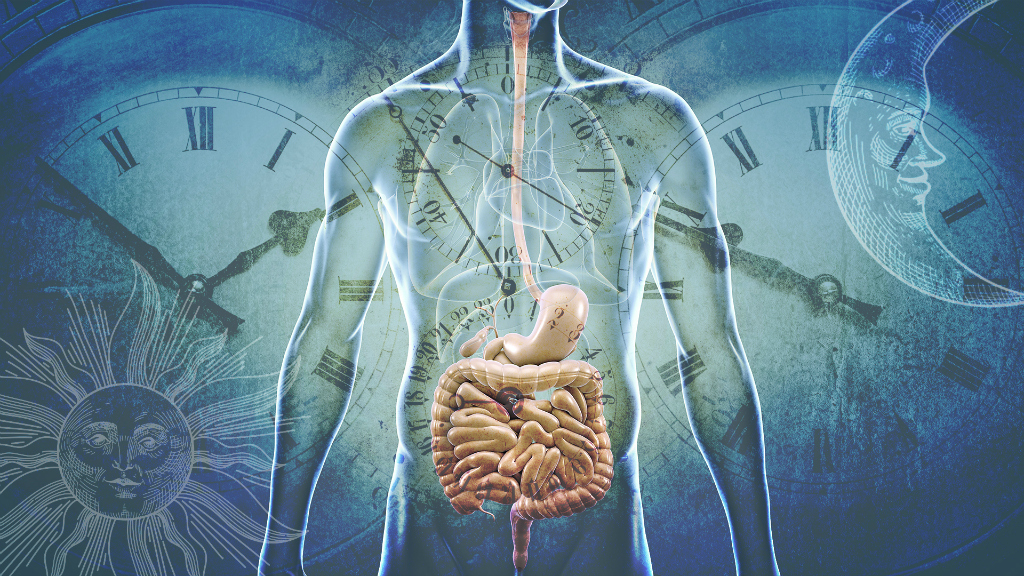
Researchers have uncovered immune cells in the mouse that signal light and dark in the gut, a finding that could explain why people with sleep disorders or who work the night shift have certain health problems. When these clock-keeping immune cells were disrupted, the animals took in more fat from their diets, causing them to gain excess weight, and their levels of inflammation jumped.
It might come as a surprise to learn that the dark depths of your gastrointestinal tract care about sunshine. It was a surprise to Henrique Veiga-Fernandes, D.V.M., Ph.D., who led a study published Wednesday in the journal Nature on the newly discovered brain-gut-immune connection.
Researchers had previously seen cyclical oscillations in the intestines — and in their associated bacteria, the gut microbiome — but other studies had linked these digestive rhythms to the timing of regular meals rather than to light cycles.
“What is novel here is the fact that we have a very distinct circuit in the brain that talks to immune cells in the intestine, that’s really surprising,” said Veiga-Fernandes, who leads a research team at Champalimaud Center for the Unknown in Lisbon, Portugal, and is also an Allen Distinguished Investigator. “If you disrupt the area of the brain that integrates light and dark signals, it’s a disaster for the animal. All the body’s time zones become completely mixed up, even within the same organ.”
Gut health and disease
n their study, the researchers found that a certain type of gut immune cells, known as ILC3s, have an innate rhythm that syncs up with the brain’s master clock, which Veiga-Fernandes terms “the body’s Big Ben.” When the researchers removed the region of the brain responsible for this time-keeping, a section within the hypothalamus known as the suprachiasmatic nuclei, the immune cells lost their regular rhythm and the animals’ gut health was also thrown out of balance.
The research team found that circadian rhythms are important for ILC3s to find their way in the body — when the brain’s light-dark signaling was disrupted, the immune cells never made it to the intestines. These cells play a role in wound repair and in slowing fat uptake in the gut. When the ILC3s couldn’t find their way, the animals gained weight to the point of obesity and had higher levels of inflammation and increased propensity to intestinal infection.
Veiga-Fernandes hypothesizes that the brain regulates ILC3 levels in the gut on purpose, allowing animals to absorb a certain amount of fat from their diet when ILC3 levels in the gut are low, and then to repair their intestines from potential damage related to eating when ILC3 function levels rise.
It’s not yet known whether ILC3s play a similar role in our gut health, although these cells and the associated proteins that help them keep time are evolutionarily conserved between mice and humans. If it exists in people too, this interaction between light and dark, the brain, and the intestines’ immune cells could explain why people with chronically altered sleep schedules – those who work the night shift, travel frequently, or have sleep disorders — suffer certain health problems, Veiga-Fernandes said.
Sleep problems are also associated with flare-ups in the chronic family of autoimmune disorders known as inflammatory bowel disease, or IBD. The underlying cause of IBD and its flare-ups is still mysterious, but in light of these recent results, the researchers wonder whether the circadian clock could play a similar role in these diseases.
In the future, Veiga-Fernandes aims to explore the precise architecture that links the brain and the intestinal immune system. There’s a growing appreciation of the importance of neuron-immune signaling, he said, and how it could play multiple roles in health and disease.
“What are the motorways, the routes that the system uses? We’ve seen that interactions between neurons and immune cells are important in many tissues,” he said. “We’re hopeful that by harnessing these neuro-immune interactions, we can shed light not only on understanding more about this biology but also improve therapies for several kinds of pathologies.”
Citations
about the allen institute
The Allen Institute is an independent, 501(c)(3) nonprofit research organization founded by philanthropist and visionary, the late Paul G. Allen. The Allen Institute is dedicated to answering some of the biggest questions in bioscience and accelerating research worldwide. The Institute is a recognized leader in large-scale research with a commitment to an open science model. For more information, visit alleninstitute.org.