impact
impact
open science
subheadline
careers and opportunities
subheadline
people & teams
people & teams
subheadline
allenites
subheadline
allen institute advisors
subheadline
board of directors
subheadline
shanahan foundation fellowship
subheadline
next generation leaders
subheadline
research
overview
our approach
subheadline
publications
subheadline
open science
subheadline
accelerator
brain science
subheadline
cell science
subheadline
neural dynamics
subheadline
immunology
subheadline
synthetic biology
subheadline
education
education
science education
subheadline
education resources
subheadline
field trips
subheadline
open science
subheadline
open science quest
subheadline
news
news
stories
subheadline
podcast
subheadline
sign up for our newsletter
subheadline
events
events
all events
subheadline
conferences
subheadline
event code of conduct
subheadline
events
open science quest
subheadline
summer workshop on the dynamic brain
subheadline
open science week
subheadline
brain fest
subheadline
science resources
science resources
allencell.org
subheadline
allenimmunology.org
subheadline
allenneuraldynamics.org
subheadline
brain-bican.org
subheadline
brain-map.org
subheadline
microns-explorer.org
subheadline
impact
back to menu
impact
open science
subheading
careers and opportunities
subheading
people & teams
people & teams
subheading
allen institute advisors
subheading
board of directors
subheading
shanahan foundation fellowship
subheading
next generation leaders
subheading
research
back to menu
impact
Label
subheading
Label
subheading
people & teams
education
back to menu
research
Label
subheading
Label
subheading
Heading
news
back to menu
research
Label
subheading
Label
subheading
Heading
events
back to menu
research
Label
subheading
Label
subheading
Heading
science resources
back to menu
science resources
allencell.org
subheading
allenimmunology.org
subheading
allenneuraldynamics.org
subheading
brain-bican.org
subheading
brain-map.org
subheading
microns-explorer.org
subheading
search
stories
news

How vision sculpts the developing brain

Nature study reveals the key role vision plays in shaping the brain’s mosaic of neurons.

April 24, 2024
 min read
share/
Nature study reveals the key role vision plays in shaping the brain’s mosaic of neurons.
Thank you! Your submission has been received!
Oops! Something went wrong while submitting the form.

in this article

table of contents will display on published page only
set h2 to populate the table of contents here

authors

Jake Siegel

Scientists have long known that our brains are organized into specialized areas, each responsible for distinct tasks. The visual cortex processes what we see, for instance, while the motor cortex governs movement.

But how these regions form—and how their neural building blocks differ—remain a mystery.

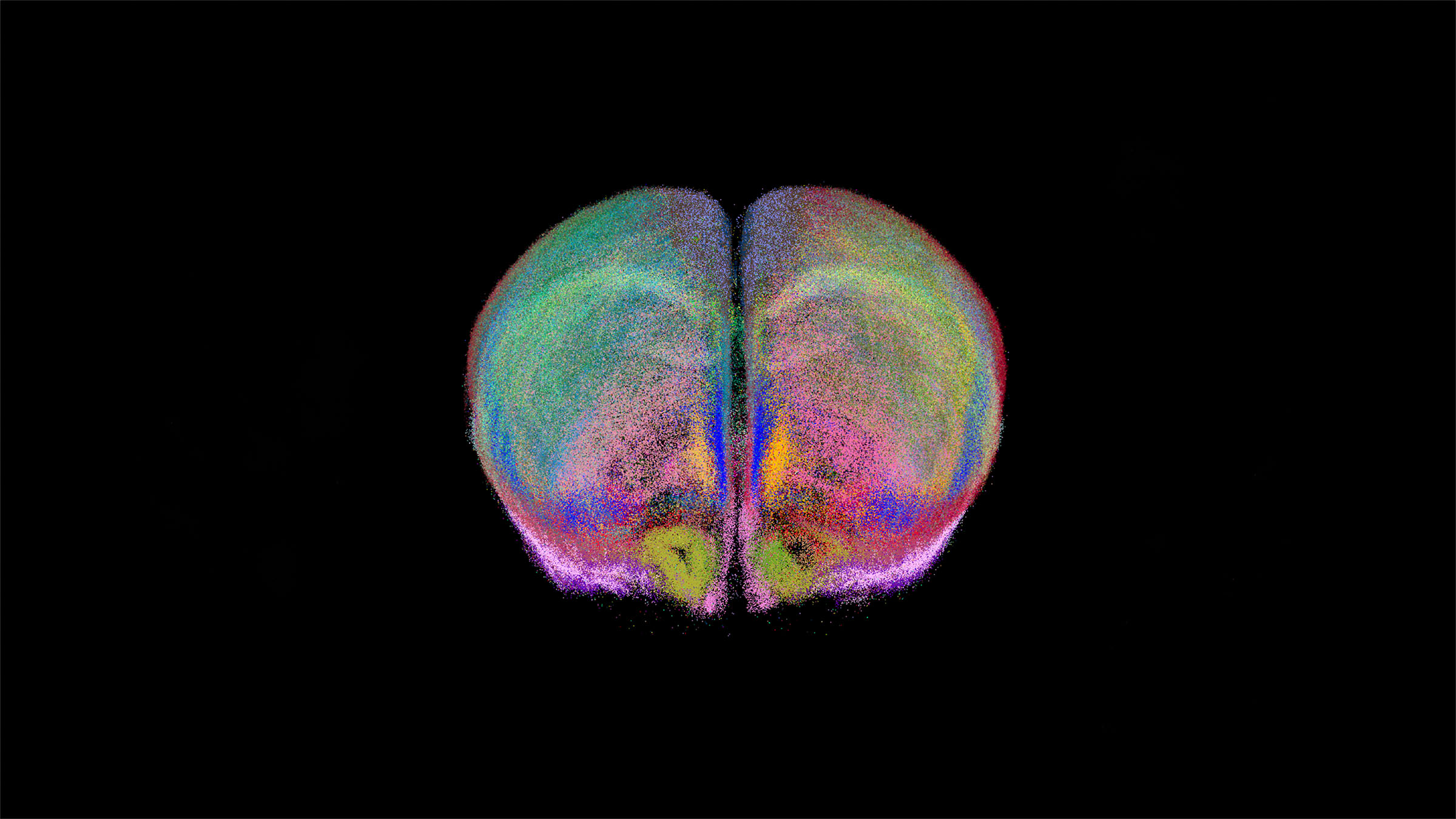
A study published today in Nature sheds new light on the brain’s cellular landscape. Researchers at the Allen Institute for Brain Science and their international collaborators used an advanced method called BARseq to swiftly classify and map millions of neurons across nine mouse brains. They discovered that while brain regions share the same types of neurons, the specific combination of these cells gives each area a distinct ‘signature,’ akin to a cellular ID card.

This isn’t something that only the big labs can do.

- Mara Rue, Ph.D., Co-lead author and a Scientist at the Allen Institute

The team further explored how sensory inputs influence these cellular signatures. They discovered that mice deprived of sight experienced a major reorganization of cell types within the visual cortex, which blurred the distinctions with neighboring areas. These shifts were not confined to the visual area but occurred across half of cortical regions, though to a lesser extent.

The study underscores the pivotal role of sensory experiences in shaping and maintaining each brain region’s unique cellular identity.
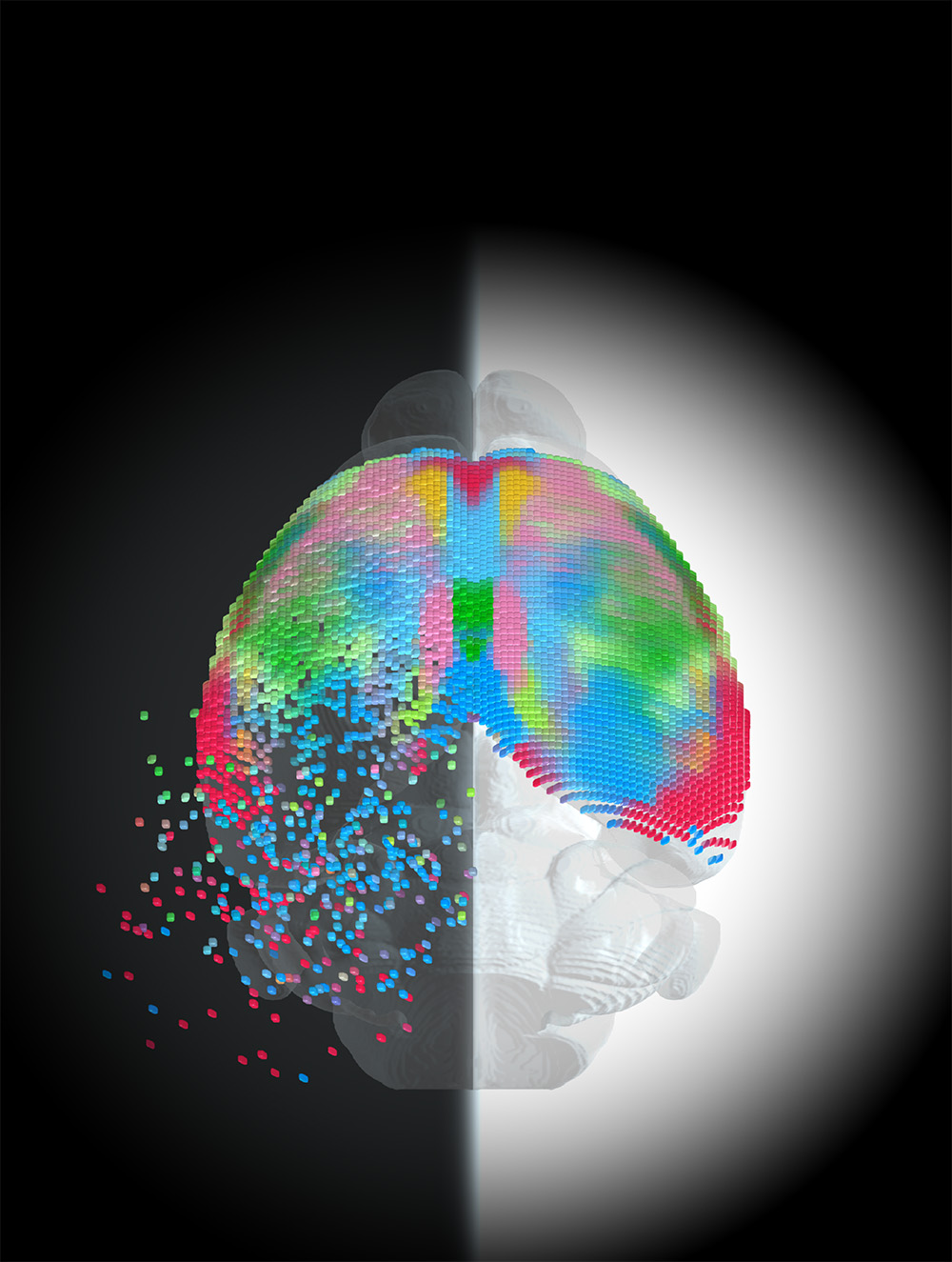
Digitized profile of human face with colorful pixelated brain and dispersing particles against dark background
The study indicates that our brains function like pointillist art, using varied combinations of neural ‘dots’ to form distinct brain regions. Image courtesy Xiaoyin Chen.

“BARseq lets us see with unprecedented precision how sensory inputs affect brain development,” said Xiaoyin Chen, Ph.D., the study’s co-lead author and an Assistant Investigator at the Allen Institute. “These broad changes illustrate how important vision is in shaping our brains, even at the most basic level.”

The findings suggest our brains mirror the mosaic-like paintings of pointillism, where small dots of color are arranged in patterns to form images, he added. Similarly, different combinations of the same neural ‘dots’ create distinct regions in the brain.

And just as a painting may look dull and murky when the dots aren’t placed with precision, the brain’s neural canvas can lose some of its distinctiveness and clarity without visual input.

A powerful new brain mapping tool

Previously, capturing single-cell data across multiple brains was challenging, said Mara Rue, Ph.D., co-lead author and a Scientist at the Allen Institute. But BARseq is cheaper and less time-consuming than similar mapping technologies, she said, enabling researchers to examine and compare brain-wide molecular architecture across multiple individuals.

BARseq tags individual brain cells with unique RNA ‘barcodes’ to track their connections across the brain. This data, combined with gene expression analysis, allows scientists to pinpoint and identify vast numbers of neurons in tissue slices.

For this study, the researchers used BARseq as a standalone method to rapidly analyze gene expression in intact tissue samples. In just three weeks, the researchers mapped more than 9 million cells from eight brains.
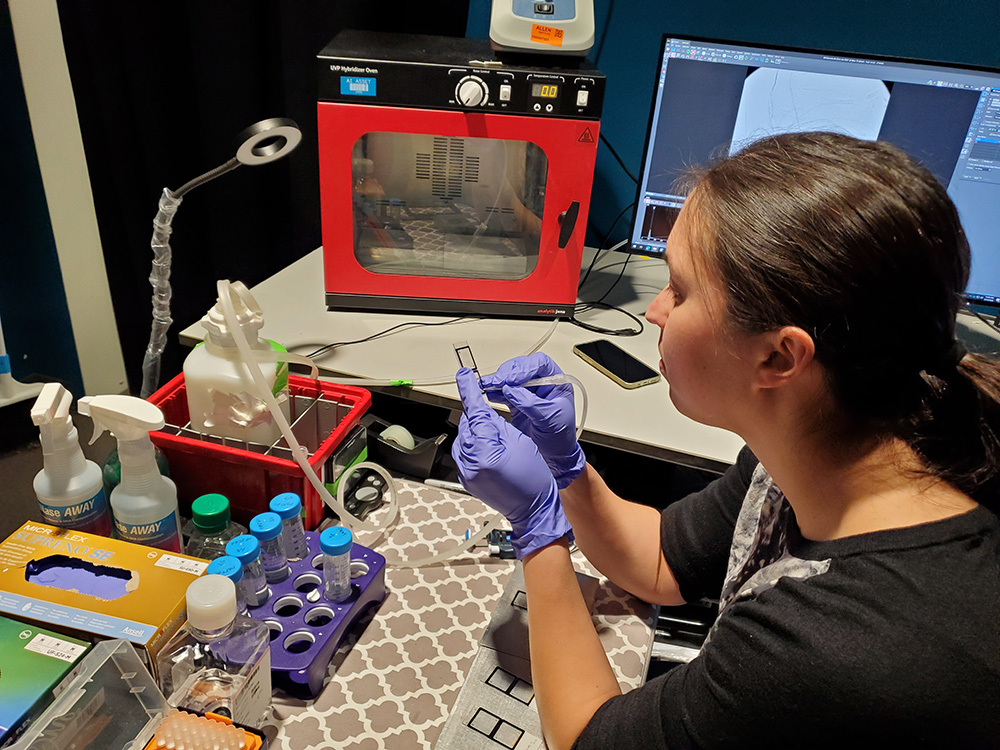
Scientist in lab gloves examining sample in laboratory workspace with equipment and computer.
Mara Rue prepares a sample for analysis using BARseq. Photo by Peter Kim / Allen Institute

The scale and speed of BARseq provides scientists with a powerful new tool to delve deeper into the intricacies of the brain, Chen said.

“BARseq allows us to move beyond mapping what a ‘model’ or ‘standard’ brain looks like and start to use it as a tool to understand how brains change and vary,” Chen said. “With this throughput, we can now ask these questions in a very systematic way, something unthinkable with other techniques.”

Chen and Rue emphasized that the BARseq method is freely available. They hope their study encourages other researchers to use it to investigate the brain’s organizational principles or zoom in on cell types associated with disease.

“This isn’t something that only the big labs can do,” Rue said. “Our study is a proof of principle that BARseq allows a wide range of people in the field to use spatial transcriptomics to answer their own questions.”

This study was a collaboration with Tony Zador at Cold Spring Harbor Laboratory, Jesse Gillis at University of Toronto, Stephan Fischer at Institut Pasteur, and Patrick Kanold at Johns Hopkins University.

Citations
No items found.

about the allen institute

The Allen Institute is an independent, 501(c)(3) nonprofit research organization founded by philanthropist and visionary, the late Paul G. Allen. The Allen Institute is dedicated to answering some of the biggest questions in bioscience and accelerating research worldwide. The Institute is a recognized leader in large-scale research with a commitment to an open science model. For more information, visit alleninstitute.org.
explore related stories

explore more stories
No articles for the category
we acceleratedevelopcatalyzeimpact

science done differently. shared with the world.

explore our accelerators

brain science

Mapping every cell, connection, and circuit in the brain—openly shared with the world.

cell science

Decoding how cells become tissues, then programming that knowledge into powerful new research tools.

neural dynamics

Revealing the brain's hidden algorithms that transform neural activity into real-world behavior.

immunology

Creating the deepest open reference for the healthy human immune system ever built.

synthetic biology

Engineering cells to record their own histories, transforming how we understand disease over time.

research

Big questions, open answers, and science built to be shared.

education

Inspiring the next generation of scientists through open science resources.

impact

Our science is empowering researchers and advancing health worldwide.
advancing science through open, collaborative research
Get the allen institute newsletter
Stay informed on the latest breakthroughs in neuroscience, bioscience, and AI-driven research.
allen institute
impactpeople & teamscareers & opportunitiesalumnihistory & founder
science resources
allencell.orgallenimmunology.orgallenneuraldynamics.orgbrain-bican.orgbrain-map.orgmicrons-explorer.org
research
brain sciencecell scienceneural dynamicsimmunologysynthetic biologypublications
education
science educationfield tripsprofessional developmenteducation resources
quick links
newseventsopen sciencepodcastscience resourceshuman brain donationvisit uscontact
follow us/

allen institute, 615 Westlake Ave North, Seattle, WA 98109 +12065487055

© 0000 allen institute. all rights reserved.
privacy policyterms of usecitation policyemployee portalpolicy & compliance