
How do neurons react to magic mushrooms? What happens in the brain when we see motion, or when we recognize grain patterns in a piece of wood? How do our brains track the subtle changes in our friends’ appearances over time?
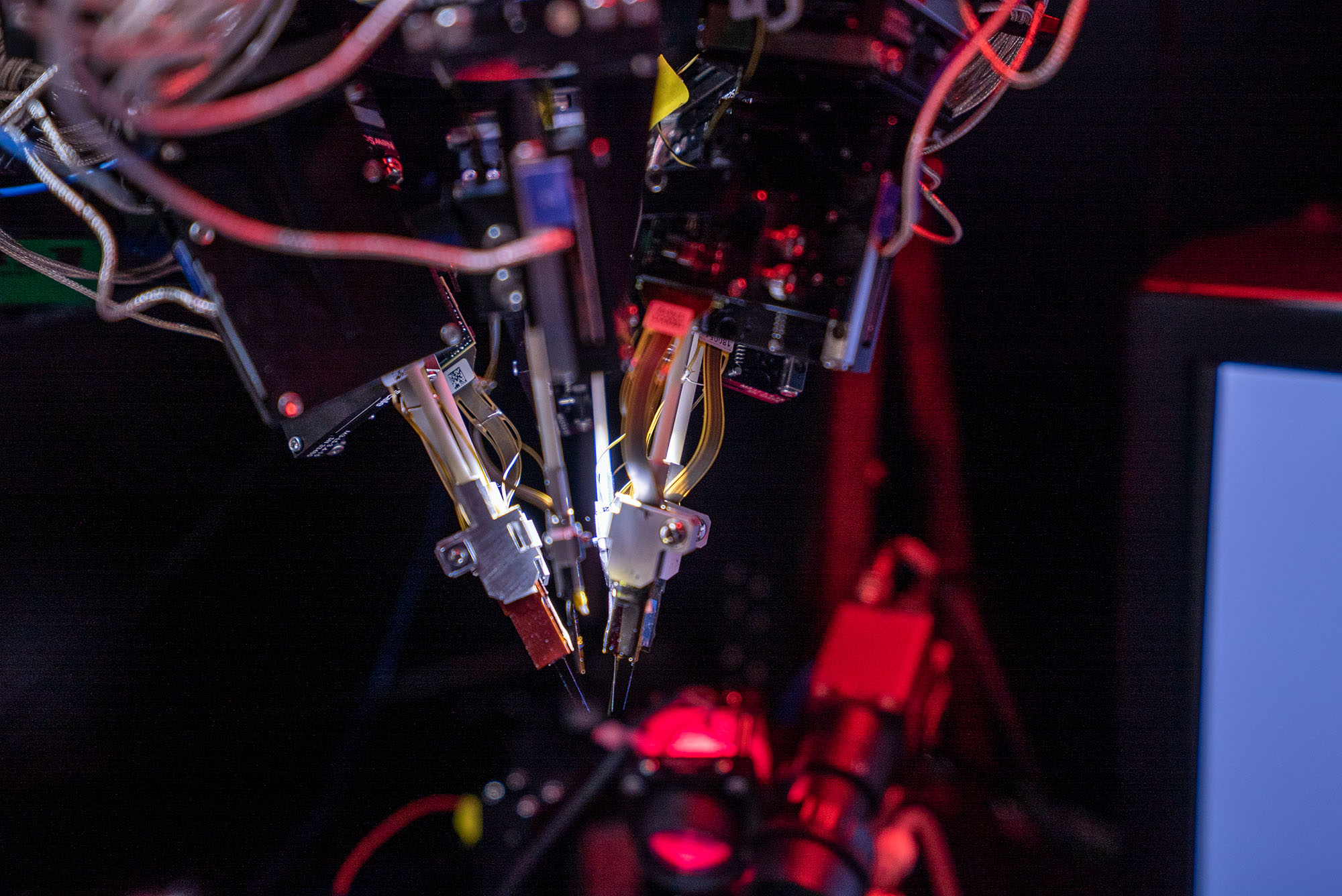
The Allen Institute has launched four projects to investigate these questions through OpenScope, a shared neuroscience observatory. Just as astronomers use a few well-equipped observatories to study the universe, the OpenScope program lets neuroscientists worldwide propose and direct experiments on the Allen Brain Observatory pipeline. All research is made freely available to anyone tackling open questions in neural activity in health and disease.
Now in its 6th year, OpenScope aims to “pioneer a new model in neuroscience,” said Jérôme Lecoq, Ph.D., Associate Investigator at the Allen Institute.
“Our platform enhances data acquisition and global sharing, while empowering individual labs to leverage it for their unique scientific pursuits,” said Lecoq, who co-leads OpenScope with Christof Koch. “We’re striving to combine the best of both worlds: focused questions tackled by passionate teams, and a sophisticated platform driven by experienced experimentalists. This is our vision for the future of neuroscience.”

Psychedelic science
One of this year’s OpenScope projects will explore how psilocybin, the psychoactive compound in “magic mushrooms,” changes brain activity at a cellular level. This compound, known for inducing intense psychedelic experiences in humans, will be used to investigate the neural mechanisms that underlie altered cognition and perception.
Using advanced recording techniques in mice, scientists will observe how neurons communicate differently under the influence of psilocybin. They will also explore how those changes might influence the brain’s ability to process and predict sensory information, which is crucial to understanding how perception is constructed.
“Our interest in these compounds goes beyond their potential clinical applications,” said Roberto de Filippo, Ph.D., a postdoc at Humboldt University of Berlin. “We believe that uncovering the biological mechanisms underlying their effects can provide fundamental insights into the processes that govern perception, cognition, and consciousness itself.”
This project is being led by de Filippo; Torben Ott, Ph.D., of Humboldt University of Berlin; and Dietmar Schmitz, Ph.D, of Charité – Universitätsmedizin Berlin.
How the past subtly shapes our worldview
We often overlook the gradual changes in people we see regularly, only noticing differences when we view an old photo or reunite with friends after a long time. Despite these changes being almost imperceptible, our brains constantly update our memories with these details.

A 2024 OpenScope project aims to uncover the neural underpinnings of these updates. Using the Allen Brain Observatory platform, researchers will analyze brain activity in mice to understand how the brain’s visual system reacts to changes over time. Traditionally, neuroscientists thought that the visual system only processed incoming sensory information. But recent findings suggest that this system also archives visual memories and uses them to predict what we see next.
“We want to understand how such memories influence the perception of real-world visuals and what role different brain areas play in this process,” said Yaniv Ziv, Ph.D., professor at the Weizmann Institute of Science. “By understanding this, we aim to uncover whether these memories influence how flexible or rigid our visual processing is. For instance, if we’ve seen something similar before, does that make our brain more or less likely to adapt to new visual information?”
This project is being led by Ziv; Daniel Deitch; Alon Rubin, Ph.D.; and Itay Talpir, all at the Weizmann Institute of Science
Deciphering how the brain perceives motion
How does the brain recognize objects moving around us? A 2024 OpenScope project aims to demystify this fundamental process by studying motion perception in the visual cortex of mice.
While previous studies have identified brain regions that respond to different types of motion, the underlying neural circuitry remains poorly understood. This project will use microscopy to simultaneously observe the activity of many neurons over several weeks and in different parts of the visual cortex.
The team hopes to characterize the neuronal representation of motion across brain regions and cell types and understand the specific circuits that support them. The insights gleaned from this work may have broader implications, as the same cell types and circuits are found throughout the cortex.
“If we manage to understand how these circuits process information in the visual system, there’s a good chance that the same principles apply throughout the brain,” said Julia Veit, Ph.D., a professor at the University of Freiburg.
This project is being led by Veit; Henning Sprekeler, Ph.D., of Technical University of Berlin; and Yael Oran, Ph.D., of University of Freiburg.
Seeing the patterns around us
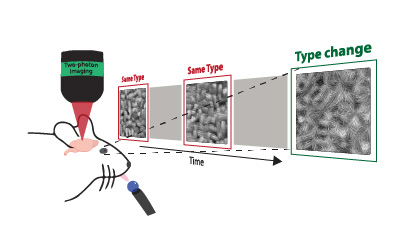
Our brains instantly recognize countless complex visual textures that surround us, from the intricate designs on a butterfly’s wings to the grain pattern of wood. But how does it pull off this remarkable feat of visual perception?
In this OpenScope project, mice will be trained to distinguish textures while their neuronal activity is monitored in the visual cortex, linking neural responses to perception. The key goals are to determine how certain textures are easily recognized while others pose a challenge, and to map how different brain regions interact to transform visual inputs into coherent representations that guide behavior.
Those findings could uncover core principles for how the brain extracts understanding from our richly patterned visual world, the researchers said. But the scale and complexity of the research necessitates tools and resources beyond those in a typical laboratory setting.
“Using the Allen Brain Observatory will not only increase the scope and reach of our project several fold, but it will also allow us to compare and contextualize with all the other Open Science projects they have led in the last decade,” said Federico Bolaños, Ph.D., lead data scientist at University of British Columbia. “As it happened in other fields like high energy physics or astronomy, research in systems neuroscience needs to move from individual laboratories into a bigger and interconnected community, in which we progress together.”
This project is being led by Bolaños; Timothy Murphy, Ph.D., of University of British Columbia; and Javier Orlandi, Ph.D., of University of Calgary.
Research described in this article was supported by award number U24NS113646 from the National Institute of Neurological Disorders and Stroke of the National Institutes of Health. The content is solely the responsibility of the authors and does not necessarily represent the official views of NIH and its subsidiary institutes.
Citations
about the allen institute
The Allen Institute is an independent, 501(c)(3) nonprofit research organization founded by philanthropist and visionary, the late Paul G. Allen. The Allen Institute is dedicated to answering some of the biggest questions in bioscience and accelerating research worldwide. The Institute is a recognized leader in large-scale research with a commitment to an open science model. For more information, visit alleninstitute.org.




