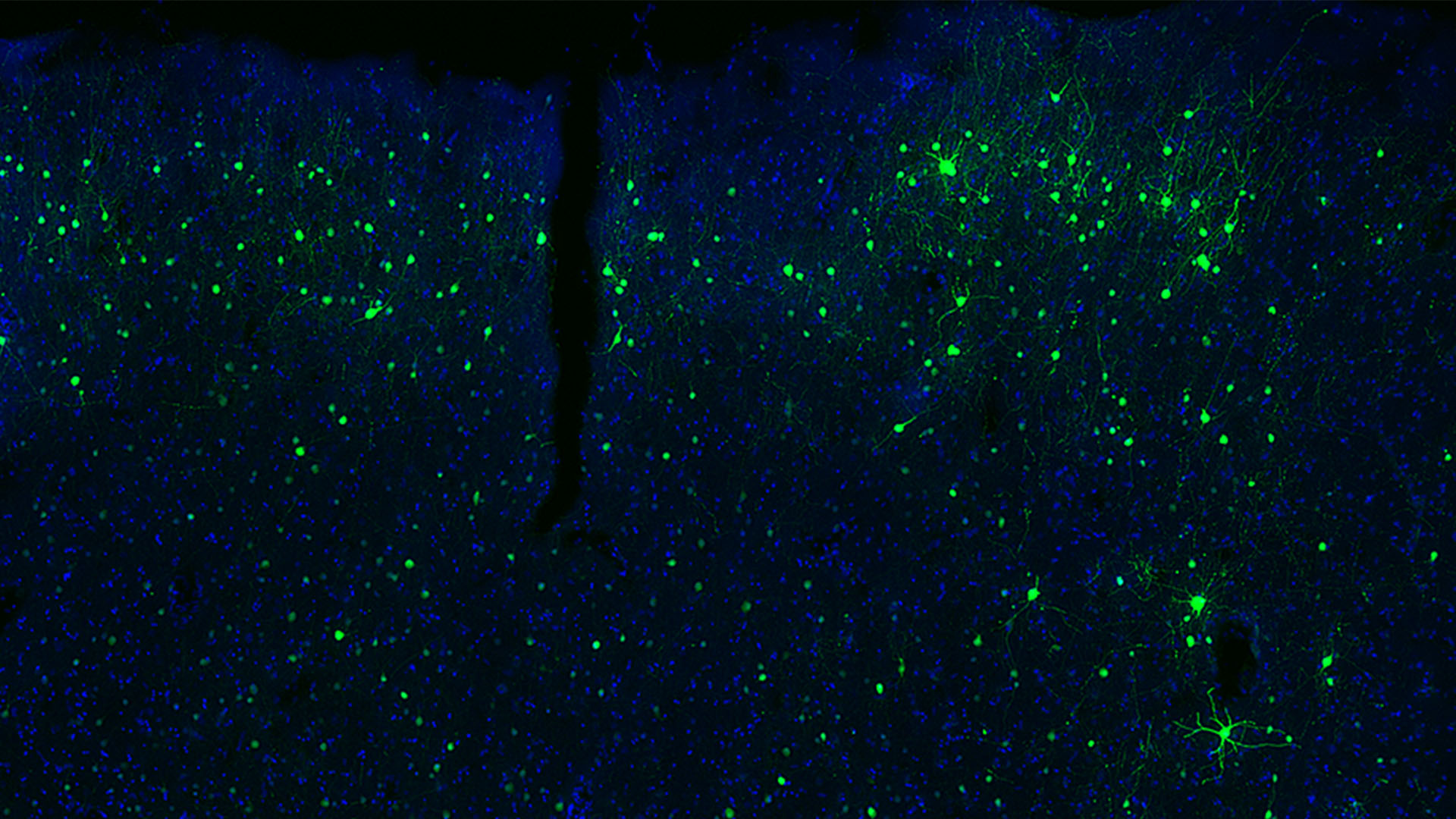

A new virus-based tool is lighting up the brain in glowing — and highly specific — colors.
Two studies, led by researchers at the Allen Institute for Brain Science, a division of the Allen Institute, were published today in the journals Neuron and Cell Reports and describe modified viruses that can deliver fluorescent labels to a single cell type in the mouse, monkey or human brain. Lighting up individual cell types will help researchers better understand what those cells do in the brain — what they look like, who they talk to, where they live.
But these viral tools could, in the not-too-distant future, carry an even more precious cargo: targeted and potentially curative gene therapies for currently untreatable — and even deadly — genetic brain diseases and disorders.
Their ability to carry both glowing color for basic neuroscience studies and their potential to ferry a new kind of gene therapy to the brain is due to these tools’ exquisite specificity. The modified viruses carry a molecular “zip code” that switch on their genetic cargo only in certain types of neurons in the brain.
That means they can be injected into the bloodstream and, while they may enter most or all cells in the body, the special genes they carry will only activate in a specific and very small subset of brain cells as stipulated by that zip code. In the context of labeling neurons for study, the result is a glowing color in one cell type in the brain, enabling more precise study of different neurons and other kinds of brain cells. In the context of gene therapy, the tools could deliver a healthy version of a gene to a patient with a genetic disorder that afflicts a single or small group of brain cell types.
“We know that many brain diseases impact not every cell in the brain, but often subsets of cells that are responsible for the disease,” said Boaz Levi, Ph.D., Associate Investigator at the Allen Institute for Brain Science. “We think selectivity is critical for both basic study of the brain and brain therapeutics, and the fact that we’re getting such selectivity from these viral tools is really powerful.”
For example, the progressive neurodegenerative disorder Parkinson’s disease is now known to begin in certain brain cells, dopaminergic neurons, in one region of the brain, the substantia nigra.
Levi led the Cell Reports publication along with Allen Institute for Brain Science Senior Scientist John Mich, Ph.D., and Assistant Investigator Jonathan Ting, Ph.D. The Neuron publication was led by the Allen Institute for Brain Science’s Bosiljka Tasic, Ph.D., Director of Molecular Genetics; Tanya Daigle, Ph.D., Assistant Investigator, and Lucas Graybuck, Ph.D., now a Senior Scientist at the Allen Institute for Immunology.
A virus engineered for good
The tools are built on the backbone of a virus called an adeno-associated virus, or AAV, tiny viruses that infect humans and some other primates. AAVs don’t cause disease and trigger little immune response. Two AAV-based gene therapies have been approved by the FDA — one for a genetic form of blindness and one for spinal muscular atrophy, a genetic childhood disease — and many more are already being tested in human clinical trials.
The Allen Institute researchers chose AAVs as the backbone of their tools in part because of that gene therapy promise. The original goal of the project was to develop tools to label specific brain cell types to further basic neuroscience studies, but using the tools as a possible springboard to more precise gene therapies was in their mind early on, the researchers said. Virus-based gene therapies are not new, but older iterations were not able to target their genetic cargo selectively, meaning they often came with many unwanted side effects as the therapeutic genes were switched on in all or most cells in the body.
“This is really a revamp of an old idea with much higher precision, and the promise of an ability to target specific cell types,” Ting said.
In lab studies, without the use of a viral tool like these, causing a single neuron type to light up under the microscope is only possible by genetically manipulating animals to bear a gene encoding for a fluorescent label in their own genome. This approach, known as transgenic engineering, is commonly done in lab mice and is also powerful for neuroscience studies. But creating transgenic mice takes a large amount of time and resources, and it also isn’t possible in many other kinds of animals. The viral tools are faster to generate and implement, more affordable, and could work in many different mammalian species.
“Creating such a large set of specific tools could be transformative in the field of neuroscience because they can be made and implemented in such a simple way,” said Daigle. “There are some labs that cannot afford to do complex breeding strategies and maintain so many animals. Making tools like this more available to all labs could have a really big impact.”
The Allen Institute researchers have made the basis for these tools, known as DNA plasmids, available for other labs to purchase through the non-profit plasmid repository Addgene. Their publications describe tools for targeting a number of different brain cell types and also lay out instructions for researchers to generate their own tools for accessing other kinds of brain cells.
Genetic volume dials
The viral tools owe their specificity to what is called an enhancer, a piece of DNA that acts like a volume dial for an individual gene, turning up its activity. Many enhancers are active only in a subset or specific type of cells. The Allen Institute teams generated a large dataset of possible enhancers from individual brain cells and looked for those unique to a given brain cell type. They then bundled those specific enhancers along with a fluorescent label inside the tiny virus package, which carries its genetic cargo to cells like a Trojan horse. The researchers selected enhancers that are similar between mice and humans; the viral tools lit up specific brain cell types in mouse, monkey and human brain cells (the researchers use live human brain pieces donated by Seattle-area patients undergoing brain surgeries for epilepsy or tumors).
That the same viral tool works in multiple species could open doors to areas of research not possible with other techniques, or in animals where more traditional genetic engineering isn’t possible — including studies of human brain tissue. The researchers also found that the viral tools could be combined to study two or more different cell types at once, using different colors to distinguish them.
The tools rely on knowing what constitutes a brain cell type, a long list of brain parts that is by no means complete even for the small mouse brain, let alone our own. But once researchers have pinned down the genetic address of a new cell type or types, the steps to create a tool to study them in detail should hopefully apply, Tasic said.
You go from the definition of a cell type to a tool in a more or less straightforward fashion,” she said. “We don’t know if this is going to hold up for every single cell type in the brain, but that’s the dream.” — written by Rachel Tompa, Ph.D.
Rachel Tompa is Senior Writer at the Allen Institute. She covers news from all scientific divisions at the Institute. Get in touch at rachelt@alleninstitute.org.
Research described in this article was supported in part by multiple grants from the National Institutes of Health, the Nancy & Buster Alvord Endowment, and the National Center for Advancing Translational Sciences. The content is solely the responsibility of the authors and does not necessarily represent the official views of the sponsors.
Citations
about the allen institute
The Allen Institute is an independent, 501(c)(3) nonprofit research organization founded by philanthropist and visionary, the late Paul G. Allen. The Allen Institute is dedicated to answering some of the biggest questions in bioscience and accelerating research worldwide. The Institute is a recognized leader in large-scale research with a commitment to an open science model. For more information, visit alleninstitute.org.




