
in this article
Allen Institute researchers are embarking on two new projects to better understand the building blocks of the mammalian brain, its cell types.
Funded by the National Institutes of Health, the projects will advance our knowledge of how our brains age and build a suite of new tools to label brain cell types.
Both studies will lay the groundwork for the scientific community to better understand the brain in health and disease, the lead researchers say. Many human brain diseases are associated with or accelerated by old age, such as Alzheimer’s and Parkinson’s diseases, but scientists don’t understand the cellular-level details of how the brain changes in normal aging or in diseases. The new tools will accelerate and refine studies of brain cells, reducing the number of animals needed for experiments and enabling researchers anywhere in the world to follow a “recipe book” to study specific cell types in the mouse brain.
The aging brain
The research team studying the aging brain will generate a complete atlas of brain cell types from the elderly mouse. Researchers at the Allen Institute and around the world are already developing similar atlases from young adult animals, as well as from human and non-human primate brains, through the NIH’s BRAIN Initiative Cell Census Network, but nobody has yet tackled such a census to describe brain aging at the single-cell level.
Understanding how brain cell types change with age is critical to understanding the biology behind our own brain aging, said Hongkui Zeng, Ph.D., Executive Director of Structured Science at the Allen Institute for Brain Science, a division of the Allen Institute, who is leading the aging project.
“Neurodegenerative diseases, such as Alzheimer’s and Parkinson’s, are increasingly prevalent in modern society,” Zeng said. “So many cognitive functions of the brain change with age, but we don’t know how these changes are reflected at brain cell level; that hasn’t been studied. We need foundational studies in animal models to tease out specific age-related changes in the mammalian brain.”
The project, which is funded by the National Institute on Aging of the NIH at $5.9M over five years, will look at cell types across the entire mouse brain, and zero in on areas of the brain most vulnerable to aging or age-related diseases for more detailed analyses. The team will study 18-month old mice, which are roughly equivalent to humans in their 60s. Mice exhibit cognitive decline with age just as we do, Zeng said, losing their capacity to learn and remember as they age.
A recipe book to light up cells in the brain
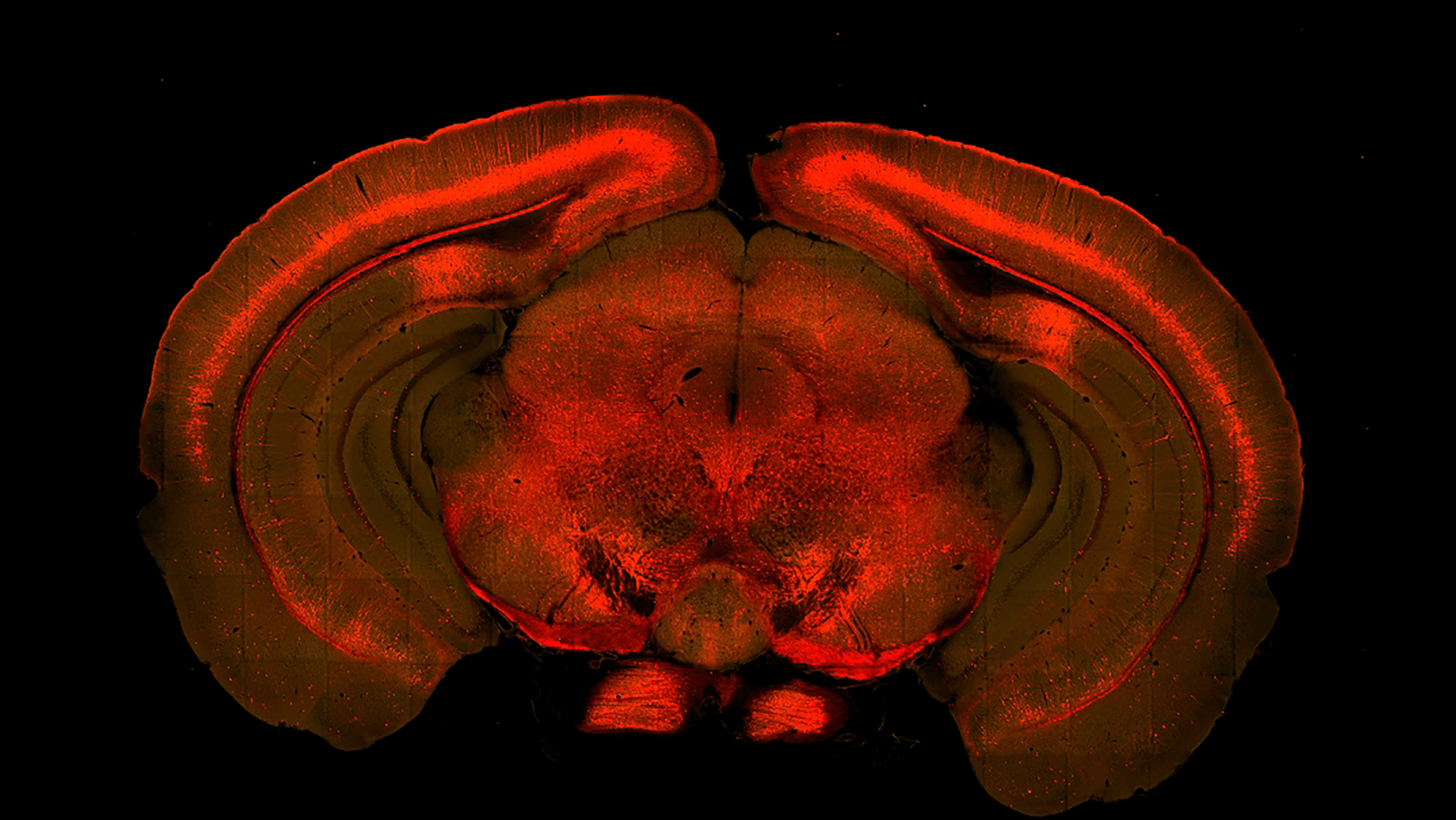
Viral tools developed by Allen Institute for Brain Science researchers cause specific brain cells to glow under fluorescence microscopes.
Another Allen Institute team is building hundreds of new tools to light up brain cells in glowing colors. This technique relies on a modified virus that targets and harmlessly infects brain cells in the mouse, bringing with it a genetic payload that will cause only one brain cell type to glow under the microscope, letting researchers pick out one cell type among a sea of gray matter in the mouse brain.
For neuroscientists who want to study specific kinds of cells in the brain, being able to see where it is and what it looks like is a key first step to understanding what that particular cell does — and how it might change in disease. Bosiljka Tasic, Ph.D., Associate Director of Molecular Genetics at the Allen Institute for Brain Science, is leading a team that will engineer and test 300 of these modified viruses, each to target a different brain cell type.
Tasic and her colleagues have already shown the technique works, testing it on a few cell types. Through the three-year project funded by the National Institute of Mental Health of the NIH at $2.6M, they hope to generate and publicly share a “recipe book” for labeling hundreds of different brain cell types, recipes that any researcher in the world can follow to use the technique in their own lab.
Research reported in this publication was supported by the National Institute On Aging of the National Institutes of Health under Award Number R01AG066027, and by the National Institute Of Mental Health of the National Institutes of Health under Award Number RF1MH121274. The content is solely the responsibility of the authors and does not necessarily represent the official views of the National Institutes of Health.
Citations
about the allen institute
The Allen Institute is an independent, 501(c)(3) nonprofit research organization founded by philanthropist and visionary, the late Paul G. Allen. The Allen Institute is dedicated to answering some of the biggest questions in bioscience and accelerating research worldwide. The Institute is a recognized leader in large-scale research with a commitment to an open science model. For more information, visit alleninstitute.org.




