impact
impact
open science
subheadline
careers and opportunities
subheadline
people & teams
people & teams
subheadline
allenites
subheadline
allen institute advisors
subheadline
board of directors
subheadline
shanahan foundation fellowship
subheadline
next generation leaders
subheadline
research
overview
our approach
subheadline
publications
subheadline
open science
subheadline
accelerator
brain science
subheadline
cell science
subheadline
neural dynamics
subheadline
immunology
subheadline
synthetic biology
subheadline
education
education
science education
subheadline
education resources
subheadline
field trips
subheadline
open science
subheadline
open science quest
subheadline
news
news
stories
subheadline
podcast
subheadline
sign up for our newsletter
subheadline
events
events
all events
subheadline
conferences
subheadline
event code of conduct
subheadline
events
open science quest
subheadline
summer workshop on the dynamic brain
subheadline
open science week
subheadline
brain fest
subheadline
science resources
science resources
allencell.org
subheadline
allenimmunology.org
subheadline
allenneuraldynamics.org
subheadline
brain-bican.org
subheadline
brain-map.org
subheadline
microns-explorer.org
subheadline
impact
back to menu
impact
open science
subheading
careers and opportunities
subheading
people & teams
people & teams
subheading
allen institute advisors
subheading
board of directors
subheading
shanahan foundation fellowship
subheading
next generation leaders
subheading
research
back to menu
impact
Label
subheading
Label
subheading
people & teams
education
back to menu
research
Label
subheading
Label
subheading
Heading
news
back to menu
research
Label
subheading
Label
subheading
Heading
events
back to menu
research
Label
subheading
Label
subheading
Heading
science resources
back to menu
science resources
allencell.org
subheading
allenimmunology.org
subheading
allenneuraldynamics.org
subheading
brain-bican.org
subheading
brain-map.org
subheading
microns-explorer.org
subheading
search
stories
news

New knowledge on how the brain develops

Researchers at the Allen Institute for Brain Science and Harvard University have published a series of papers that identify patterns in the gene...

March 27, 2017
 min read
share/
Researchers at the Allen Institute for Brain Science and Harvard University have published a series of papers that identify patterns in the gene expression of single brain cells, and use that knowledge to gain insight into how both mouse and human embryonic stem cells differentiate.
Thank you! Your submission has been received!
Oops! Something went wrong while submitting the form.

in this article

table of contents will display on published page only
set h2 to populate the table of contents here

Taken together, the papers are a key body of work for the scientific community seeking to understand brain development at its most fundamental level.

“Nothing quite like this exists in the stem cell literature,” says Sharad Ramanathan, Ph.D., Professor of Molecular and Cellular Biology and of Applied Physics at Harvard University. “Any complex language is governed by grammatical rules, and we wanted to know whether the development of early human cortex could be decoded by understanding its underlying rules, or grammar. We’ve combined a series of approaches to address this question in a way that sheds valuable light on a difficult to study topic.”

“We are learning about the brain in some of its earliest moments of development, and uncovering the patterns that give rise to what it may look like and how it may function in adulthood,” says Boaz Levi, Ph.D., Assistant Investigator at the Allen Institute for Brain Science. “This takes a unique combination of novel computational approaches, dedicated, fastidious bench work, and a willingness to dive into new technologies and see how they can benefit our research.”

Learn more about each paper below, and click to view the full manuscripts on the publisher’s website.

Discovering sparse transcription factor codes for cell states and state transitions during development, eLife

Leon A. Furchtgott, Samuel Melton, Vilas Menon, Sharad Ramanathan

This elegant computational study develops a statistical framework using gene expression patterns to simultaneously infer both lineage transitions and the genes that determine these relationships. Extending their methodology into gene expression information from early human cells, they were able to identify a key early developmental split and the genes that could control this lineage decision.

Dynamics of embryonic stem cell differentiation inferred from single-cell transcriptomics show a series of transitions through discrete cell states, eLife

Sumin Jang, Sandeep Choubey, Leon Furchtgott, Ling-Nan Zou, Adele Doyle, Vilas Menon, Ethan Loew, Anne-Rachel Krostag, Refugio Martinez, Linda Madisen, Boaz Levi, Sharad Ramanathan

This study applies the computational framework developed in the first paper to characterize the early germ layer differentiation lineage of mouse embryonic stem cells using data and a cell line generated at the Allen Institute. They characterize and experimentally validate the transitions between nine discrete cell states detected in the early differentiations, as well as some key molecular regulators of those transitions.

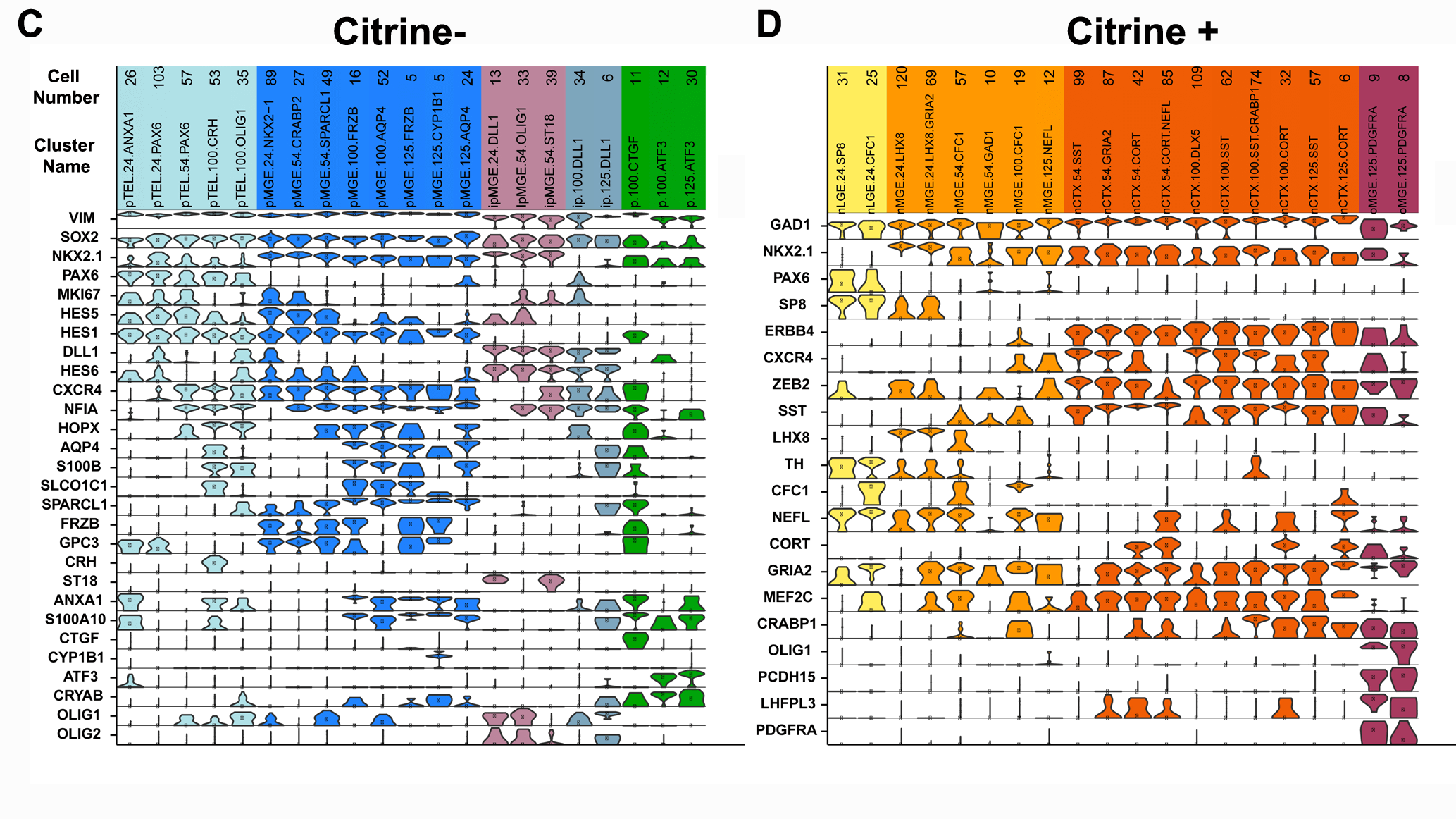
Single-Cell Profiling of an In Vitro Model of Human Interneuron Development Reveals Temporal Dynamics of Cell Type Production and Maturation, Neuron

Jennie L. Close, Zizhen Yao, Boaz P. Levi, Jeremy A. Miller, Trygve E. Bakken, Vilas Menon, Jonathan T. Ting, Abigail Wall, Anne-Rachel Krostag, Elliot R. Thomsen, Angel M. Nelson, John K. Mich, Rebecca D. Hodge, Soraya I. Shehata, Ian A. Glass, Susan Bort, Nadiya V. Shapovalova, N. Kiet Ngo, Joshua S. Grimley, John W. Phillips, Carol L. Thompson, Sharad Ramanathan, Ed Lein

This paper presents a recipe for growing a class of GABAergic interneurons in a dish. After characterizing cell types present during in vitro production of human interneurons, researchers identified the genes expressed during maturation and developed computational methods that allowed them to describe those changes over time.

Read the news story about this paper.

Citations
No items found.

about the allen institute

The Allen Institute is an independent, 501(c)(3) nonprofit research organization founded by philanthropist and visionary, the late Paul G. Allen. The Allen Institute is dedicated to answering some of the biggest questions in bioscience and accelerating research worldwide. The Institute is a recognized leader in large-scale research with a commitment to an open science model. For more information, visit alleninstitute.org.
explore related stories

explore more stories
No articles for the category
we acceleratedevelopcatalyzeimpact

science done differently. shared with the world.

explore our accelerators

brain science

Mapping every cell, connection, and circuit in the brain—openly shared with the world.

cell science

Decoding how cells become tissues, then programming that knowledge into powerful new research tools.

neural dynamics

Revealing the brain's hidden algorithms that transform neural activity into real-world behavior.

immunology

Creating the deepest open reference for the healthy human immune system ever built.

synthetic biology

Engineering cells to record their own histories, transforming how we understand disease over time.

research

Big questions, open answers, and science built to be shared.

education

Inspiring the next generation of scientists through open science resources.

impact

Our science is empowering researchers and advancing health worldwide.
advancing science through open, collaborative research
Get the allen institute newsletter
Stay informed on the latest breakthroughs in neuroscience, bioscience, and AI-driven research.
allen institute
impactpeople & teamscareers & opportunitiesalumnihistory & founder
science resources
allencell.orgallenimmunology.orgallenneuraldynamics.orgbrain-bican.orgbrain-map.orgmicrons-explorer.org
research
brain sciencecell scienceneural dynamicsimmunologysynthetic biologypublications
education
science educationfield tripsprofessional developmenteducation resources
quick links
newseventsopen sciencepodcastscience resourceshuman brain donationvisit uscontact
follow us/

allen institute, 615 Westlake Ave North, Seattle, WA 98109 +12065487055

© 0000 allen institute. all rights reserved.
privacy policyterms of usecitation policyemployee portalpolicy & compliance