impact
impact
open science
subheadline
careers and opportunities
subheadline
people & teams
people & teams
subheadline
allenites
subheadline
allen institute advisors
subheadline
board of directors
subheadline
shanahan foundation fellowship
subheadline
next generation leaders
subheadline
research
overview
our approach
subheadline
publications
subheadline
open science
subheadline
accelerator
brain science
subheadline
cell science
subheadline
neural dynamics
subheadline
immunology
subheadline
synthetic biology
subheadline
education
education
science education
subheadline
education resources
subheadline
field trips
subheadline
open science
subheadline
open science quest
subheadline
news
news
stories
subheadline
podcast
subheadline
sign up for our newsletter
subheadline
events
events
all events
subheadline
conferences
subheadline
event code of conduct
subheadline
events
open science quest
subheadline
summer workshop on the dynamic brain
subheadline
open science week
subheadline
brain fest
subheadline
science resources
science resources
allencell.org
subheadline
allenimmunology.org
subheadline
allenneuraldynamics.org
subheadline
brain-bican.org
subheadline
brain-map.org
subheadline
microns-explorer.org
subheadline
impact
back to menu
impact
open science
subheading
careers and opportunities
subheading
people & teams
people & teams
subheading
allen institute advisors
subheading
board of directors
subheading
shanahan foundation fellowship
subheading
next generation leaders
subheading
research
back to menu
impact
Label
subheading
Label
subheading
people & teams
education
back to menu
research
Label
subheading
Label
subheading
Heading
news
back to menu
research
Label
subheading
Label
subheading
Heading
events
back to menu
research
Label
subheading
Label
subheading
Heading
science resources
back to menu
science resources
allencell.org
subheading
allenimmunology.org
subheading
allenneuraldynamics.org
subheading
brain-bican.org
subheading
brain-map.org
subheading
microns-explorer.org
subheading
search
stories
news

New technique captures view of 10,000 genes' activity in the moment

The technique, which the researchers dubbed seqFISH, detects a very transient form of RNA, the go-between molecule that bridges the gap between a gene...

June 7, 2018
 min read
share/
The technique, which the researchers dubbed seqFISH, detects a very transient form of RNA, the go-between molecule that bridges the gap between a gene...
Thank you! Your submission has been received!
Oops! Something went wrong while submitting the form.

in this article

table of contents will display on published page only
set h2 to populate the table of contents here
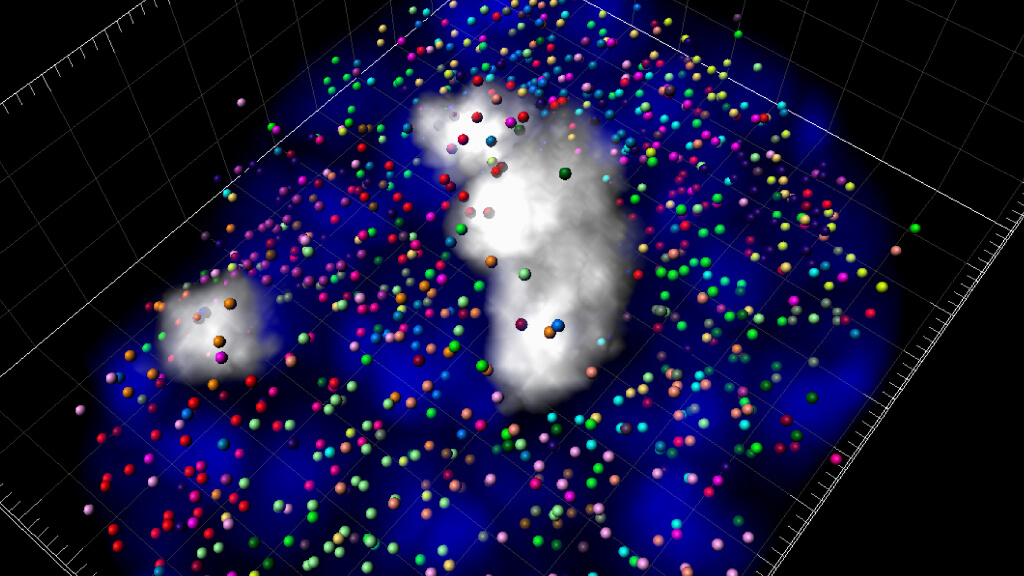
In a study published in the journal Cell, Caltech biologist Dr. Long Cai and his colleagues demonstrated a scaled up version of their technique, seqFISH, that let them view close to real-time activity of 10,000 genes in a single cell at once. In this 3D reconstruction of a mouse cell, chromosomes are stained blue and all the active genes in the cell are labeled with different colored dots that correspond to their native chromosome.

The technique, which the researchers dubbed seqFISH, detects a very transient form of RNA, the go-between molecule that bridges the gap between a gene and its protein product. Other RNA sequencing techniques look at a mature, longer-lived form of the molecule.

There’s a lot you can learn from those sturdier bits of RNA, Cai said, but because they last for three to four hours, you can’t get a glimpse of gene activity when – and where – it’s happening. The transient version their technique analyzes only lasts about five minutes.

New discoveries made possible

In the study, the researchers captured images of more than 10,000 genes’ RNA within minutes of its birth in mouse stem cells and connective tissue cells. The resulting images revealed a few surprises about the nature of genome-wide activity, Cai said. The first was that the genes’ activity seemed to be synchronized in each cell – but not cell to cell – on a two-hour biological clock. The cells turn on and off in concert, they found.

Cai and his team don’t understand why gene activity cycles like this, but they want to probe the mystery further. A similar two-hour biological clock acts in embryo development, Cai said, so one possibility is that same clock persists to adulthood but hadn’t previously been detected.

The researchers also found that each chromosome takes up its own little ball of space inside the cell, with the active genes clustered around the outside of each chromosome.

“It’s almost like a ball of yarn that’s packed in the middle and more fuzzy on the surface,” Cai said. The active genes tend to reside on the outside of chromosomes and appear more intertwined with neighboring chromosomes, they found.

Next, the scientists want to apply the technique to cells in their native environs, both looking at how cells change during animal development and mapping the differences between human cells – and maybe eventually looking at how cells’ gene activity goes awry in different diseases.

Getting seqFISH to work at the genome scale was a four-year road with a lot of bumps, Cai said. The flexible funding through The Paul G. Allen Frontiers Group, which partially supported the technology development, was essential along the way, he said.

“It took a lot of tries to get this to work. The funding through the Allen Discovery Center gave us the freedom to try a lot of things,” Cai said.

Citations
No items found.

about the allen institute

The Allen Institute is an independent, 501(c)(3) nonprofit research organization founded by philanthropist and visionary, the late Paul G. Allen. The Allen Institute is dedicated to answering some of the biggest questions in bioscience and accelerating research worldwide. The Institute is a recognized leader in large-scale research with a commitment to an open science model. For more information, visit alleninstitute.org.


explore related stories

explore more stories
No articles for the category
we acceleratedevelopcatalyzeimpact

science done differently. shared with the world.

explore our accelerators

brain science

Mapping every cell, connection, and circuit in the brain—openly shared with the world.

cell science

Decoding how cells become tissues, then programming that knowledge into powerful new research tools.

neural dynamics

Revealing the brain's hidden algorithms that transform neural activity into real-world behavior.

immunology

Creating the deepest open reference for the healthy human immune system ever built.

synthetic biology

Engineering cells to record their own histories, transforming how we understand disease over time.

research

Big questions, open answers, and science built to be shared.

education

Inspiring the next generation of scientists through open science resources.

impact

Our science is empowering researchers and advancing health worldwide.
advancing science through open, collaborative research
Get the allen institute newsletter
Stay informed on the latest breakthroughs in neuroscience, bioscience, and AI-driven research.
allen institute
impactpeople & teamscareers & opportunitiesalumnihistory & founder
science resources
allencell.orgallenimmunology.orgallenneuraldynamics.orgbrain-bican.orgbrain-map.orgmicrons-explorer.org
research
brain sciencecell scienceneural dynamicsimmunologysynthetic biologypublications
education
science educationfield tripsprofessional developmenteducation resources
quick links
newseventsopen sciencepodcastscience resourceshuman brain donationvisit uscontact
follow us/

allen institute, 615 Westlake Ave North, Seattle, WA 98109 +12065487055

© 0000 allen institute. all rights reserved.
privacy policyterms of usecitation policyemployee portalpolicy & compliance


