impact
impact
open science
subheadline
careers and opportunities
subheadline
people & teams
people & teams
subheadline
allenites
subheadline
allen institute advisors
subheadline
board of directors
subheadline
shanahan foundation fellowship
subheadline
next generation leaders
subheadline
research
overview
our approach
subheadline
publications
subheadline
open science
subheadline
accelerator
brain science
subheadline
cell science
subheadline
neural dynamics
subheadline
immunology
subheadline
synthetic biology
subheadline
education
education
science education
subheadline
education resources
subheadline
field trips
subheadline
open science
subheadline
open science quest
subheadline
news
news
stories
subheadline
podcast
subheadline
sign up for our newsletter
subheadline
events
events
all events
subheadline
conferences
subheadline
event code of conduct
subheadline
events
open science quest
subheadline
summer workshop on the dynamic brain
subheadline
open science week
subheadline
brain fest
subheadline
science resources
science resources
allencell.org
subheadline
allenimmunology.org
subheadline
allenneuraldynamics.org
subheadline
brain-bican.org
subheadline
brain-map.org
subheadline
microns-explorer.org
subheadline
impact
back to menu
impact
open science
subheading
careers and opportunities
subheading
people & teams
people & teams
subheading
allen institute advisors
subheading
board of directors
subheading
shanahan foundation fellowship
subheading
next generation leaders
subheading
research
back to menu
impact
Label
subheading
Label
subheading
people & teams
education
back to menu
research
Label
subheading
Label
subheading
Heading
news
back to menu
research
Label
subheading
Label
subheading
Heading
events
back to menu
research
Label
subheading
Label
subheading
Heading
science resources
back to menu
science resources
allencell.org
subheading
allenimmunology.org
subheading
allenneuraldynamics.org
subheading
brain-bican.org
subheading
brain-map.org
subheading
microns-explorer.org
subheading
search
stories
news

New technique explores the ins and outs of our immune cells

Method that captures 3 different characteristics of individual human cells at once can shed light on aging and disease.

May 6, 2021
 min read
share/
A method, described in a study published in the journal eLife last month, captures three types of data simultaneously from individual human immune cells: proteins present on the cells’ surfaces, which can signal an immune cell’s specific job in the body; the set of genes switched on or expressed in each cell; and the cell’s “epigenetic” landscape, which gives clues as to how its genes are regulated.
Thank you! Your submission has been received!
Oops! Something went wrong while submitting the form.

in this article

table of contents will display on published page only
set h2 to populate the table of contents here

Researchers at the Allen Institute are on a quest to understand everything they can about the microscopic defense system coursing through our blood — our immune cells.

The human immune system touches all aspects of health and disease, as the last year’s global pandemic has all too painfully highlighted. But many characteristics of the system remain poorly understood, especially when you get down to the level of individual cells.

How many different “types” of immune cells do we have? What suite of changes do those cells undergo when faced with a foreign invader? Which molecular differences signal a healthy — or misfunctioning — immune system?

These questions are at best only partially answered by existing data. A new method developed by scientists at the Allen Institute for Immunology, a division of the Allen Institute, aims to address some of these unknowns.

The method, described in a study published in the journal eLife last month, captures three types of data simultaneously from individual human immune cells: proteins present on the cells’ surfaces, which can signal an immune cell’s specific job in the body; the set of genes switched on or expressed in each cell; and the cell’s “epigenetic” landscape, which gives clues as to how its genes are regulated.

The research team is using the technique to probe how the immune system changes or goes wrong in patients with advanced multiple myeloma, a blood cancer, in partnership with clinical researchers at Fred Hutchinson Cancer Research Center. They’re also launching a new study with the method to understand the details of immune changes as we age, comparing immune cells from healthy children and older adults in collaboration with researchers at the University of Pennsylvania.

‘Multi-omics’ to probe the immune system

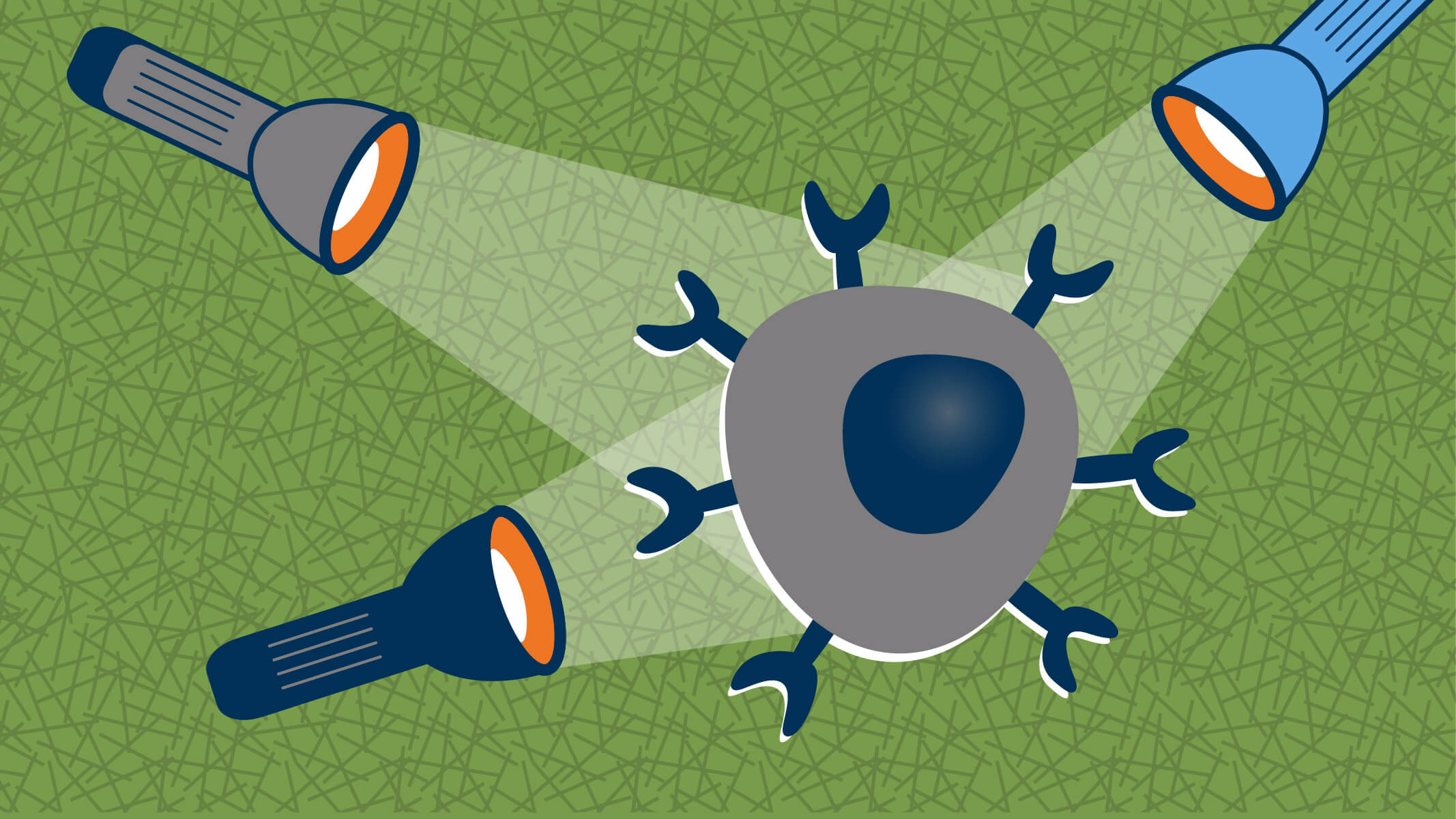
The technique joins a growing set of methods that fall under the rubric of “multi-omics,” techniques that capture multiple, complete sets of different kinds of data. The -ome in multi-omics harkens from terms like genome and proteome, the complete set of a cell’s DNA or proteins. The researchers dubbed their technique TEA-seq, which stands for transcription (another term for gene expression), epitopes (the immune cells’ surface markers), and accessibility of the DNA (the gene regulation).

Many methods exist to capture these data from single cells separately, and the Allen Institute researchers are using some of those methods in their research.

“These separate measurements are valuable and interesting, but what we really needed was a way to connect all three,” said Lucas Graybuck, Ph.D., Senior Scientist at the Allen Institute for Immunology. Graybuck, Elliott Swanson, Methods Development Specialist at the Allen Institute for Immunology, and Peter Skene, Ph.D., Director of Molecular Biology and Biochemistry, led the eLife publication.

Running separate experiments to capture the three kinds of data means there’s no way to know which cells match up across the datasets — it takes an educated guess guided by computational analysis. With multi-omics approaches, researchers can link those data points directly, no guessing required.

Linking different kinds of changes that happen to immune cells in disease — from changes in how genes are regulated to proteins that dot the surface of immune cells — will help the scientists get a more complete picture of the immune system as a whole, in health and in disease. Their ultimate goal is to use the resulting datasets as a starting point to find better treatments for the diseases they study.

“The more we understand the complete system, the more points in that system we could potentially target for better therapies,” Skene said.

Citations
No items found.

about the allen institute

The Allen Institute is an independent, 501(c)(3) nonprofit research organization founded by philanthropist and visionary, the late Paul G. Allen. The Allen Institute is dedicated to answering some of the biggest questions in bioscience and accelerating research worldwide. The Institute is a recognized leader in large-scale research with a commitment to an open science model. For more information, visit alleninstitute.org.


explore related stories

explore more stories
No articles for the category
we acceleratedevelopcatalyzeimpact

science done differently. shared with the world.

explore our accelerators

brain science

Mapping every cell, connection, and circuit in the brain—openly shared with the world.

cell science

Decoding how cells become tissues, then programming that knowledge into powerful new research tools.

neural dynamics

Revealing the brain's hidden algorithms that transform neural activity into real-world behavior.

immunology

Creating the deepest open reference for the healthy human immune system ever built.

synthetic biology

Engineering cells to record their own histories, transforming how we understand disease over time.

research

Big questions, open answers, and science built to be shared.

education

Inspiring the next generation of scientists through open science resources.

impact

Our science is empowering researchers and advancing health worldwide.
advancing science through open, collaborative research
Get the allen institute newsletter
Stay informed on the latest breakthroughs in neuroscience, bioscience, and AI-driven research.
allen institute
impactpeople & teamscareers & opportunitiesalumnihistory & founder
science resources
allencell.orgallenimmunology.orgallenneuraldynamics.orgbrain-bican.orgbrain-map.orgmicrons-explorer.org
research
brain sciencecell scienceneural dynamicsimmunologysynthetic biologypublications
education
science educationfield tripsprofessional developmenteducation resources
quick links
newseventsopen sciencepodcastscience resourceshuman brain donationvisit uscontact
follow us/

allen institute, 615 Westlake Ave North, Seattle, WA 98109 +12065487055

© 0000 allen institute. all rights reserved.
privacy policyterms of usecitation policyemployee portalpolicy & compliance


