in this article
In 1885, a German scientist named Paul Ehrlich made an odd discovery: If he injected a blue dye into a mouse’s veins, all the animal’s organs would end up stained blue, except for the brain.
In the decades since, this lack of access between the blood and the brain was repeatedly demonstrated with different types of dyes and fluorescent tracing molecules. The concept was termed the “blood-brain barrier” and it’s one of the reasons treating brain diseases and disorders is so complicated — it can be hard to find a drug that can cross that barrier. For years, the scientific dogma held that the barrier is nearly impermeable.
Some later research discoveries called the concept into question, but a new study in mice published Wednesday in the journal Nature has turned this dogma on its head. Many blood proteins routinely traffic to the brain and even make their way inside neurons and other brain cells, the study found.
The study, which was supported in part by the American Heart Association-Allen Initiative in Brain Health and Cognitive Impairment, also found that the blood-to-brain transport mechanism goes sideways in older animals, but this age-related dysregulation can be seemingly reversed with an FDA-approved drug.
A paradox contained in young animals’ blood
The project has its genesis in a startling discovery several years ago by Tony Wyss-Coray, Ph.D., Professor of Neurology at Stanford University School of Medicine, that blood from young mice or humans can halt brain aging in old mice, and might even improve some symptoms of Alzheimer’s disease. That finding didn’t jive with the concept of a nearly impenetrable wall between the blood and the brain.
“There was this paradox,” said Andrew Yang, a Stanford graduate student and first author on the Nature study, which was also led by Wyss-Coray. “The turning point for us was realizing that the way people study the blood-brain-barrier, one artificial molecule at a time, maybe that’s not capturing the full picture.”
So the research team set out to get more of that picture. They added fluorescent labels to all the proteins in mouse plasma, the liquid part of the blood that doesn’t include all the blood cells, and then looked for the presence of these hundreds of different proteins in the mice’s brains.
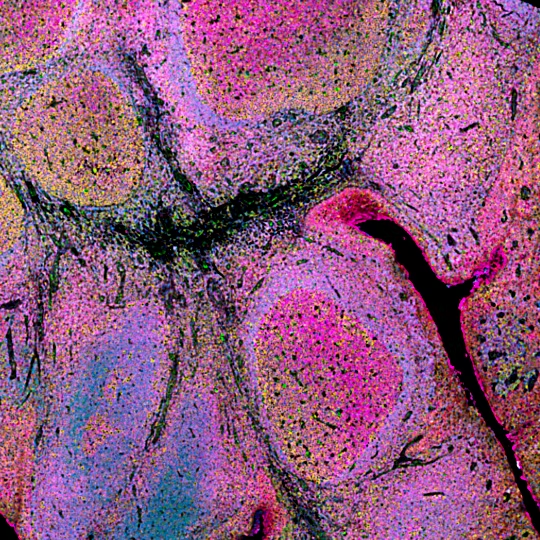
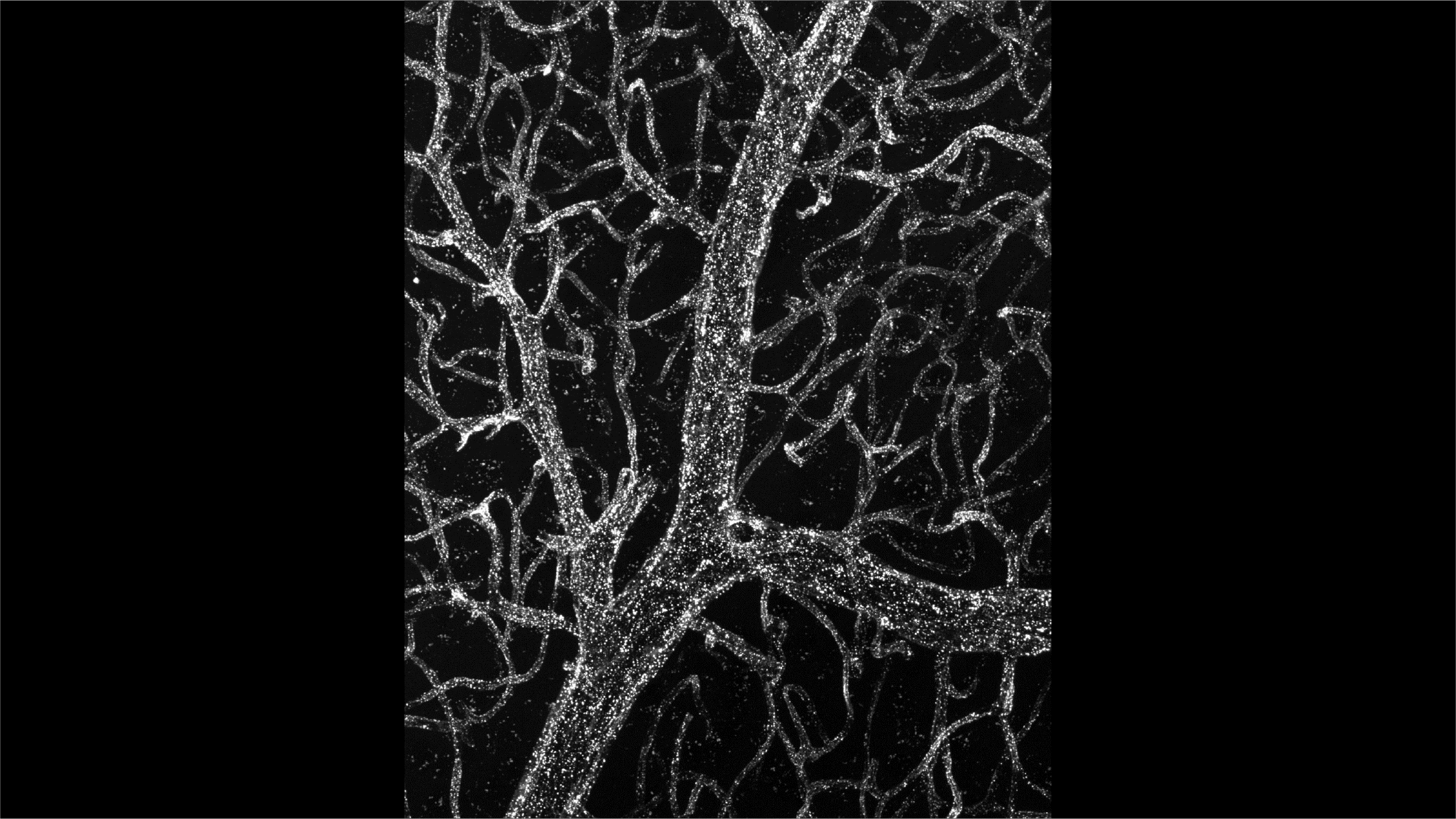
They were expecting to see that some of those blood proteins made it to the brain, but they weren’t quite expecting the extent of it. Looking at where the delicate, branching blood vessels wrap around the brain, the team could see how much of the blood’s contents were exchanging with the brain at every point: “The brain was basically lit up like a Christmas tree,” Wyss-Coray said.
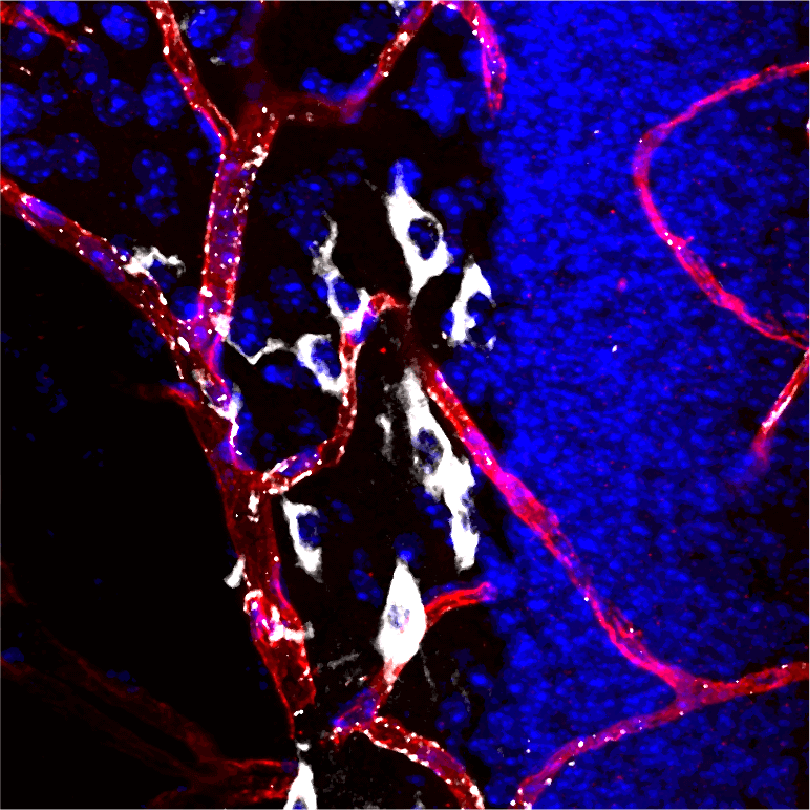
They also saw the labeled proteins inside every kind of brain cell they looked at – neurons, microglia, astrocytes. The plasma proteins weren’t just sloshing around between brain cells, but neurons and other brain cells actually seem to be absorbing blood proteins.
“That was totally surprising to me,” Wyss-Coray said. “We actually didn’t believe it initially.”
Aging transport systems
The researchers also found that things look different in older animals’ brains — many of the blood proteins weren’t getting into the brain as readily as in young animals. The team delved into the genes switched on in young and old mouse blood vessel cells and found a likely cause for this age-related difference: Young and old animals rely on different means of transport for the blood proteins.

Young, healthy brains use a precise shuttling system. Each protein in the blood must fit into a corresponding receptor protein, like a key fitting into a lock, before it gains access to the brain. Older brains use a less specific and less efficient system, where microscopic bubbles filled with proteins bud off from blood vessels and diffuse into the brain, like drops of water soaking into a sponge.
This difference is important in part because many drugs currently under development for Alzheimer’s and other age-related brain disorders rely on the key-and-lock transport. If that transportation system breaks down with age, those drugs might hitch the wrong ride and fail to reach therapeutic levels in the brain, Wyss-Coray said. The researchers also found that an FDA-approved drug — a drug that blocks the activity of a protein known as ALPL — causes old mice to switch back to the young form of transport. ALPL levels rise in the brain with age, and they are even higher in people with Alzheimer’s disease.
It’s not clear yet which components of the blood might be involved with dementia or other age-related cognitive problems, or if giving old mice the ALPL-blocking drug reverses brain aging. Wyss-Coray and his team are aiming to tackle those questions through their AHA-Allen Initiative project, which is part of a funding collaboration between The Paul G. Allen Frontiers Group, a division of the Allen Institute, and the American Heart Association. “We believe the vasculature has a key role in mediating cognitive impairment and diseases like Alzheimer’s,” Wyss-Coray said. “It became very apparent that we need to understand how the interface between the blood and the brain works.”
They want to look at the specific proteins that traffic to the brains in young but not old animals, to see if they can pinpoint the molecules that play a role in brain aging. They’re also doing comparisons between the blood vessels that serve the brain in mice and in humans — this will help them assess whether their findings in mice might translate to us.
Ultimately, Wyss-Coray said, they want to figure out a way to mimic the beneficial aspects of young blood to create better therapies for Alzheimer’s and other age-related brain disorders.
Citations
about the allen institute
The Allen Institute is an independent, 501(c)(3) nonprofit research organization founded by philanthropist and visionary, the late Paul G. Allen. The Allen Institute is dedicated to answering some of the biggest questions in bioscience and accelerating research worldwide. The Institute is a recognized leader in large-scale research with a commitment to an open science model. For more information, visit alleninstitute.org.