in this article
It’s a deceptively simple goal with a complicated backstory: The new guide relies on thousands of images and years of scientific work for its existence.
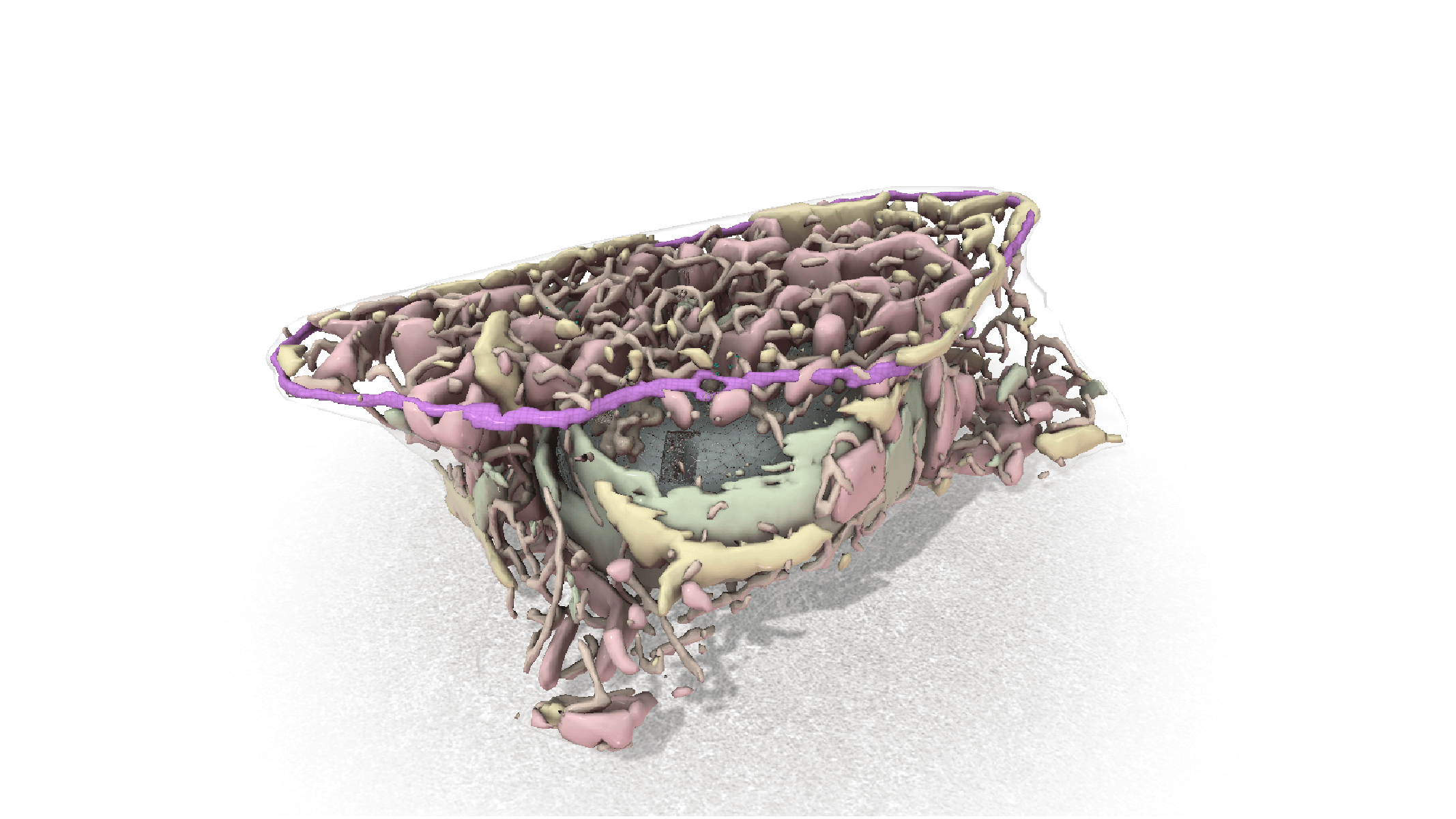
The visual guide frames much of the data that the Allen Institute for Cell Science generates in its quest to better understand human cells into the context of an interactive 3D cell viewer. Users can explore a curated collection of cells from any angle, and they can view snapshots of what happens to a human cell’s innards as it grows and divides using visual models based on real data.
The guide consolidates information about human cells that had previously been scattered across multiple pages and different web-based tools on allencell.org, the public platform that contains all the data, tools and models produced by the cell scientists, said Graham Johnson, Ph.D., Director of the Animated Cell team at the Allen Institute for Cell Science.
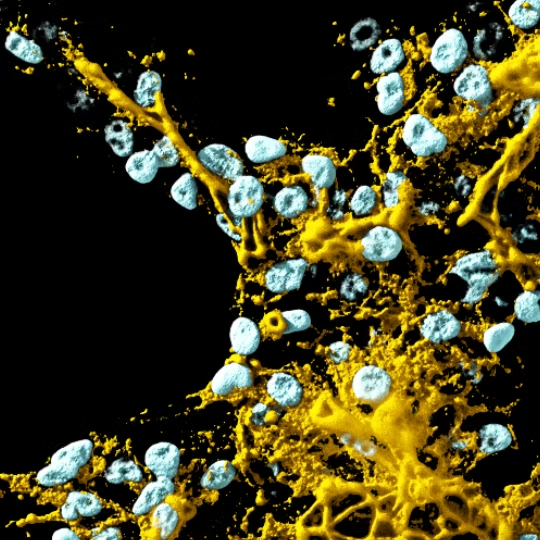
Humans are visual creatures, cell biologists included. Seeing what the cell and all its components look like – what they really look like, as the guide is based on thousands of microscopy images of fluorescently labeled human cells – will provide a platform to help scientists better understand how the whole cell works, Johnson said.
“That’s why we’ve structured the entire visual guide around cell function and the relationships between function and structure,” said Megan Riel-Mehan, Ph.D., a visualization scientist at the Allen Institute for Cell Science who helped develop the guide along with other software engineers and scientific illustrators at the Institute. The scientists combined computational modeling with detailed illustrations to capture all the different components of the cell in one interactive model.
The guide can be navigated by selecting different categories of what cells do, such as “sense the environment,” “produce energy” or even “die.” Within each category, users can choose individual cell structures to highlight in the 3D view and see how those molecular machines change in shape and position as the cell moves through the regimented stages of cell division, or mitosis.
The guide was created in part as a response to user feedback, Riel-Mehan said. Scientists attempting to navigate the Allen Cell Explorer were having a hard time knowing where to start among the mountains of data, she said. The animators envisioned the visual guide as a portal to all that raw and curated data – once a user picks a structure to explore in the 3D model, they can click through to access the original fluorescent images.
“We’re trying to give an entrance both to our data and to the cell itself,” Riel-Mehan said. “You can start at a high level and dig your way down.”
Capturing the dynamic cell
Johnson and his team also envisioned another audience for the guide: students. As a textbook illustrator and author, Johnson understands the limitations of a flat, unchanging depiction of the cell. The visual guide is new enough that it’s not yet in use in classrooms, but Johnson hopes that’s where it might soon have an impact.
Thomas Martinez, a biology teacher at Glenbard East High School in Lombard, Illinois, has used other tools from the Allen Cell Explorer website in some of his classes. Next fall, Martinez wants to incorporate the visual guide into a class segment focusing on how cells use energy. For many students, working with interactive visuals can help them better understand the material, he said.
“I can talk to them until the cows come home; they go to Disneyland in their heads in about five minutes,” Martinez said. “But if they sit down with tablets and search on their own to see what they can find, that’s when it really brings it home for them.”
The visual guide could also help students understand a cell’s true shape, said Jan Chalupny, Ph.D., biotechnology outreach manager at Shoreline Community College in Shoreline, Washington.
“It’s hard for students to imagine what cells are like in 3D with available tools,” she said.
For one, a 2D picture can’t capture how much “stuff” there really is in a cell, Chalupny said. Take for example mitochondria, cells’ tiny energy-producing factories. Human cells have anywhere from a couple to a couple thousand mitochondria per cell, but there’s no way to capture that sheer volume in a flat cartoon of a cell.
“This could really give students a much better sense of what the cell is like inside” and how it changes as the cell goes through different phases of its life, such as cell division, Chalupny said.
“It’s also important for students to understand that things move around in the cell. They’re not still; they’re vibrating with energy,” she said. “This shows how dynamic a cell is compared to that 2D picture in a textbook.”
Citations
about the allen institute
The Allen Institute is an independent, 501(c)(3) nonprofit research organization founded by philanthropist and visionary, the late Paul G. Allen. The Allen Institute is dedicated to answering some of the biggest questions in bioscience and accelerating research worldwide. The Institute is a recognized leader in large-scale research with a commitment to an open science model. For more information, visit alleninstitute.org.